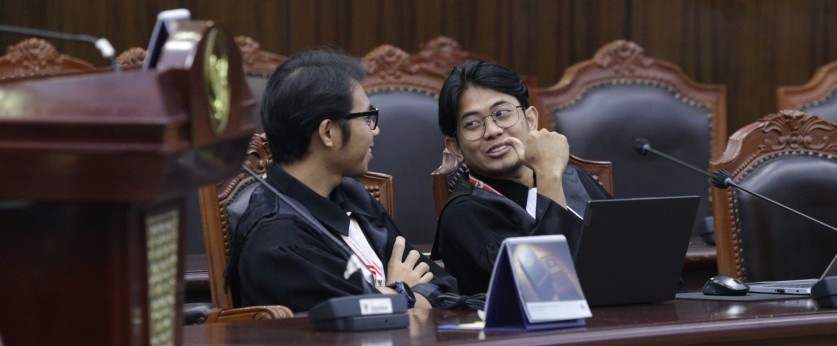
The Petitioner’s legal counsels at the ruling hearing for the judicial review of the Regional Election Law for case No. 91/PUU-XXIII/2025, Thursday (7/3/2025). Photo by MKRI/Bayu.
JAKARTA (MKRI) — Election monitoring institutions is an inseparable part of the participatory democratic system guaranteed by the Constitution. Public participation through these monitoring bodies in ensuring that elections are conducted freely, fairly, honestly, and with integrity represents an embodiment of popular sovereignty and a form of public oversight over democratic processes. Therefore, regulations concerning the rights, obligations, and prohibitions of election monitoring institutions must be framed within the context of protecting the principles of a democratic state governed by the rule of law, including the guarantee of the right to legal certainty.
Such was the Court’s legal consideration for Decision No. 91/PUU-XXIII/2025, delivered at a ruling hearing on Thursday, July 3, 2025 in the plenary courtroom.
The material judicial review petition of Law No. 1 of 2015 on the Stipulation of the Government Regulation in Lieu of Law No. 1 of 2014 on the on the Election of Governors, Regents, and Mayors into Law (Pilkada Law), last amended by Law No. 6 of 2020, was filed by chairperson of the South Kalimantan Province’s representative council of the Indonesian Reform Monitoring Institute (DPD LPRI) Syarifah Hayana. She challenged Article 128 letter k of the Pilkada Law, which stipulates prohibitions for election monitoring organizations, which she argued had lead led to multiple interpretations and failed to provide legal certainty.
In its legal considerations, delivered by Constitutional Justice Arief Hidayat, the Court examined whether Article 128 letter k of Law No. 1 of 2015 met the principle of fair legal certainty. The Court stated that the principle of legal certainty, as stipulated in Article 1 paragraph (3) of the 1945 Constitution, requires that every legal norm, especially those containing criminal sanctions, must be written (lex scripta), clear and unambiguous (lex certa), not expanded through analogy (lex stricta), and not retroactive (lex praevia).
Justice Arief explained that Article 128 letter k of Law No. 1 of 2015, when read alongside the Petitioner’s claims, shows that the phrase “other activities” in the provision is an open-ended clause that does not clearly define what is included or excluded as activities “not” part of election monitoring. As a result, this phrase grants broad discretion to law enforcement officials to interpret virtually any activity of election monitoring bodies as “other activities” that are prohibited, without legal boundaries to guide such interpretations. Such open-ended and ambiguous formulations tend to become what is known as “catch-all provisions,” which carry significant legal implications.
“In criminal law and administrative law, especially where sanctions are imposed, prohibitory norms must adhere to the principles outlined above to ensure fair legal certainty,” said Justice Arief.
Furthermore, he continued, the absence of an explanation of the phrase “other activities” in Article 128 letter k—which is merely described as “sufficiently clear”—also creates legal uncertainty. The elucidation to legislation should clarify norms rather than create further ambiguity. The Court considered this contrary to the principles of a democratic state governed by law, particularly because the criminal sanctions for violating this provision were only introduced later through Law No. 10 of 2016 and are not included in Law No. 7 of 2017, thus leading to inconsistencies in regulation.
Driving Force of Democracy
In the context of democratic elections, the Court further emphasized that election monitoring bodies should serve as driving forces of healthy democracy, especially in elections with only a single candidate. Monitoring institutions must carry out their duties honestly, fairly, and impartially, and must not engage in campaigning for or against candidates. The Court underscored that the independence of election monitors must mean freedom from pressure by any party, including election organizers who hold the authority to revoke accreditation.
Based on these considerations, the Court found that the Petitioner’s argument—that Article 128 letter k of Law No. 1 of 2015 violates the constitutional right to fair legal certainty as guaranteed by Article 28D paragraph (1) of the 1945 Constitution—was legally founded.
“In view of the foregoing legal considerations, it has been demonstrated that Article 128 letter k of Law No. 1 of 2015 indeed creates legal uncertainty as guaranteed by Article 28D paragraph (1) of the 1945 Constitution, as claimed by the Petitioner. Accordingly, the Petitioner’s argument is entirely legally founded,” stated Justice Arief.
Therefore, in its ruling, the Court granted the Petitioner’s petition in full. “The Court declares that Article 128 letter k of Law No. 1 of 2015 on the Stipulation of Government Regulation in Lieu of Law No. 1 of 2014 on the Election of Governors, Regents, and Mayors into Law (State Gazette of the Republic of Indonesia of 2015 No. 23, Supplement to the State Gazette No. 5656), as last amended by Law No. 6 of 2020 on the Stipulation of Government Regulation in Lieu of Law No. 2 of 2020 on the Third Amendment to Law No. 1 of 2015 into Law (State Gazette of the Republic of Indonesia of 2020 No. 128, Supplement to the State Gazette No. 6512), is contrary to the 1945 Constitution of the Republic of Indonesia and has no binding legal force,” announced Chief Justice Suhartoyo.
Dissenting Opinion
In this decision, Constitutional Justice Daniel Yusmic P. Foekh issued a dissenting opinion. He stated that the Petitioner’s status as an accredited election monitoring body had been revoked prior to filing the petition on May 23, 2025. As a consequence of the revocation of this accreditation, the Petitioner should no longer have had the legal standing or qualification to act as an election monitoring institution tasked with monitoring and supervising elections.
Also read:
Restrictions Against Election Monitoring Organizations in Pilkada Law Challenged
Election Watch LPRI Revises Legal Standing for Case on Pilkada Law
In the revised petition, the Petitioner contends that Article 128 letter k of the Pilkada Law has led to actual and real constitutional loss, because their status and rights as an accredited election monitoring organization in the revote for the Banjarbaru mayoral election has been revoked by the South Kalimantan Provincial KPU (Elections Commission).
The Petitioner also claims that in carrying out their duties and exercising their authority to monitor the Banjarbaru mayoral election revote, they were allegedly subjected to pressure, fear, intimidation, and threats by officials within the South Kalimantan Provincial Government, particularly after they submitted a petition disputing the regional election results to the Constitutional Court.
During the course of an examination by the South Kalimantan Provincial Bawaslu (Elections Supervisory Body) on an alleged violation of Article 128 letter k of the Pilkada Law—which is the object of judicial review—the South Kalimantan governor issued letter No. 100.1.4/0805/PEM.OTDA on 28 April 2025. The letter concerns the withdrawal of the petition for the dispute over the results of the 2024 Banjarbaru mayoral and vice-mayoral election, case No. 8/PAN.MK/e-AP3/04/2025, essentially urging the Petitioner to withdraw their petition from the Constitutional Court. The letter was signed by the governor, police chief, DPRD (Regional Legislative Council) speaker, and head of the National and Political Unity Office (Kesbangpol) of South Kalimantan, as well as Military District VI Mulawarman commander.
Author : Utami Argawati
Editor : Lulu Anjarsari P.
PR : Andhini S.F.
Translator : Yuniar Widiastuti (NL)
Disclaimer: The original version of the news is in Indonesian. In case of any differences between the English and the Indonesian versions, the Indonesian version will prevail.
Thursday, July 03, 2025 | 12:02 WIB 261