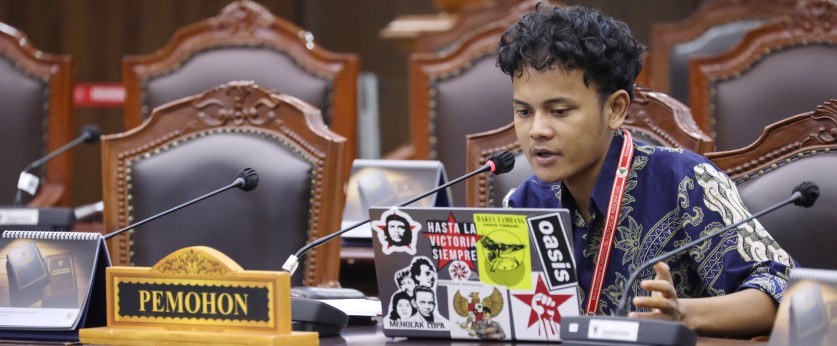
Tri Prasetio Putra Mumpuni (Petitioner) conveying revisions to the petition at a material judicial review hearing of Law No. 3 of 2025 on the Armed Forces, Tuesday (7/1/2025). Photo by MKRI/Panji.
JAKARTA (MKRI) — The Constitutional Court (MK) held the second hearing for the petition filed by Tri Prasetio Putra Mumpuni, a student of the University of Singaperbangsa Karawang. The case No. 92/PUU-XXIII/2025 concerns the material judicial review of Article 53 paragraph (4) of Law No. 3 of 2025 on the Amendment to Law No. 34 of 2004 on the Indonesian Armed Forces (TNI Law). The petition revision hearing took place on Tuesday, July 1, 2025 and was presided over by Chief Justice Suhartoyo and Constitutional Justices Daniel Yusmic P. Foekh and M. Guntur Hamzah.
In his petition against the provision extending the retirement age of Indonesian National Armed Forces (TNI) officers, the Petitioner refined several aspects of his argument. One concerned his legal standing and constitutional standing. He asserted that his legal standing was not only based on his status as a citizen and student, but also supported by detailed evidence demonstrating that he had suffered actual, specific constitutional harm directly caused by the application of Article 53 paragraph (4) of the TNI Law.
This harm was described across three dimensions. First, physical and psychological, manifested in repressive actions by security forces against him during a peaceful demonstration coinciding with the deliberation of the TNI Bill on March 20, 2025. Second, social and reputational, evidenced by stigma, campus pressure, and the cancellation of academic activities following his public involvement in opposing the contested provision. Third, potential career and political impacts, explained by how the provision has closed off opportunities for regeneration in strategic positions and created an unaccountable power structure, thereby harming the Petitioner’s prospects and rights to compete in civilian and military career.
Furthermore, the Petitioner referred to constitutional precedents demonstrating that the Constitutional Court has consistently recognized students’ legal standing in judicial review cases. This was evident in several significant decisions initiated by students and granted by the Court, including Decision No. 90/PUU-XXI/2023, Decision No. 12/PUU-XXII/2024, and Decision No. 62/PUU-XXII/2024.
“These precedents show that the Court does not merely consider a petitioner’s employment status or institutional affiliation, but instead focuses on the actual, specific, and relevant constitutional harm as stipulated in Article 51 paragraph (1) of the Constitutional Court Law. As part of the citizenry, students have legitimate rights and interests in safeguarding the principles of democracy, accountability, and constitutional supremacy,” stated Tri, who appeared without legal counsel.
The Petitioner also added a political-constitutional argument related to the legislative process that produced the contested provision, which was carried out by a working committee (panja) of the House of Representatives (DPR) composed of representatives elected from the Petitioner’s electoral district. When legislators representing the Petitioner’s constituency approve a provision contrary to the people’s constitutional interests, it leads to what Robert Dahl terms a “crisis of representation.” In such circumstances, the Constitutional Court becomes the final institution capable of correcting the imbalance between the people and the legislative body.
Additionally, the Petitioner elaborated on the reasoning behind Article 53 paragraph (4) of the TNI Law. Although this provision does not literally target civilians like the Petitioner, he argued that, in constitutional reality, it creates a military power structure that has systemic effects on citizens’ civil rights. As a civilian who has criticized the military, the Petitioner feels vulnerable to becoming a victim of security policies directly controlled by military officials whose power is prolonged by the contested provision. Therefore, the power structure legitimized by this provision is argued to cause real harm to the Petitioner. Based on these improvements, he also made adjustments to the petitums (the Petitioner’s requests).
“The Petitioner respectfully requests the Court to declare that Article 53 paragraph (4) of Law No. 3 of 2025 on the Amendment to Law No. 34 of 2004 on the Indonesian National Armed Forces unconstitutional and not legally binding and to order lawmakers to revise the regulation of the tenure of four-star TNI officers in a constitutionally sound manner, by establishing clear and accountable limits, involving legislative oversight, and ensuring legitimate civilian control,” said the Petitioner, who was present in person in the plenary courtroom.
Also read: Extension of High-Ranking Military Officers’ Terms of Office Called into Question
At the preliminary hearing on Wednesday, June 18, the Petitioner argued that the provision in question could potentially lead to abuse of executive authority due to the absence of any control or oversight mechanism over the President’s decision to extend the service period of four-star high-ranking officers. As such, the a quo norm is in violation of the principles of due process of law and transparency, as the granting of such extensions is unilateral and does not involve legislative approval. Therefore, he requested that the Court declare Article 53 paragraph (4) of Law No. 34 of 2004 on the Indonesian National Armed Forces unconstitutional and not legally binding, and further, to consider the revocation of the TNI Law in its entirety.
Author : Sri Pujianti
Editor : Lulu Anjarsari P.
PR : Fauzan Febriyan
Translator : Yuniar Widiastuti (NL)
Disclaimer: The original version of the news is in Indonesian. In case of any differences between the English and the Indonesian versions, the Indonesian version will prevail.
Tuesday, July 01, 2025 | 15:39 WIB 252