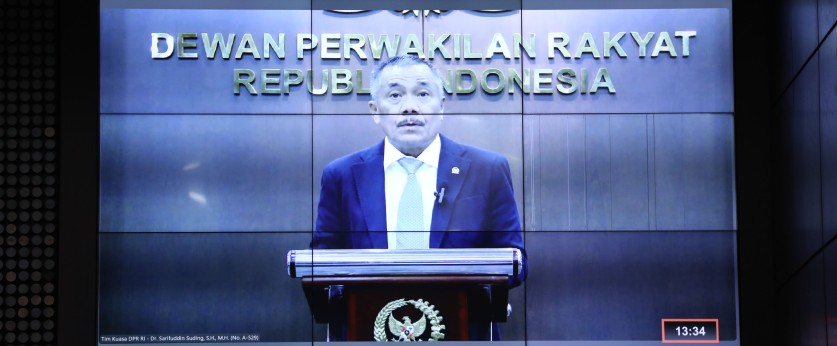
JAKARTA, MKRI – Member of Commission III of the Indonesian House of Representatives (DPR RI), Sarifuddin Sudding, stated that the term of office of the Chief of the Indonesian National Police (Kapolri) cannot be equated with that of the President. If the two are equated, the role of the Police Chief becomes a political position, which would compromise the neutrality and professionalism of the police force in carrying out its duties and functions.
"This not only endangers the independence of the police institution, but could also lead to the politicization of law enforcement officers," said Sarifuddin during the hearing for Case Number 19/PUU-XXIII/2025, which was scheduled to hear the House of Representatives' testimony on Tuesday (1 July 2025) in the Plenary Courtroom of the Constitutional Court, Jakarta.
This case concerns the judicial review of Article 11 paragraph (2) and the Elucidation of Article 11 paragraph (2) of Law Number 2 of 2022 concerning the Indonesian National Police. Article 11 paragraph (2) of the Police Law reads: "The proposal for the appointment and dismissal of the Chief of Police shall be submitted by the President to the House of Representatives along with the reasons." Meanwhile, the Elucidation of Article 11 paragraph (2) stipulates: "The approval of the House of Representatives of the Republic of Indonesia for the proposal of dismissal and appointment of the Chief of Police shall be carried out in accordance with applicable provisions within the House. The proposal for dismissal shall be submitted by the President along with valid reasons, including: the term of office has ended, resignation, reaching retirement age, permanent incapacity, or having been convicted with final and binding legal force. If the House of Representatives rejects the proposal, the President shall withdraw the proposal and may resubmit it in the next session.”
According to Sarifuddin, the position of Chief of Police is a career position, and thus subject to a retirement age of 58. However, this does not preclude the possibility of the Chief of Police’s term ending before reaching retirement age, as appointment and dismissal fall under the President's prerogative.
"Even though there is no set term and the retirement age applies, it does not mean the Police Chief cannot be dismissed before retirement, as the authority to appoint and dismiss rests with the President,” Sarifuddin explained.
Therefore, Sarifuddin argued that the Petitioners’ request does not raise a constitutional issue. The appointment and dismissal of the Chief of Police has never depended on the presidential transition. In fact, some Chiefs of Police appointed under one president have continued their service into the term of the next president.
See also:
Petitioners: Proposal for Appointment and Dismissal of National Police Chief Must Be Accompanied by Valid Reason
Judicial Review Filed over National Police Chief's Tenure and Dismissal
For context, the Petitioners in Case Number 19/PUU-XXIII/2025 are Syukur Destieli Gulo, Christian Adrianus Sihite, and Devita Analisandra, who are students. They argued that the phrase “along with the reasons” in the provision is not further regulated or, at the very least, is not clearly formulated in the Police Law. According to the Petitioners, the article is not only normatively flawed but has also created a real problem — namely, that the current Police Chief, Listyo Sigit Prabowo, is unlawfully holding office, as he has not been reappointed by the newly elected President, Prabowo Subianto.
Based on Article 8 paragraph (2) of Law No. 2/2002, the Indonesian National Police is led by the Chief of Police, who, in carrying out his duties, is accountable to the President in accordance with applicable laws and regulations. While the President holds the prerogative to propose the appointment and dismissal of the Police Chief, this process must also be approved by the House as part of the checks and balances mechanism.
The President has the prerogative to appoint other highly strategic positions with significant implications for achieving state goals, including the Police Chief. Therefore, since the appointment and dismissal of the Police Chief falls under the President's prerogative, every President should be entitled to the same prerogative rights during their term. Thus, when a President's term ends, the term of the Police Chief appointed by that President should also end.
The Petitioners are requesting the Court to declare Article 11 paragraph (2) of the Police Law as inconsistent with the 1945 Constitution of the Republic of Indonesia (UUD NRI 1945) and to have no binding legal force unless interpreted as follows: "The proposal for the appointment and dismissal of the Police Chief shall be submitted by the President to the House of Representatives along with valid reasons, including: (a) the end of the President’s term together with that of the cabinet; (b) dismissal during their term by the President with the House’s approval; (c) resignation; (d) reaching retirement age; (e) permanent incapacity; and (f) being convicted with final legal force."
The Petitioners also request that the Elucidation of Article 11 paragraph (2) of the Police Law be declared contrary to the 1945 Constitution and to have no binding legal force. (*)
Author : Mimi Kartika
Editor : Lulu Anjarsari P.
PR : Andhini S.F.
Translator : Agusweka Poltak Siregar
Disclaimer: The original version of the news is in Indonesian. In case of any differences between the English and the Indonesian versions, the Indonesian version prevails.
Tuesday, July 01, 2025 | 16:17 WIB 667