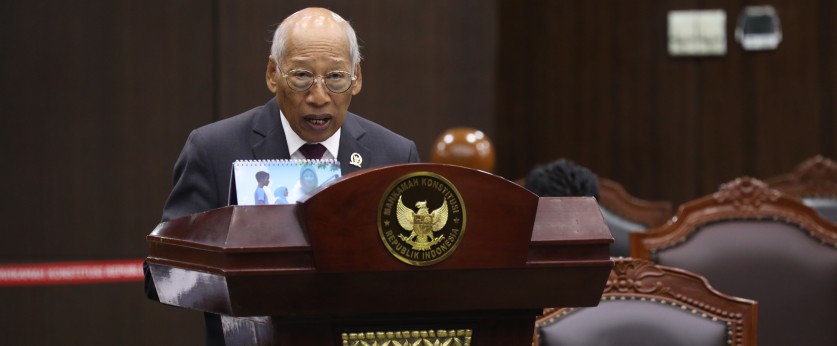
Director General of Regional Autonomy of the Ministry of Home Affairs, Akmal Malik, representing the Government delivered his statement regarding the special and exceptional status of Aceh. Photo: Public Relations/Panji
JAKARTA (MKRI) - The Constitutional Court (MK) held an evidentiary hearing on Case Number 40/PUU-XXIII/2025 concerning the constitutionality of Article 115 paragraph (3) of Law Number 11 of 2006 concerning the Government of Aceh (Aceh Government Law), on Monday (30/6/2025) in the MK Courtroom. The hearing agenda was to hear statements from the Indonesian House of Representatives and the President (Government).
This petition was filed by five keuchik (village heads) in Aceh. The petition questioned the provisions regarding the keuchik's term of office which is limited to six years and can only be re-elected for one term of office, as stated in Article 115 paragraph (3) of the Aceh Government Law.
The Petitioners compared the provisions with Law Number 6 of 2014 concerning Villages (Village Law) which has been amended by Law Number 3 of 2024. This Village Law regulates the term of office of the village head for eight years and can be re-elected for one term.
Affirmation of Speciality Principle
Member of Commission III of the Indonesian House of Representatives (DPR), I Wayan Sudiarta explained that the difference in terms of office between keuchik and village head is not a constitutional issue. He emphasized that the Aceh Government Law is a lex specialis that applies specifically in Aceh and therefore overrides the general provisions in the Village Law that apply nationally.
"In Article 39 paragraph (2) and Article 118 of Law Number 3 of 2024, it is not explicitly stated that these provisions apply to keuchik in Aceh. The DPR as the law maker has also considered regional specialties, as regulated in Articles 107, 109, and the general explanation of the Village Law," explained Wayan.
Respect for the Special Status of Aceh
The government, represented by the Director General of Regional Autonomy of the Ministry of Home Affairs, Akmal Malik, said that the Aceh Government Law was issued as an acknowledgement and respect for the special and exceptional status of Aceh, based on the history of the struggle of the Acehnese people and the character of their customs and culture.
"This difference is the embodiment of the motto Bhinneka Tunggal Ika, and to guarantee and protect the Acehnese people in their social and political life. Therefore, the provisions of Article a quo do not conflict with Article 28D paragraph (1) of the 1945 Constitution, because it actually provides legal certainty," explained Akmal.
He also emphasized that not all different treatment is a form of discrimination, but rather a form of respect for regional specialties that are recognized in the Indonesian constitutional system.
Special Authority
Meanwhile, Deputy Regional House of Representative of Aceh (DPRD Aceh) Ali Basrah emphasized that Aceh is a province with a special legal status recognized by the 1945 Constitution. Therefore, Law Number 11 of 2006 remains valid and applicable in regulating the six-year term of office of the keuchik.
"With the principle of lex specialis derogat legi generali, the provisions in the Village Law cannot be enforced in Aceh, until there is another decision. Therefore, Article 115 of Law 11/2006 remains binding," he emphasized.
In the Academic Manuscript of the Aceh Government Bill, it is also emphasized that regional autonomy in Aceh is based on special authority granted by the central government, including in terms of regulating village governance.
Meanwhile, Muhammad Junaidi, Head of the Legal Bureau of the Aceh Regional Secretariat, emphasized that procedurally, Law Number 11 of 2006 has regulated the procedures for changing special laws regarding Aceh. This is to ensure that Aceh's Special Autonomy is respected. Junaidi also said that currently the Aceh Government has proposed changes to Law Number 11 of 2006 concerning the Government of Aceh to the DPR. He also emphasized that there is no legal norm in Article 115 paragraph (3) of the Aceh Government Law that is contrary to the 1945 Constitution. In fact, according to him, the existence of Article 115 paragraph (3) as a norm that regulates villages is a mandate from Article 18B of the 1945 Constitution.
"The Aceh Government rejects the petition for judicial review that was submitted, because the right to change or create laws is the direct authority of DPR and the President (Government)," he stressed.
Also read:
Keuchik in Aceh Request Term of Office to Extension to Eight Years
Implementation of Village Law in Aceh Still Hampered
For information, the Petition for Case Number 40/PUU-XXIII/2025 was filed by five keuchik (village heads) in Aceh, namely Venny Kurnia, Syukran, Sunandar, Badaruddin, and Kadimin. The Petitioners are testing the constitutionality of Article 115 paragraph (3) of the Aceh Government Law which states, "The village is led by a keuchik who is directly elected from and by community members for a term of office of 6 (six) years and can be re-elected for only one subsequent term of office."
In the preliminary hearing, Febby Dewiyan Yayan explained that Article 115 paragraph (3) Aceh Government Law was deemed to have eliminated the constitutional rights of the Petitioners as regulated in Article 27 paragraph (1), Article 28D paragraphs (1) and (3), and Article 28I paragraph (2) of the 1945 Constitution. Febby explained that if we pay attention to the legal considerations of the Constitutional Court Decision Number 92/PUU-XXII/2024 dated January 3, 2025, as well as changes stated in Law Number 3 of 2024 concerning the Second Amendment to Law Number 6 of 2014 concerning Villages, the term of office of the village head has been regulated for 8 years and can be re-elected once.
"Law Number 3 of 2024 and Constitutional Court Decision Number 92/PUU-XXII/2024 apply nationally, including for Aceh, since its enactment. However, the implementation of the term of office is hampered by the provisions of Article 115 paragraph (3) of the Aceh Government Law," said Febby.
She added that the Aceh People's Representative Council (DPRA) through letter Number 161/1378, and the Aceh Government through letter Number 400.14.1.3/11532 dated September 23, 2024 signed by the Acting Governor of Aceh, Safrizal, have stated that they have no objection to the implementation of the Village Law in Aceh. However, the existence of Article 115 paragraph (3) of the Aceh Government Law remains in effect until there is a Constitutional Court decision stating otherwise. Febby emphasized that the authority to declare a norm in a law to be contrary to the 1945 Constitution and not have binding legal force lies with the Constitutional Court.
Based on these reasons, the Petitioners in his petition asked the Constitutional Court to declare Article 115 paragraph (3) of the Aceh Government Law contradicts the 1945 Constitution and has no binding legal force as long as it is not interpreted as "The village is led by a keuchik who is directly elected from and by community members for a term of 8 (eight) years and can only be re-elected for one subsequent term of office".
Read full Petition for Case Number 40/PUU-XXIII/2025 here.
Author: Utami Argawati.
Editor: N. Rosi
PR: Raisa Ayuditha Marsaulina.
Translator: SO
Disclaimer: The original version of the news is in Indonesian. In case of any differences between the English and the Indonesian versions, the Indonesian version will prevail.
Monday, June 30, 2025 | 16:46 WIB 322