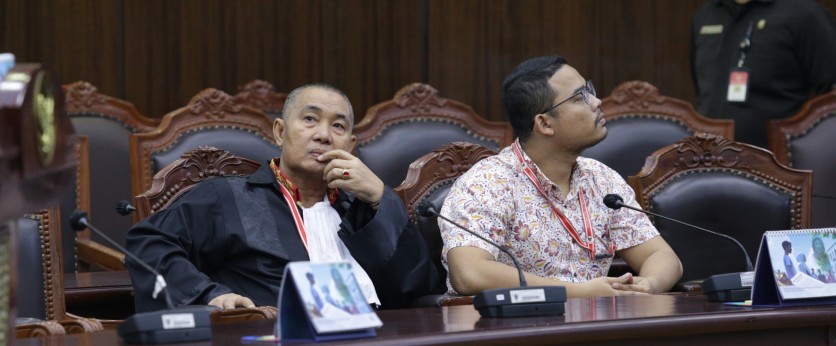
Petitioner’s legal counsel attending the Decision Pronouncement Hearing of Case No. 63/PUU-XXIII/2025 on the material judicial review of the Reglement of Legal Procedures for Regions Outside Java and Madura (Reglement Tot Regeling Van Het Rechtswezen In De Gewesten Buiten Java En Madura (RBg)), which were promulgated and validated by Emergency Law No. 1 of 1951 concerning Temporary Measures to Organize the Unified Structure of the Powers and Procedures of Civil Courts, and Article 54 paragraph (2) of Law No. 48 of 2009 on the Judiciary (Judiciary Law), Thursday (26/6/2025). Photo by MKRI/Bay.
Jakarta (MKRI) – The norms of Article 206 paragraph (1) RBg and Article 54 paragraph (2) of Law No. 48 of 2009 have provided clear regulations related to the implementation of the execution of civil cases. Besides functioning as a legal enforcement, the norms have protected all parties, both for those involved in the case and those outside the case who felt harmed by the execution of civil cases.
The foregoing legal consideration was delivered by Justice Arsul Sani regarding the judicial review of Article 162 and Article 206 paragraph (1) of Reglement of Legal Procedure for Regions Outside Java and Madura (Reglement Tot Regeling Van Het Rechtswezen In De Gewesten Buiten Java En Madura (RBg)), which were promulgated and validated by Emergency Law No. 1 of 1951 concerning Temporary Measures to Organize the Unified Structure of the Powers and Procedures of Civil Courts, and Article 54 paragraph (2) of Law No. 48 of 2009 on the Judiciary (Judiciary Law). The pronouncement of Decision No. 63/PUU-XXIII/2025 on a case filed by Frendys Eka Luki Putra was held on Thursday, June 26, 2025.
“Therefore, should the norms of Article 206 paragraph (1) of the RBg and Article 54 paragraph (2) of Law No. 48 of 2009 be interpreted as the Petitioner’s wish, it will limit the discretionary authority of the Head of the High Court and the parties that felt harmed may raise their concerns and protect their rights during the execution process,” Justice Arsul Sani delivered the legal considerations.
Limiting the Aggrieved Party
Whereas, the Petitioner is limiting the term aggrieved parties only to those related to other parties, instead of parties involved in executed civil cases. According to the Court, there may be cases where parties involved in civil cases, including other interested parties, may be harmed by the implementation of execution. In addition, the Court also read the norm being challenged as a whole based on the Petitioner’s request. As a result, the norms become unaligned because they create vagueness and legal uncertainty.
In addition, the Petitioner’s problem is a concrete case related to the implementation of norms rather than constitutional issues. If that is the case, the Petitioner may look for other available legal remedies. Therefore, the Court considers that the Petitioner’s arguments are legally unfounded. “Adjudicate, reject the petitioner’s petition in its entirety,” Chief Justice Suhartoyo pronounced the verdict.
Also read:
Seeking Justice in Civil Cases Execution Process
Petition on the Civil Case Execution Process Revised
In previous hearing, legal counsel Iwan Kurniawan stated that in a concrete case, his party has lost the ownership of a land of 632 square meters, which initially was bought from another party under the Deed of the Land Maker Deed Riza Emir Cyrillus Caloh, S.H. No. 57/BON/RC/2003 dated February 25, 2003. The petitioner’s constitutional harms began with the execution and auction execution conducted by the Head of the Pontianak District Court, Agung Wibowo, who manipulated the auction execution decision by listing the Petitioner’s Ownership Certificate No. 13765 in the Order of Auction Execution No. 74/PDT.G/2003/PN.PTK jo No. 29/PDT/2004/PT.PTK jo No. 2650K/PDT/2004 dated April 25, 2012.
Whereas the Petitioner was not involved at all in the civil case that was executed, and even the vacant plot of land owned by the Petitioner was never placed under execution seizure. As a result, the manipulation made by Agung Wibowo as the Executor was investigated by the Supreme Court Supervisory Board and the Judicial Commission. He was sanctioned to become a non-judge for two years. According to the Petitioner, the enactment of this norm provided an opportunity for a perfunctory judicial process, provided an opportunity for the head of the district court as executor to carry out executions arbitrarily, and created a long-winded judicial process that did not deliver justice.
In his petitums, the Petitioner requested that the Court declare Article 206 paragraph (1) of the Reglement of Legal Procedure for Regions Outside Java and Madura (Reglement Tot Regeling Van Het Rechtswezen In De Gewesten Buiten Java En Madura (RBg)) which was promulgated and validated by Emergency Law No.1 of 1951 on Temporary Measures to Organise the Unified Structure of the Powers and Procedures of Civil Courts which reads, "The execution of cases decided by the district court in the first instance shall be carried out by order and under the direction of the chairman in the manner specified in the following articles’ is contrary to the Constitution of the Republic of Indonesia and has no binding legal force to the extent that it is not interpreted as ‘Execution carried out arbitrarily, unlawfully, and/or to the detriment of third parties who are not parties to the civil case being executed is invalid’.
Author: Sri Pujianti.
Editor: Nur R.
PR: Fauzan F.
Translator: Rizky Kurnia Chaesario
Decision in Indonesian: Decision No. 63/PUU-XXIII/2025
Disclaimer: The original version of the news is in Indonesian. In case of any differences between the English and the Indonesian versions, the Indonesian version will prevail.
Thursday, June 26, 2025 | 18:05 WIB 135