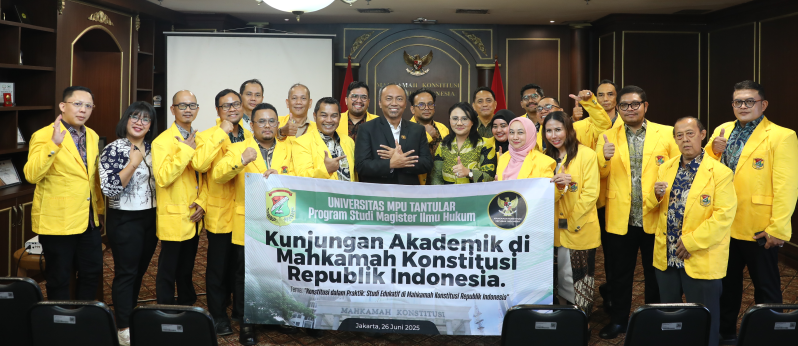
Graduate Law Program students of Mpu Tantular University (UMT) visiting and being welcomed by Senior Expert Legal Analyst Syamsudin Noer at Building I, Constitutional Court, Thursday (6/26/2025). Photo by PR/Fauzan
JAKARTA (MKRI)-The Constitutional Court (MK) welcomes a field-lecture visit by graduate students and lecturers from the Faculty of Law, Mpu Tantular University, Jakarta, on Thursday, June 26, 2025. The group is received by Senior Expert Legal Analyst Syamsudin Noer, familiarly called Syam.
Delivering a presentation titled “Building Constitutional Awareness,” Syamsudin Noer explains that every petition filed with the Registry is uploaded to the Court’s website soon after registration. “This guarantees transparency and accountability, this is our domain,” he says.
Syam goes on to note a recent trend among university students to lodge petitions because the Court was established precisely so that citizens can sue the state. “The Constitutional Court is where you can take the state to court,” he remarks, adding that not every statute produced by the legislature or executive is flawless.
Tracing the history of judicial review, he recalls that its spirit emerged in the U.S. case of Daniel Hylton v. United States, a dispute over the Carriage Tax Act, although Marbury v. Madison is better known. In Indonesia, although the Court was formally established in 2003, the idea of a court empowered to review laws against the 1945 Constitution first surfaced during the meetings of the Investigating Committee for Preparatory Work for Indonesian Independence (BPUPKI).
Besides reviewing laws, Syamsudin reminds the audience that, under the 1945 Constitution, the Court also settles disputes over the powers of state institutions, decides on the dissolution of political parties, adjudicates election-result disputes, and must rule on any House of Representatives accusation that the President and/or Vice-President has violated the Constitution.
He stresses that Court decisions are final and binding: once the Court has ruled, debate over the norm must cease, regardless of personal agreement. “Whatever the outcome, whether it fits your reasoning or not, you must submit, as mandated by Article 1(3) of the 1945 Constitution,” he states.
Syamsudin then outlines the petition-filing procedure, which can be done online or in person. If petitioners are represented by legal counsel, the filing must be online. After registration, hearings are open to the public unless the panel of constitutional justices orders otherwise. Case progress can also be monitored through the case-tracking feature on the Court’s website. In judicial-review cases, the President and the House of Representatives act as parties providing statements to the Court.
Finally, Syamsudin notes that the Court may change its stance in judicial-review matters. For example, in a previous review of the Regional Head Election Law (Pilkada Law), the Court initially held that regional head elections were not part of the general-election regime and ordered the legislature to establish a special pilkada court. It later declared that pilkada is indeed part of the general-election regime and that related disputes fall within the Court’s jurisdiction.(*)
Author: Ilham W. M.
Editor: Lulu Anjarsari P.
Translator: Siti Rosmalina Nurhayati
Disclaimer: The original version of this news item is in Indonesian. In the event of any discrepancy, the Indonesian version shall prevail
Thursday, June 26, 2025 | 16:07 WIB 201