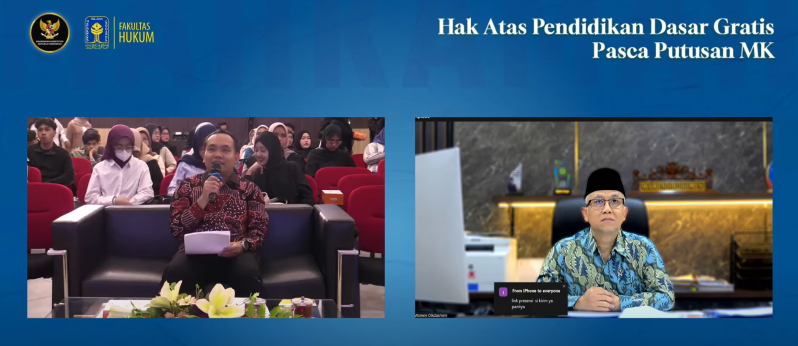
The Constitutional Court, in collaboration with the Faculty of Law at the Islamic University of Indonesia, held a Constitutional Webinar entitled "The Right to Free Basic Education Following the Constitutional Court’s Decision". Photo by MKRI/Fauzan.
JAKARTA (MKRI) – The Constitutional Court, in cooperation with the Islamic University of Indonesia (UII), held a constitutional webinar titled "The Right to Free Basic Education Following the Constitutional Court’s Decision", featuring the Deputy Minister for Primary and Secondary Education Atip Latipulhayat as keynote speaker. This online event was moderated by UII Law Faculty lecturer Jamaludin Ghafur on Thursday, June 26, 2025. The event aimed to enhance public understanding of constitutional rights and Pancasila ideology among citizens connected via the Constitutional Court’s video conferencing system at 68 higher education institutions and Constitutional Villages across Indonesia.
It was stated that in Decision No. 3/PUU-XXII/2024, the Court affirmed that the Central and Regional Governments are obliged to ensure the implementation of compulsory education at a minimum level of basic education without charging any fees—both for basic education units operated by the government and those managed by the community. In this regard, Atip added that the Government or the Ministry of Primary and Secondary Education considers the decision as about the issue of budget allocations, which have not been focused on the implementation of basic education. He further noted that the education budget is currently spread across several implementing or technical ministries.
"Therefore, the Constitutional Court seeks to convey a normative ideal message to the Government while considering the availability of funds within implementing institutions. The Government’s steps include coordinating the restructuring of the education budget and developing scenarios for the proper implementation of the Court’s ruling. Currently, the Ministry of Primary and Secondary Education manages a 2025 budget of IDR 33.55 trillion, which constitutes only 4.63 percent of the total education budget. Hence, there are still educational priorities that remain insufficiently funded, necessitating efforts to increase efficiency and effectiveness in educational spending. Thus, regarding the Constitutional Court’s decision on compulsory education, there is no debate—what matters is how we implement it with the available budget," Atip explained virtually.
In technical terms, the Government has proposed several options regarding private schools eligible for fee waivers. These include applying the fee exemption to all private schools or, in the case of "high-cost" private schools, granting the exemption under the condition that such schools commit to accepting poor and economically vulnerable students and do not reject the fee waiver policy—provided that a clear definition of “high-cost private schools” is established.
"The Government has formulated the first alternative, in which all private schools receive the fee exemption. For high-cost private schools, the exemption is granted on the condition that they accept poor and vulnerable students and do not reject the waiver. The second alternative involves granting the exemption to certain groups of private schools based on specific classification criteria such as tuition fees, the socio-economic status of the school, the location of the education unit (prioritizing regions with a high proportion of poor children), and BOSP recipient status," Atip elaborated.
Mitigating Budget Misuse
During the discussion session, a participant raised a question regarding the Government’s mitigation measures to prevent the misappropriation of allocated education funds. In response, Atip stated that to avoid misuse, the Government will apply eligibility criteria to determine which private schools qualify for government funding related to compulsory education. He emphasized that the Court does not prohibit community participation in education funding, including private schools continuing to receive contributions.
"For private schools that are financially capable, they certainly will not be eligible for government funding. Each funding allocation by the government is already subject to oversight mechanisms by the competent supervisory institutions," Atip replied.
Interpretation of “High-Cost Private Schools”
Another significant question concerned how the Government defines “high-cost private schools” in the categorization for education fee waivers and the quality of free education. Atip responded that the Government will collect data on private schools across Indonesia, including the educational contributions they receive and manage, by taking several factors into account. He also noted that the Government has already prepared mechanisms for identifying underprivileged students eligible for educational funding.
"Regarding concerns about the decline in the quality of free education, the Government is committed to fulfilling the constitutional mandate by ensuring quality education. So, this is not merely about providing education, but about ensuring that it is of high quality. This will remain a key focus of the Government, aligned with its vision and mission to deliver quality education for all," Atip concluded.
Author :Sri Pujianti
Editor : Lulu Anjarsari P.
Translator : Nies Lindy
Disclaimer: The original version of the news is in Indonesian. In case of any differences between the English and the Indonesian versions, the Indonesian version will prevail.
Thursday, June 26, 2025 | 16:04 WIB 326