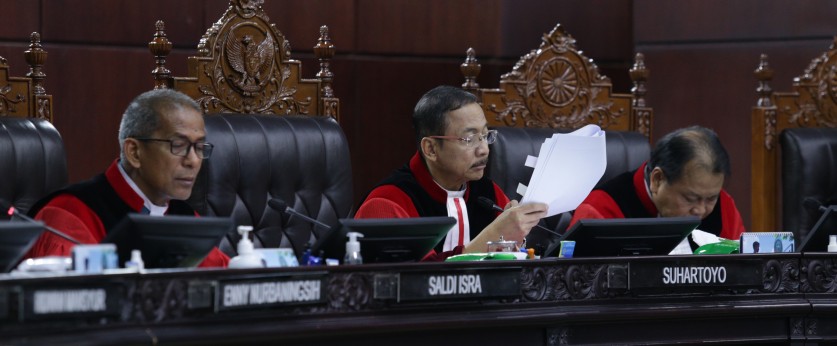
Chief Justice Suhartoyo reading the Decision No. 53/PUU-XXIII/2025 on the material judicial review of Law No. 48 of 2009 on the Judiciary and Law No. 16 of 2004 as amended by Law No. 11 of 2021 on the Attorney General’s Office of the Republic of Indonesia, Thursday (26/6/2025). Photo by MKRI/Bay.
Jakarta (MKRI) – The Constitutional Court decided on the material review on several articles of three laws: Law No. 48 of 2009 on the Judiciary, Law No. 16 of 2004 on the Attorney General’s Office of the Republic of Indonesia, and Law No. 11 of 2021 on the amendment to the Attorney General’s Office Law. Decision No. 53/PUU-XXIII/2025 declares that the petition of Petitioner I and Petitioner II cannot be accepted, and Petitioner III’s petition is rejected in its entirety. The Decision was pronounced in the plenary hearing on Thursday, June 26, 2025.
The case was filed by three law students: Alfonsus Salomo Rafel Sihombing (Petitioner I), Mikhael Pandya Dewanata (Petitioner II), and Milha Niami Maulida (Petitioner III) to challenge several provisions in Law No. 48 of 2009 on the Judiciary, Law No. 16 of 2004 on the Attorney General’s Office Law, and Law No. 11 of 2021 on the amendment to the Attorney General’s Office Law.
Justice Daniel, pronouncing the legal considerations, stated that the Court's norm provisions in Article 60 paragraph (1) of Law No. 48 of 2009 are clear as long as the phrase “or different opinion settlement institution through a procedure agreed by all parties, namely settlement outside the court by consultation, negotiation, mediation, consiliation, or expert assessment”. So do the norms contained in Article 30 paragraph (2) of Law No. 16 of 2004 jo. Article 18 paragraph (2) of Law No. 11, insofar as the phrase “and outside of the court” and the norm in Article 18 paragraph (2) of Law No. 11 of 2021, as long as the phrase “as well as the public interest” does not contradict the principle of the judicial authorithy, just legal certainty guarantee to protect human rights, and equal treatment before the law as guarantedd in Article 24 paragraph (1), Article 27 paragraph (2), and Article 28D paragraph (1) of the 1945 Constitution of the Republic of Indonesia. Therefore, the Petitioners’ petition is legally unfounded in its entirety.
The Court asserted that arbitration is one way to settle disputes outside the court. Hence, there are alternative methods to resolve disputes outside the court, such as consultation, negotiation, mediation, conciliation, or expert assessment, as stipulated in Article 0, paragraph (1) of Law No. 48 of 2009.
Regarding the need to establish the arbitration procedural law in dispute settlement outside the court as argued by the Petitioners, the Court holds that the issue cannot be separated from the nature of the dispute, which belongs to the civil case and the method chosen is fully the parties’ prerogative as part of their constitutional right. Thus, to provide protection and respect for individual rights, the state ensures legal certainty and justice, including in choosing the method to resolve civil cases. In addition, civil disputes recognize several principles, such as consensual, freedom of contract, and pacta sunt servanda. Hence, the choice of legal remedies to resolve private disputes aligns with such principles.
Meanwhile, procedural law issues in dispute settlement through arbitration, which the petitioners have argued, have been factually and clearly stipulated in Law No. 30 of 1999, which provides the procedure for dispute settlement through arbitration. Moreover, factually, there is no crucial issue related to the procedure. Related to the dispute settlement procedure through arbitration, arbiters adhere to the clauses in the substance of the contract that the parties have made. Hence, the method of settlement in court cannot be compared to that outside the court.
Based on legal considerations, although there is no integrated procedural law for dispute settlement outside the court, the state recognizes the dispute settlement method outside the court, or non-litigation. Hence, the petitioners’ arguments related to Article 60 paragraph (1) of Law No. 48 of 2009, as long as the phrase “or different opinion settlement institution through a procedure agreed by all parties, namely settlement outside the court or non-litigation is not legally reasonable.
State Attorney’s Authority
Moreover, Justice Daniel explained, related to the constitutionality of the provision stipulated in Article 30 paragraph (2) of Law No. 16 of 2004 jo Article 18 paragraph (2) of Law No. 11 of 2021 as long as the phrase “or outsite the court”, the Petitioners opined that it needs to be limited constitutionally because it is potentially interpreted widely and absolutely by the government or the attorney itself, which result in the state attorney to have an absolute authority.
Based on the provisions of the articles mentioned, although the prosecutor is part of the executive branch, which carries out functions related to the judiciary, prosecutors have the independence to exercise prosecution authority when conducting their duties. It is to ensure that citizens are given the maximum guarantee of the fulfillment of their rights concerning the acknowledgement, protection, and guarantee of just law, and equal treatment in the process of criminal litigation. Meanwhile, the Petitioners' arguments are that the state attorney has the authority as the government's legal representation in civil and administrative cases, as it has the potential to wield absolute power.
In the context of the state attorney representing the state or government in civil, administrative, and constitutional cases, it must be understood as intended by the norms of Article 18 paragraph (2) of Law No. 11 of 2021 as the legal subject that represents the state or government related to the state or government civil rights and the state administrative product as the state administrative institution and those pertaining to consitutionality universally, which are interpreted as the state, government, and constitutional interest as long as they serve the public interest.
According to the Court, State Attorney may only act as legal representatives with a limited mandate to represent the interests of the state or government for the public interest, whereas advocates may serve as legal representatives for the interests of any party, whether the state, government, or the wider community, in both litigation and non-litigation matters. Moreover, the limitation on the authority of State Prosecutors to represent the state or government as state attorneys is fundamentally based on the rationale that the Attorney General’s Office is a government institution performing functions related to judicial power, as stipulated in Article 1 paragraph (1) of Law No. 11 of 2021. Therefore, the Attorney General’s Office is obliged to participate in efforts to uphold the dignity of the government and the state as a manifestation of guarantees and legal certainty that are just for the Indonesian people.
Furthermore, the restricted authority of prosecutors as state attorneys in civil, administrative, and constitutional cases is a statutory mandate contained in the provisions of Article 18 paragraph (2) of Law No. 11 of 2021 and Article 30 paragraph (2) of Law No. 16 of 2004, as amended by Law No. 11 of 2021.
Based on the legal considerations outlined above, the Petitioners’ argument concerning the unconstitutionality of the phrase "as well as the public interest" in Article 18 paragraph (2) of Law No. 11 of 2021 is legally unfounded.
Also read:
Students Ask to Limit Attorney General’s Authority as the State’s Attorney
Petition on State Prosecutor’s Authority Revised
During the preliminary hearing, the Petitioners highlighted Article 60 paragraph (1) of the Judiciary Law, which enables dispute settlement through non-litigation channels, such as mediation, conciliation, and expert assessment. They considered that the provisions do not provide clear boundaries, which potentially blurs the line between judicial and non-judicial processes. The Petitioners explained that the provisions on the prosecutor’s authorities in Article 30 paragraph (2) of the Judiciary Law and Article 18 paragraph (2) of Law No. 11 of 2021 are limited only to a special authorization letter. It is unlike Article 30 paragraph (1), which explicitly regulates the prosecutor’s duties in criminal matters. They also highlighted the Presidential Regulation No. 15 of 2024 and the Attorney General’s Office Regulation No. 7 of 2021, which expands the role of the State’s Attorney, including providing non-judicial legal assistance. According to the Petitioners, the provisions in Article 24, paragraph (2) of the Presidential Regulation open the opportunity for prosecutors to act as legal representatives of both the plaintiff and the defendant.
The Petitioners considered that the absence of limitation means that the prosecutors’ authorities in civil and state administration matters could be broadly interpreted and absolute, both for the government and the prosecutors themselves. It is apparent in the regulation on duties and authorities and the State’s Attorney in Presidential Regulation No. 15 of 2024 on the Third Amendment to the Presidential Regulation No. 38 of 2010 on the Organization and Management of the Attorney General’s Office of the Republic of Indonesia and the Attorney General’s Office Regulation No. 7 of 2021 on the Guidance in the Implementation of Legal Enforcement. Hence, the Petitioners requested the articles to be declared contrary to the 1945 Constitution of the Republic of Indonesia. (*)
Author: Utami Argawati
Editor: Lulu Anjarsari P.
PR: Raisa Ayuditha Marsaulina
Translator: Rizky Kurnia Chaesario
Disclaimer: The original version of the news is in Indonesian. In case of any differences between the English and the Indonesian versions, the Indonesian version will prevail.
Thursday, June 26, 2025 | 20:36 WIB 136