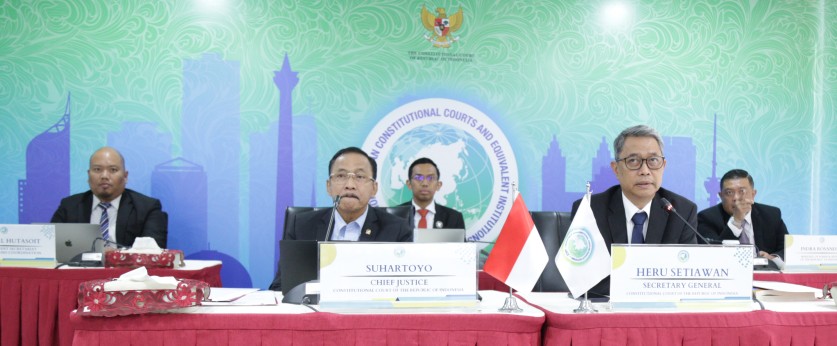
Chief Justice of the Constitutional Court Suhartoyo and Secretary General of the Constitutional Court Heru Setiawan presented at the Board of Members Meeting (BoMM) and the 2025 International Symposium with the theme "The Role of the Constitutional Courts and Equivalent Institutions in the Protection of Human Rights", Tuesday (24/6/2025). Photo by Public Relations/Bay
JAKARTA (MKRI) - The Association of Asian Constitutional Courts and Equivalent Institutions (AACC) through the Board of Members Meeting (BoMM) has accepted the Federal Supreme Court of Iraq as its new member on Tuesday (24/6/2025). Chief Justice of the Constitutional Court of the Republic of Indonesia (MKRI) Suhartoyo believes that this membership will bring significant added value to the AACC as a whole.
"This [recommendation] is in line with the spirit of the AACC to continually expand an inclusive cooperation and strengthen the enforcement of constitutional supremacy and the rules of law in the Asian region in a sustainable manner," said Suhartoyo who attended the event online accompanied by the Secretary General of the Constitutional Court Heru Setiawan, Head of the Public Relations and Protocol Bureau of the Constitutional Court Pan Mohamad Faiz, Head of the Permanent Secretariat of the AACC and Foreign Cooperation of the Constitutional Court Immanuel Bungkulan Binsar Hutasoit, and the Director of Law and Political and Security Agreements of the Ministry of Foreign Affairs Indra Rosandry from Building 1 of the Constitutional Court, Jakarta.
MKRI, which is the Permanent Secretariat for Planning and Coordination (SPC) of AACC, said that the membership proposal was submitted by the Chief Justice of the Federal Supreme Court of Iraq Jassim Mohammed Abboud since December 4, 2024. At the time of this BoMM, the Permanent Secretariat had received positions from 17 member countries regarding the membership proposal from Iraq, except for the Constitutional Court of the Kingdom of Thailand as the President of AACC.
However, there are 3 other member states that have not yet expressed their position, namely Bangladesh, Maldives, and Afghanistan. Nevertheless, in the BoMM chaired by the President of the AACC (Thailand), the AACC officially accepted the membership of the Iraqi Federal Supreme Court with a majority vote.
Uzbekistan Leads AACC
In addition, the leadership of the AACC also shifted from the Constitutional Court of the Kingdom of Thailand to the Constitutional Court of the Republic of Uzbekistan. On other matters, it was also explained about the preparation of the AACC in participating in the 6th Congress of the World Conference on Constitutional Justice (WCCJ) which will be held on 28-30 October 2025 in Madrid, Spain. Suhartoyo said that currently the AACC has 3 representatives in the WCCJ Bureau, namely the AACC President from Thailand, Indonesia as the host of the 2022 WCCJ Congress, and Türkiye as the representative of the Asian region.
However, the membership period of Indonesia and Türkiye in the WCCJ Bureau will end. In this context, AACC as the Association of the Asian Region also holds the responsibility to start preparing candidates who will represent the Asian Continent in the WCCJ Bureau. Although no decision needs to be taken at this time, MKRI hopes that each AACC member can begin to consider their own readiness. As usual, the process of determining representatives will be carried out inclusively and deliberatively by involving all AACC members equally and openly.
"We believe that this step will strengthen AACC's position at the global level while affirming our collective commitment to advancing constitutional justice in the international arena," said Suhartoyo.
MKRI Decision on Education
Before the BoMM, Suhartoyo also had time to explain the Role of the Constitutional Court of the Republic of Indonesia in the Protection of Human Rights, particularly in the Field of Education in a public lecture entitled "The Court and the Protection of Human Rights". Suhartoyo said that the Constitutional Court of the Republic of Indonesia ensures that the state guarantees compulsory education at least at the basic education level without charging fees for both state and private schools through Decision Number 3/PUU-XXII/2024.
"The Constitutional Court is of the opinion that the government cannot transfer the responsibility for financing the provision of basic education, because this has been expressly stated in the 1945 Constitution of the Republic of Indonesia," said Suhartoyo.
In this case, the Petitioners questioned the constitutionality of the norm of Article 34 paragraph (2) of Law Number 20 of 2003 concerning the National Education System which states, "The Government and Regional Governments guarantee the implementation of compulsory education at least at the elementary education level without charging fees". In practice, this provision only applies to state schools, ignoring the reality that some children can only attend private schools due to limited capacity in state schools. In addition, the allocation of the education budget in practice is not focused on financing elementary education, resulting in many children dropping out of school.
The Constitutional Court first examined the provisions of Article 31 paragraph (2) of the 1945 Constitution of the Republic of Indonesia (UUD NRI), which states that every citizen is obliged to follow basic education and the government is obliged to finance it. Moreover, if we look at the provisions of Article 31 paragraph (4) of the 1945 Constitution of the Republic of Indonesia, it requires the state to prioritize the education budget in the State Budget (APBN) and Regional Budget (APBD) with an allocation of at least 20 percent of the total budget. This means that the failure to fulfill the government's obligation to finance basic education has the potential to hinder citizens' efforts to fulfill their constitutional obligations in accessing basic education.
In this context, if the phrase "compulsory education at least at the elementary education level without charging fees" in Article 34 paragraph (2) of the National Education System Law is only interpreted as applying to state schools, then the state has ignored the reality that the limited capacity of state schools forces many children to attend schools/madrasas run by the community (private) which ultimately burdens the education costs on the parents or guardians of students so that this situation is contrary to the state's obligation to guarantee basic education without charging fees for all citizens. Thus, the Court is of the opinion that the state must implement a basic education financing policy that includes basic education for all children, both those attending state schools and private schools/madrasas, through an educational assistance or subsidy mechanism so that there is no gap in access to basic education.
In order to reduce costs that can burden students, especially in fulfilling the obligation to follow basic education, the MKRI is of the opinion that the state must prioritize the allocation of the education budget for the provision of basic education, including in private schools/madrasahs organized by the community by considering the needs of the private schools/madrasahs. Educational assistance can only be provided to private schools/madrasahs that meet certain requirements or criteria based on laws and regulations. This is intended so that private schools and madrasahs receiving educational assistance are managed according to the standards set out in laws and regulations and have a governance and accountability mechanism for managing the education budget, including that sourced from government assistance.
In Decision 3/PUU-XXII/2024 which was pronounced on May 27, 2025, the Constitutional Court of the Republic of Indonesia granted the Petitioners' petition in part where Article 34 paragraph (2) of the National Education System Law was declared to be in conflict with the 1945 Constitution of the Republic of Indonesia and did not have legally binding force conditionally as long as it was not interpreted as "The Government and Regional Governments guarantee the implementation of compulsory education at least at the elementary education level without charging fees, both for elementary education units organized by the government and elementary education units organized by the community."
In addition to Suhartoyo, there were several justices from other countries who also delivered best practices in this public lecture, including Constitutional Court Judge of the Kingdom of Thailand Udom Rathamarit, Constitutional Court Judge of the Kingdom of Thailand Chiranit Havanond, Constitutional Court Judge of South Korea Bokhyung Kim, Constitutional Court Judge of Turkey Yusuf Yusuf Şevki Hakyemez, and Deputy Chief Justice of the Constitutional Court of Uzbekistan Askarjon Gafurov moderated by Ajirapa Pienkhuntod from the Faculty of Political Science of Thammasat University. They conveyed the role of the Constitutional Court through their respective decisions regarding efforts to protect human rights.(*)
Author: Mimi Kartika
Editor: Lulu ANjarsari P.
Translator: SO
Disclaimer: The original version of the news is in Indonesian. In case of any differences between the English and the Indonesian versions, the Indonesian version will prevail.
Tuesday, June 24, 2025 | 15:40 WIB 797