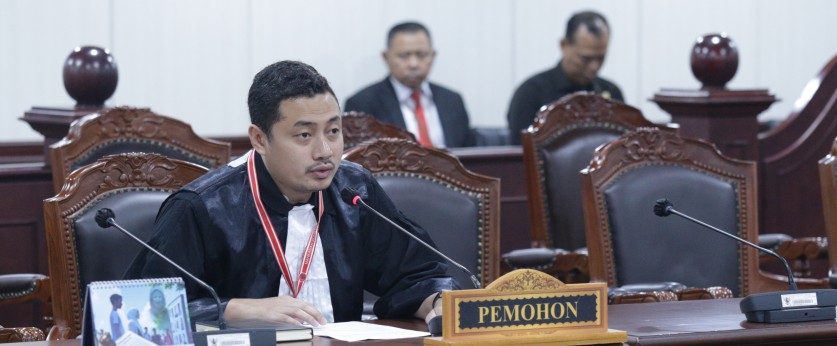
The Petitioner’s legal counsel confirming the withdrawal of the material judicial review petition of Law No. 34 of 2004 on the Indonesian Armed Forces for case No. 85/PUU-XXIII/2025, Monday (6/23/2025). Photo by MKRI/Bayu.
JAKARTA (MKRI) — The Constitutional Court (MK) held another hearing for the material judicial review of the Elucidation to Article 2 letter d of Law No. 34 of 2004 on the Indonesian Armed Forces (TNI/Army Law) on Monday, June 23, 2025. The case No. 85/PUU-XXIII/2025 was filed by Ahmad Soffan Aly.
Chairing the hearing, Deputy Chief Justice Saldi Isra asked the Petitioner’s legal counsel regarding the request to withdraw the petition.
“We received notification from the legal counsel or the Petitioner on the withdrawal of the petition No. 85. Please explain,” he said.
Legal counsel Muhammad Qabul Nusantara confirmed the request for withdrawal. “Yes, Your Honor, we have submitted a request to withdraw the petition on June 19. The reason is that the draft needed more revision,” he explained.
Also read:
Army Law Challenged for Potential Defiance to Civilian Authority
Revised Petition of Army Law Past Deadline
The Petitioner argued that the Elucidation to Article 2 letter d of the TNI Law did not anticipate emergency conditions, such as the simultaneous vacancies of the office of president and vice president as stipulated under Article 8 paragraph (3) of the 1945 Constitution.
“The Elucidation to the TNI Law only mentions the president as a leader directly elected by the people. In fact, in an emergency, executive power is delegated to the acting president, who is not the result of direct elections,” legal counsel Ferdian Zakiy explained before the panel of justices at the preliminary hearing on Tuesday, May 27.
The Petitioner was concerned that the norm’s vagueness could make way for the TNI commander’s disobedience to the acting president, especially in situations of national crisis. This, he argued, could lead to the weakening of civilian supremacy and potential military insubordination that would threaten state stability.
“In such a vacuum, national leadership is run collectively, whereas the military requires a quick and single command. This risks ineffectiveness and even insubordination,” Ferdian continued.
Author : Utami Argawati
Editor : N. Rosi
PR : Fauzan F.
Translator : Yuniar Widiastuti (NL)
Disclaimer: The original version of the news is in Indonesian. In case of any differences between the English and the Indonesian versions, the Indonesian version will prevail.
Monday, June 23, 2025 | 16:00 WIB 154