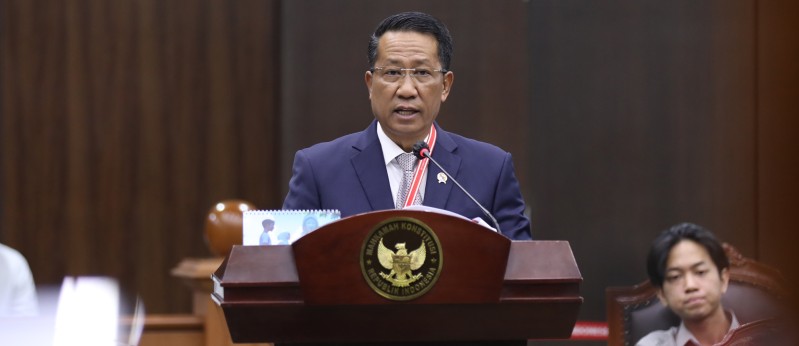
Minister of Justice Supratman Andi Agtas testifying at a formal and material judicial review hearing of Law No. 3 of 2025 on the Armed Forces, Monday (6/23/2025). Photo by MKRI/Ifa.
JAKARTA (MKRI) — The Bill of the amendment to the TNI Law was introduced in response to national urgency concerning efforts to protect and safeguard Indonesian citizens amid increasing regional security dynamics, the need to strengthen national and international defense stability, as well as threats of military, non-military, and hybrid nature (including terrorism and cyberwarfare). Additionally, the Bill serves as a follow-up to the Constitutional Court Decision No. 62/PUU-XIX/2021 and represents the shared intention of the legislative body to continue the legislative process for the TNI Law (Law No. 3 of 2025), as marked by the assignment of House of Representatives (DPR) Commission I to deliberate the proposed amendment.
The statement was made by Minister of Justice Supratman Andi Agtas at the third hearing for the formal and material judicial review of Law No. 3 of 2025 on the Amendment to Law No. 34 of 2004 on the Indonesian Armed Forces (TNI Law) on Monday, June 23, 2025. At the hearing, Chief Justice Suhartoyo and the other constitutional justices heard the House and the Government/President in response to cases No. 56/PUU-XXIII/2025 and No. 75/PUU-XXIII/2025.
The Petitioners for case No. 56/PUU-XXIII/2025 are Muhammad Bagir Shadr, Muhammad Fawwaz Farhan Farabi, and Thariq Qudsi Al Fahd (Petitioners I-III). Meanwhile, the Petitioners of case No. 75/PUU-XXIII/2025 are Muhammad Imam Maulana, Mariana Sri Rahayu Yohana Silaban, Nathan Radot Zudika Parasian Sidabutar, and Ursula Lara Pagitta Tarigan (Petitioners I-IV).
The Government clarified that the formation of the TNI Bill has complied with lawmaking principles. At the planning stage, the Bill was prepared in accordance with Articles 16-23 of the Lawmaking Law. Prior to the submission of the draft by the House, the Government had conducted public consultations on the substance of the Bill since 2023, including focus group discussions (FGDs) organized by the Legal Agency of the TNI Headquarters.
At the drafting stage, the preparation followed the provisions of Articles 43, 44, 45, 46, and 49 of the Lawmaking Law. During this stage, the Government compiled a problem inventory list (DIM) for the TNI Bill after receiving a letter from the House on May 28, 2024. The drafting of the DIM was coordinated by the Coordinating Ministry for Political, Legal, and Security Affairs. Moving on to the deliberation stage, the legislative process followed Article 66 of the Lawmaking Law, which consists of two levels of deliberation—first- and second-level discussions.
“Finally, the enactment and promulgation stages were completed on March 26, 2025, establishing Law No. 3 of 2025 on the Amendment to Law No. 34 of 2004 on the Indonesian National Armed Forces. Therefore, public participation in the legislative process of Law No. 3 of 2025 has been properly fulfilled at the stages mandated by the Constitutional Court,” Supratman explained.
Meaningful Participation
Responding to the Petitioners’ argument that the formation of Law No. 3 of 2025 did not meet the principle of meaningful participation, the Government emphasized the Constitutional Court’s position that public should participate in lawmaking proactively, without necessarily waiting for an invitation. Consequently, whether or not the public exercises their right to participate rests solely with the community itself. Meanwhile, the Government has made extensive efforts to gather as much input as possible by providing broad access for public engagement.
This effort included facilitating access for the public to proactively submit their opinions. In summary, public aspirations had already been incorporated into the substance of the TNI Bill since 2023. Therefore, this indicates that the legislative process for the TNI Bill was not rushed and had complied with the principles of openness and meaningful participation.
Need for Improvement
Meanwhile, representing the House, Utut Adianto explained that under Law No. 13 of 2022 on Lawmaking, the continuation of deliberations on the TNI Bill depends on a political agreement between the President and the newly-inaugurated House. This is reflected in Presidential Letter No. R-12/Pres/02/2025 dated 13 February 2025. Furthermore, Utut noted, the growing number of public aspirations reflects the need to revise Law No. 34 of 2004 to address present-day challenges and prepare for future developments.
“At the plenary session on February 18, 2025, prior to the first agenda item, the plenary chair sought approval to include the TNI Bill in the 2025 National Legislative Program (Prolegnas) and assigned the House Commission I to deliberate the draft. This proposal was approved by the plenary session, as documented in the live broadcast of the session accessible on YouTube,” Utut elaborated.
Utut further explained that with regard to the continuation of the TNI Bill, the House believes Article 71A of the Lawmaking Law, which provides a legal basis for continuing the deliberation of the bill in the next period of the House and Government without restarting the process from scratch. Thus, whether to proceed with deliberating a bill that has reached the proposal stage—by either the House or the Government, who have proposed the bill to the president—depends entirely on a political agreement, supported by either a plenary session resolution or a presidential letter submitted to the House.
Also read:
Students Question Army Law’s Lack of Public Participation and Abuse of Power
Students Revise Legal Arguments for Formal and Material Petition of Army Law
At the preliminary hearing on Friday, May 9, the Petitioners of case No. 56/PUU-XXIII/2025 argued that the elucidation to the Law stated that the Armed Forces (TNI) is the main force in the defense and security of the people. It is tasked with defending, protecting, and maintaining the integrity and sovereignty of the country, so it is necessary to strengthen it to perform its tasks and functions. They further argued that in order to support the optimal implementation of its tasks and functions, certain ministries/institutions may involve soldiers in accordance with their specificities. This is what the Petitioners question. The legislature, they asserted, has not provided a logical correlation between the connection between the state’s integrity and sovereignty and the Army’s involvement in certain ministries/institutions, as well as for the increase of the retirement age of Army personnel.
They cited the principle of clarity of purpose based on the National Law Development Agency’s (BPHN) Guidelines for Evaluation of Legislation No. PHN-HN. 01.03-07. The parameters of clarity of purpose in the effectiveness of the legislation include ratio of burdens and benefits, institutional/organizational coordination, and access to public information. Therefore, the Petitioners believe the drafting of the TNI Law did not demonstrate the effectiveness of legislation, so it does not meet the indicators for clarity of purpose as mandated by the Lawmaking Law.
The formation of the TNI Law, they argued, used the ends-means approach that characterizes autocratic regimes. It was formed very hastily and excluded public participation. Instead, it became a means to achieve the goal of extending the retirement age of high-ranking officers. In addition, the poor quality of the academic paper and the receipt of public feedback has drawn public backlash.
Meanwhile, the Petitioners of case No. 75/PUU-XXIII/2025 believe the formation of the Law was against Article 1 paragraphs (2) and (3), Article 22A, and Article 28D of the 1945 Constitution and disregarded the principles of the effective lawmaking.
They stressed that effective lawmaking is not limited to the formality in all stages, but must also include public participation as the mandate of popular sovereignty. However, the formation of the TNI Law did not allow for public participation, which would have meant upholding popular sovereignty and preventing arbitrariness in the lawmaking process.
On that basis, the Petitioners requested that the Court declare the formation of Law No. 3 of 2025 contrary to the lawmaking provisions in the 1945 Constitution and has no binding legal force; and declare the provisions in Law No. 34 of 2004 on the Indonesian National Armed Forces that have been amended or revoked by the provisions of Law No. 3 of 2025 remain in effect.
Author : Sri Pujianti
Editor : Lulu Anjarsari P.
PR : Raisa Ayuditha M.
Translator : Yuniar Widiastuti (NL)
Disclaimer: The original version of the news is in Indonesian. In case of any differences between the English and the Indonesian versions, the Indonesian version will prevail.
Monday, June 23, 2025 | 13:31 WIB 273