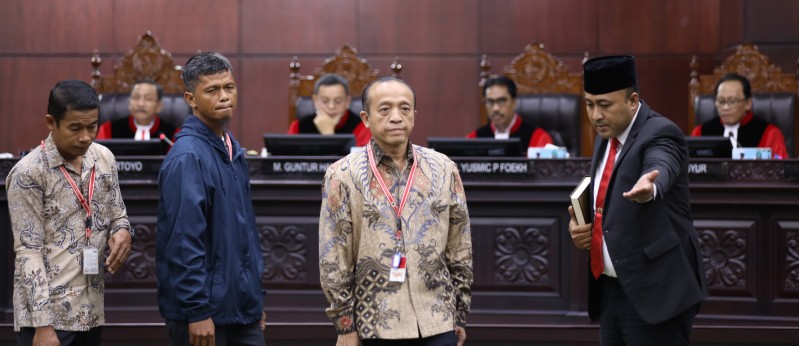
Expert and witnesses for the Government after taking an oath before testifying for the judicial review of Law No. 18 of 2013, Wednesday (6/18/2025). Photo by MKRI/Ifa.
JAKARTA (MKRI) — The President presented an expert and two witnesses at the fifth material judicial review hearing of Law No. 18 of 2013 on the Prevention and Eradication of Forest Destruction (P3H Law) as amended by Law No. 6 of 2023 on Job Creation on Wednesday, June 18, 2025 in the plenary courtroom. They are Brawijaya University environmental science lecturer Bambang Hendroyono as well as witnesses Edi Sutrisno and Zeri.
Bambang, who is also the secretary-general of the Ministry of Environment and Forestry, explained that the Job Creation Law was used to revise Law No. 18 of 2013, focusing on criminal sanctions for forestry-related crimes applying to anyone, including indigenous, customary, or local communities residing within forest areas. He explained that the Job Creation Law is intended as a government effort to balance the enforcement of forestry laws with the protection of indigenous, customary, or local communities who have historically inhabited forest areas.
“Communities will no longer be subject to criminal sanctions solely for engaging in traditional farming or agriculture, or for collecting forest products to meet their daily needs, provided that they have continuously occupied the land for at least five years and the area does not exceed five hectares. Such matters will be resolved through the forest area management process,” said Bambang at the hearing for both cases No. 147/PUU-XXII/2024 and No. 181/PUU-XXII/2024.
He said the management of forest areas referred to in this context includes social forestry programs, Agrarian Reform Object Land (TORA), changes in the function and designation of forest areas, and the use of forest areas. These provisions are in line with the Constitutional Court Decision No. 95/PUU-XII/2014.
Meanwhile, the requirement of continuous occupancy for five years is designed to ensure that it is indeed the local community that genuinely benefits from this policy. The five-hectare limit is considered a reasonable boundary for communities to utilize land in order to meet their daily needs, rather than for commercial purposes. This limit is already regulated under Article 9 of the Presidential Regulation No. 86 of 2018 on Agrarian Reform.
The term “registered” in the context of forest area management is intended to ensure that the programs of inventory, structuring of forest areas, and land redistribution are accurate and not subject to misuse. Without such registration, public oversight and accountability would be weakened, and there would be no transparency regarding who benefits from this exemption.
Further, Bambang explained that Articles 12A and 17A were formulated to regulate matters going forward, which is why they are not included in transitional provisions. Meanwhile, Article 110B paragraph (2) addresses actions that have already been “committed,” or, as referred to in the omnibus law, are “established.”
As for the absence of the word “registered” in Article 110B paragraph (2), this is because Government Regulation (PP) No. 24 of 2021 on the Procedure for the Imposition of Administrative Sanctions and the Procedure for the Collection of Non-Tax State Revenue (PNBP) Originating from Administrative Fines in the Forestry Sector stipulates that such matters be determined by the Minister (Article 17 of PP No. 24 of 2021) through the issuance of a ministerial decree on data and information (SK Datin) by the Ministry of Environment and Forestry. Therefore, there is no longer a need for the phrase “registered in the forest area management policy” as required under Articles 12A and 17A, because the resolution of land tenure within forest areas is based on PP No. 23 of 2021.
Before adjourning the session, Chief Justice Suhartoyo announced that this hearing was the last one for the case. He asked all litigating parties to submit a concluding statement on the case by Thursday, June 26, after which the Court will hand down its ruling.
Also read:
Palm Oil Owners Question Sanctions for Landowners in Forest Areas
Palm Oil Owners Improve Legal Standing to Test the Job Creation Law
Determination of Forest Area Before Petitioners Have Rights over the Land
Expert: Determining Forest Area by Appointment Unconstitutional
The case No. 147/PUU-XXII/2024 was submitted by PT Tara Bintang Nusa (Petitioner I), Makmur Jaya Village Cooperative Production Unit of South Labuhanbatu Regency (Petitioner II), and Memet S. Siregar (Petitioner III). They questioned Article 110A paragraph (1) of Law No. 18 of 2013, which has created legal implications for land rights owners to settle the requirements and pay the forest resource provision (PSDH) and reforestation fund (DR).
The legal consequences of this is that owners of rights over land that are included in protected forest areas and/or conservation areas are not only obligated to pay the forest resource provision and reforestation fund, but also to hand over their land to the state if it has passed 15 years from the planting year. Article 110B paragraph (1) of Law No. 18 of 2013 has more severe legal consequences for land rights owners, where they have to pay administrative fines and the status of the land remains a forest area.
In addition, owners of rights over land located in a production forest area receives approval to use the forest area for 1 cycle for a maximum of 25 years or according to the license period. After the period expires, they are obliged to hand over the land to the state. Meanwhile, owners of rights over land located in protected forest areas and/or conservation forest areas receive an order to transfer the land ownership to the state.
Petitioner I claimed to have suffered a loss due to the enforcement of Article 110A paragraph (1) and Article 110B paragraph (1) of Law No. 18 of 2013 because their land of approximately 41.6 hectares was included in the Decree of the Minister of Environment and Forestry dated October 31, 2023, which obliged them to complete the fulfillment of requirements under the scheme of Article 110A/Article 110B of the Job Creation Law. They have suffered loss of having to make payment to the forestry administration.
Petitioner II has 770 members who each have land rights in the form of property rights since the 1990s. The enactment of Article 110B paragraph (1) of Law No. 18 of 2013 is very detrimental to these members, especially those who own oil palm plantations of more than 5 hectares, have certificates of ownership (SHM), and whose land is included in forest areas, because they are potentially subject to administrative sanctions and have to transfer their ownership of their land to the state.
Petitioner III was convicted in a corruption case on charges of mortgaging an oil palm plantation that already had a certificate of ownership claimed as a forest area at Bank Syariah Mandiri in 2009. Due to Article 110B paragraph (1) of Law No. 18 of 2013, Petitioner III was deemed responsible for the management of oil palm plantations that had certificate of land ownership in forest areas and was subject to forestry administrative fines totaling Rp35 billion. In addition to paying the fine, they also lost the right to the land to be handed over to the state.
In their petitums, the Petitioners asked the Court to declare Article 110A paragraph (1) and Article 110B paragraph (1) of Law No. 18 of 2013 unconstitutional and not legally binding as long as it is not interpreted that the provisions in question exclude owners of land rights.
Also read:
Palm Oil Association Challenges Job Creation on Forestry
Sawit Watch Revises Petition on Job Creation Law on Forestry
Govt: Job Creation Law Limits Illegal Unilateral Claims of Land
Expert: Determining Forest Area by Appointment Unconstitutional
Meanwhile, the case No. 181/PUU-XXII/2024 was filed by Perkumpulan Pemantau Sawit (Sawit Watch), an organization established in 1998 to conduct studies on policies and laws relating to the management of natural resources, especially palm oil and its impact on ecology, society, and economy. They are represented by executive board coordinator Nurhanudin Achmad. They argued that administrative sanctions and administrative fines in forestry regulated by Law No. 18 of 2013 are not a true solution because they would only give oil palm large companies in forest areas impunity.
The Petitioner also wants to fight for their legal interests as they aim to seek and provide legal justice and legal certainty to farmers/planters and indigenous peoples who have lived around and within Indonesian forest areas, so as to realize their vision and mission. They believe the enforcement of these articles would hinder the realization of their vision, mission, and efforts to fight for people’s sovereignty in natural resource management through the protection, preservation, utilization, and control of natural resources in a fair and sustainable manner.
The Petitioner explained that many individuals residing in and/or around forest areas who carry out activities as referred to in Article 12 letters a through f and/or letter h of the Law have not been registered in the forest area arrangement policy. Therefore, it is the Government’s duty to carry out forest area arrangement for these individuals. This registration requirement as stipulated in Article 12A of the Law has led to the Government potentially acting repressively against unregistered individuals.
The Petitioner argued that the Government should have acted persuasively towards these unregistered individuals by registering them.
Author : Mimi Kartika
Editor : N. Rosi
Translator : Yuniar Widiastuti, Rizky Kurnia Chaesario (NL)
Disclaimer: The original version of the news is in Indonesian. In case of any differences between the English and the Indonesian versions, the Indonesian version will prevail.
Wednesday, June 18, 2025 | 13:48 WIB 258