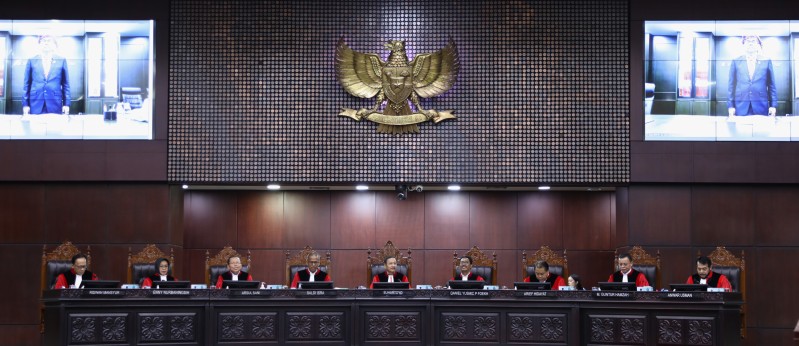
The petition revision hearing for the judicial review hearing of the Law on the Committee for State Receivables Management, Tuesday (6/17/2025). Photo by MKRI/Ifa.
JAKARTA (MKRI) — The Constitutional Court (MK) held another material judicial hearing of the Government Regulation in Lieu of Law No. 49 of 1960 on the Committee of State Receivables Management (PUPN Perppu) on Tuesday, June 17, 2025. The case No. 128/PUU-XXII/2024 was filed by Andri Tedjadharma, a shareholder of Bank Centris Internasional (BCI). In his petition, he alleged that PUPN had criminalized and coerced him by unilaterally determining him a debt insurer for state receivables. He challenges Article 8, Article 9 paragraphs (1) and (2), and Article 11 letter f of the PUPN Perppu.
At this fifth hearing, the Court heard testimonies by DPR (House of Representatives) and the Government’s expert. On behalf of the House, House Commission III member Hinca Panjaitan said provisions in the PUPN Perppu should ideally be refined through the legislative process by the authorized legislative body. The House encouraged the Petitioner to convey his aspirations in the context of revising the law so that the necessary adjustments can be made in accordance with the prevailing legislative procedures.
Panjaitan further explained that PUPN holds the authority to collect state receivables as a last resort, after collection efforts by the relevant ministries or agencies have been declared unsuccessful. This authority is regulated under Article 8 paragraph (2) letter a of Government Regulation (Perppu) No. 28 of 2022, and is further elaborated in the Minister of Finance Regulation (PMK) No. 163 of 2020 on the technical management of state receivables.
“In addition, there is PMK No. 163 of 2020, which more specifically regulates the technical procedures for the management of state receivables by ministries or agencies. If collection efforts have been undertaken but the receivables remain unpaid, the ministries or agencies shall transfer the uncollected state receivables to PUPN. Based on this framework, the design for the settlement of state receivables places PUPN as the final mechanism to pursue collection and to secure the state’s rights over its receivables,” Panjaitan explained.
Therefore, he continued, the principle governing the management of state receivables by PUPN is to ensure a swift, efficient process as laid out in the general provision of Perppu No. 49 of 1960. He also emphasized the importance of execution in the management of state Perppu No. 28 of 2022, which confers executorial power upon the letter of coercion issued by PUPN, equating it to a final and binding civil court decision.
“If every stage of the process—starting from the determination of receivables, the identification of the debtor, to the objection mechanism—were to be carried out through the courts, as proposed by the Petitioner, it would undermine the principles of speed and efficiency in the execution of PUPN’s duties. Legal certainty is required to ensure the fulfillment of the state’s rights, but it must also be accompanied by legal safeguards for debtors, as stipulated in [Perppu] No. 49 of 1960,” Panjaitan stated.
Collection Has a Legal Basis
Meanwhile, the Government presented state administrative law expert Oce Madril, who explained that the phrase “for any reason” in Article 8 of the PUPN Perppu must be interpreted as “reasons that are legally valid.” He argued that any deviation from this interpretation would create new legal issues for PUPN.
He also emphasized that Article 9 paragraph (2) was designed to protect state finances from administrators of institutions who attempt to evade responsibility for debts, including in cases such as the Bank Indonesia Liquidity Assistance (BLBI) case. He argued that the concept of joint and several liability for members of the board of commissioners and directors is crucial to prevent the loss of state funds.
He further explained that PUPN’s duty is to execute the collection of legitimate and definite-amount receivables, based on the calculations of the relevant ministries or agencies, or supported by legal documents such as audit reports from BPK (Audit Board) or court rulings. Therefore, PUPN’s actions are declarative, not constitutive, and thus do not include the authority to determine new amounts of receivables.
“Accordingly, objections to state receivables should be directed to the ministries or agencies responsible for determining the amount of the receivables, not to PUPN, which merely executes the collection,” Oce explained.
PUPN Not Above the Law
Nevertheless, Oce emphasized that PUPN is not above the law. He stated that various legal actions it has taken have been subject to judicial review in both the district court and the state administrative court. In several cases involving PUPN, there have been instances where the court upheld PUPN’s actions, while in others, the court annulled them. For example, in Decision No. 64/G/2022/PTUN.Bdg by the Bandung Administrative Court and Decision No. 19/B/2023/PT.TUN.Jkt by the Jakarta Administrative High Court, PUPN’s actions were annulled. This demonstrates that there are legal safeguards ensuring a balance between PUPN and debtors of the state.
“This confirms that there are legal guarantees ensuring a balanced relationship between the state as creditor and the debtor, making it inaccurate to claim that PUPN is a ‘superbody’ institution without oversight,” Oce asserted.
Also read:
BCI Shareholder Challenges State Receivables Committee Law
BCI Shareholder Revises Petition on State Receivables Management Committee Law
Govt: PUPN Law Protects State Finances
At the preliminary hearing, the Petitioner revealed that the DKI Jakarta PUPN had issued a decree on state receivables amounting to Rp897,678,101.21 under the name of Andri Tedjadharma/Bank Centris Internasional, with added administrative fees of 1% or 10% of the receivables, depending on the time of payment. The decree referred to a letter by the Minister of Finance, who had handed over the management of receivables to PUPN based on the findings of the Audit Board (BPK) in the 2002-2003 financial statements.
The Petitioner argued that the transfer of receivables management was legally flawed, because it did not meet the requirements of legal certainty as stipulated in Article 4 paragraph (2) and Article 12 paragraph (1) of Perppu No. 49 of 1960 on the State Receivables Management Committee. He also highlighted the PUPN’s far-reaching authority, as stated in Article 4 paragraph (3), which stipulates that the PUPN can “manage state receivables without having to wait for their transfer.” This authority, the Petitioner argued, has led to arbitrary actions by the PUPN, who determines the amounts of receivables and guarantor without a clear legal basis. He feels that his constitutional rights have been violated when he was declared a guarantor and his property confiscated without due process of the law. He has suffered a constitutional loss as a result of the PUPN’s unlimited authority as referred to in Article 4 paragraph (3), especially the phrase “manage state receivables without having to wait for the transfer if there is a strong enough reason.” The receivables must be managed immediately. This phrase means that the PUPN overrides large state receivables according to the law.
In the provisional petitums, he requests the Court to order the PUPN to delay the confiscation and auction of his and his wife’s property, to declare Perppu No. 49 of 1960 on PUPN unconstitutional, and to order the House of Representatives (DPR) and the Government to immediately form a new law on the State Receivables Management Committee in accordance with the 1945 Constitution. Furthermore, he requests that all PUPN’s actions, including the determination of state receivables, confiscation of property, letter of coercion, and execution of auctions, be declared invalid and cannot be continued after this decision is pronounced.
Author : Utami Argawati
Editor : Lulu Anjarsari P.
PR : Fauzan Febriyan
Translator : Yuniar Widiastuti (NL)
Disclaimer: The original version of the news is in Indonesian. In case of any differences between the English and the Indonesian versions, the Indonesian version will prevail.
Tuesday, June 17, 2025 | 16:09 WIB 320