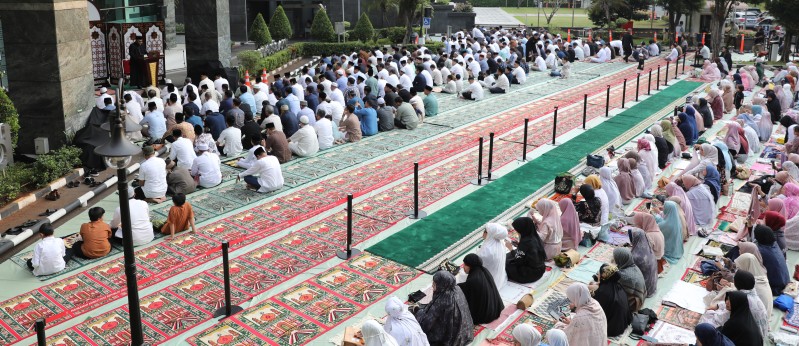
The Constitutional Justices and all Constitutional Court staff performing the Eid prayer in congregation at the Court’s courtyard on Friday (6/6/2025). Photo by MKRI/Ifa.
JAKARTA, MKRI – “Allahu akbar, Allahu akbar, Allahu akbar. La ilaha illallahu wallahu akbar. Allahu akbar walillahil hamd.”
The chants of takbir echoed throughout the Constitutional Court's compound as Justices and staff who observe Eid al-Adha 1446 H performed the Eid prayer together, led by Ustadz Ahmad Ridwan, in the courtyard of Building 2 of the Court on Friday (6/6/2025).
In his khutbah titled “Justice is Closer to Piety,” Ustadz Ahmad Ridwan invited the jamaat to reflect on the story of sacrifice shown by Prophet Ibrahim and his son, Ismail. Every Eid al-Adha, Muslims are reminded of this remarkable man, described in the Quran (Surah An-Nahl, verse 120) as “a nation in himself,” an obedient and upright servant of God, free from polytheism.
“We draw deep wisdom from Prophet Ibrahim (peace be upon him). When commanded by God to sacrifice his son, Ismail (peace be upon him), he did not negotiate, hesitate, or delay. He was just in fulfilling God's command and obedient without compromise, setting aside the affection of a father in complete submission to his Lord. Ismail, too, did not resist,” said Ustadz Ahmad.
He also recounted stories from the lives of the Prophet Muhammad’s companions, who upheld justice not only in the courts but in daily life. He cited Caliph Umar ibn Khattab (may Allah be pleased with him), who once sentenced his own son, Abdullah ibn Umar, for violating the law. When signs of favoritism emerged in the distribution of war spoils, Umar said, “Were it not for my fear of Allah and my responsibility before Him, I would not distinguish you from the common folk.” His justice knew no bounds—not even blood relations.
A Moment for Moral Purification
Eid al-Adha is more than a spiritual celebration; it is also a moment for moral purification in social and state life. In the context of Indonesia as a state based on law, Pancasila, and the 1945 Constitution, Ustadz Ahmad emphasized that the value of justice is fundamental. Here lies the vital role of the legal community—especially the Constitutional Court of the Republic of Indonesia—as the final guardian of constitutional justice and moral compass of the nation’s legal system.
“Every ruling, every legal consideration, every interpretation of the Constitution is a form of sacrifice—a sacrifice of ambition, political pressure, ego, and self-interest. A just judge doesn’t simply read the law but interprets it with conscience, piety, and moral courage, just as Prophet Ibrahim once did,” he said.
Sacrificial Slaughter
After the Eid prayer and a communal meal, the justices and staff proceeded to the courtyard of Building 3 for the ritual slaughter of sacrificial animals. For Eid al-Adha 1446 H, the Court offered 15 cows and 10 goats. Chief Justice Suhartoyo, Deputy Chief Justice Saldi Isra, and Secretary General Heru Setiawan symbolically handed over the animals to the slaughtering team. Two cows were sacrificed to mark the theme: “Sincere in Sacrifice, Sincere in Giving.”
Ustadz Ahmad then led a heartfelt prayer:
“Ya Allah, let our sacrifice today be a sign of our piety—not just in flesh and blood, but in sincere spirit and devotion. Ya Allah, guide our leaders, our law enforcers, and our justices—especially the Justices of the Constitutional Court of the Republic of Indonesia—so that each of their decisions upholds justice and brings benefit to this nation. Ya Allah, bless this land with prosperity, security, and steadfastness in upholding the true values of Pancasila: divinity, humanity, unity, democracy, and social justice.”(*)
Author : Sri Pujianti.
Editor : Lulu Anjarsari P.
Translator : Agusweka Poltak Siregar (NL)
Disclaimer: The original version of the news is in Indonesian. In case of any differences between the English and the Indonesian versions, the Indonesian version will prevail
Friday, June 06, 2025 | 08:59 WIB 346