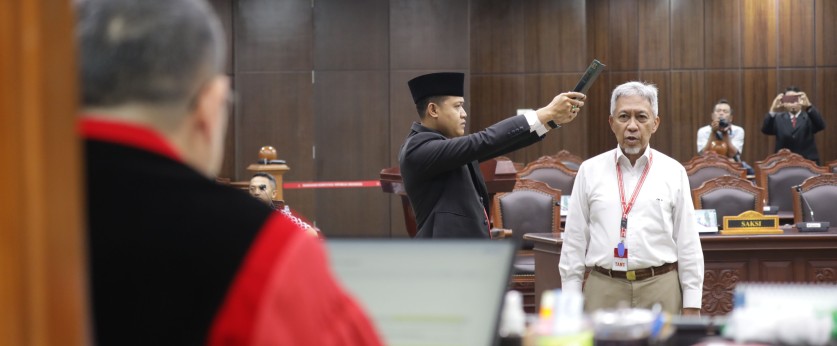
University of Indonesia’s housing finance expert Prof. Ruslan Prijadi testifying for the president at a judicial review hearing of the Tapera Law, Thursday (6/5/2025). Photo by MKRI/Panji.
JAKARTA (MKRI) — The Constitutional Court (MK) held another material judicial review hearing of Law No. 4 of 2016 on Public Housing Savings (Tapera Law) on Thursday, June 5, 2025 in the plenary courtroom. The hearing was for three cases: No. 86/PUU-XXII/2024, 96/PUU-XXII/2024, and 134/PUU-XXII/2024. The Court heard testimonies by the president’s experts—Gadjah Mada University Law Faculty’s state administration expert Oce Madril and University of Indonesia’s housing finance expert Prof. Ruslan Prijadi—and witness Adang Sutara, a Housing Ministry retiree.
Ruslan said Tapera is a long-term social investment for employers, although he acknowledged that the scheme also adds to overall labor costs. In his view, when workers come to realize that owning a decent home is no longer a mere illusion, they will be more motivated to work productively and remain loyal to their employers.
“This, in turn, will have a positive impact on business sustainability alongside social stability, which forms the foundation for socio-economic resilience,” he added.
He explained that the primary issue in meeting housing needs in Indonesia lies not merely in the availability of housing units, but in the lack of long-term, low-cost funding. To date, most of the financial sources available for housing have been short-term in nature.
When short-term funds are used to finance long-term housing loans, the cost of mortgage credit (KPR) becomes significantly higher. He argued that Tapera is designed to address this mismatch. By providing financing for first-time home purchases for low-income communities, the State seeks to reduce structural inequalities in access to housing.
Ruslan further stated that many countries face similar challenges, and the solutions often follow a similar path: establishing inclusive, contribution-based financing models that are governed by principles of social protection. Tapera adopts this model and, within the Indonesian context, serves as a state instrument to fulfill constitutional obligations.
Why Is Tapera Mandatory?
A common question arises: why is participation in the Tapera program mandatory rather than voluntary? According to Ruslan, this policy does not stem from an intent to limit individual freedom, but rather aims to establish a sustainable collective financing mechanism. This same model is employed by Healthcare BPJS, which could not function effectively if it relied solely on voluntary participation.
“A broad population base is required to build a sufficiently large and stable fund pool to facilitate housing finance with low interest rates and long tenors. That is why a mandatory savings scheme is implemented—not as a burden, but as an entry point for access to financing that has traditionally been out of reach for low-income communities,” Ruslan explained.
In addition, Oce Madril noted that the concept of mandatory participation is not new. It has long been applied in the context of social insurance or social security programs. Tapera’s objective of providing long-term, low-cost housing finance for its participants can only be achieved through the principle of mutual cooperation.
“The principle of mutual cooperation requires the participation of many parties in a collective and long-term manner,” said Oce at the hearing, which he attended virtually.
He further stated that the enactment of the Tapera Law is part of the implementation of the right to housing as mandated by Article 28H paragraph (1) of the 1945 Constitution. The Tapera Law also serves as a realization of Law No. 1 of 2011 on Housing and Settlement Areas (PKP Law), which aims to ensure the availability of long-term, low-cost funding for housing development.
According to Oce, the implementation of the Tapera program does not diminish the role of the State. On the contrary, the State is practically involved in providing housing for vulnerable groups by enacting regulations and establishing a dedicated institution—the Tapera Management Agency (BP Tapera).
Also read:
Parameters of Mandatory Public Housing Savings Participation Questioned
Labor Unions Question the Obligation of Workers to Become Tapera Participants
Petitioners Present Survey on Rejection of Public Housing Savings
Petitioners Mention China’s Failed Tapera Program
Government: Obligation to Become Tapera Participants in Line with the Principle of Mutual Cooperation
BP Tapera: Tapera Scheme Is Not a Financial Burden
Expert: Tapera Mandatory Program May Lower Investment and Increase Employment Termination
The case No. 86/PUU-XXII/2024 was filed by private employee Leonardo Olefins Hamonangan and MSME businessman Ricky Donny Lamhot Marpaung. The case No. 96/PUU-XXII/2024 was filed by the Confederation of All Indonesian Labor Unions (KSBSI), represented by national executive board president Elly Rosita Silaban and secretary-general Dedi Hardianto. The case No. 134/PUU-XXII/2024 was filed the Federation of National Worker Unions (FKSPN), Federation of Energy Chemical and Mining Worker Union-Confederation of Indonesian Worker Unions (FSP KEP KSPSI), the Federation of Tourism and Creative Economy Workers Union-Confederation of Indonesian Worker Unions, the Federation of Independent Electrical Workers of the Homeland (Pelita Mandiri)-West Kalimantan, the Federation of Agricultural and Plantation Workers’ Unions, the Confederation of Independent Workers of Indonesia, the Confederation of All Indonesian Workers’ Unions, the Independent Prosperous Labor Union ‘92, the Federation of Food Beverage Tobacco Cigarette Workers’ Unions, and the Indonesian Workers’ Union Association.
They challenge, among others, Article 7 paragraph (1) of the Tapera Law, which reads, “Every employee and self-employed person who earns at least the minimum wage shall be obliged to become a participant.” They also challenge Article 9 paragraph (1), which reads, “Workers as referred to in Article 7 paragraph (1) shall be registered by the Employers.”
The Petitioners, who are low-income workers, have limited purchasing power and thus requires help from the Government to be able to afford housing (Article 1 point 24 of the Law on Housing and Settlement Areas), a 3-percent salary deduction for mandatory public housing savings will undoubtedly place an additional financial burden amidst marginal increases in the regional minimum wage (UMR). In addition to this deduction, they already face significant financial strain from various other mandatory social security contributions, which only serves to further exacerbate their living conditions, especially in light of rising inflation.
For financially secure workers, who may already own at least one residential property, the primary issue centers on the utility of the Tapera program. Monthly salary or wage deductions raise concerns about their long-term value, especially considering that the funds can only be withdrawn upon reaching retirement age. They argue that the program is unlikely to provide any tangible benefit for these workers.
Similarly, employers, who are required to contribute 0.5 percent of employee wages to the Tapera program, will face an additional financial burden on their businesses, leading to reduced productivity.
On the other hand, low-income earners are already subject to a considerable number of mandatory deductions, such as contributions to the Healthcare and Employment Social Security (BPJS) as well as income tax (PPh). The Petitioners estimated that a worker required to pay monthly contributions for Health BPJS, Employment BPJS, and income tax (PPh21) would see a total deduction of approximately 8.7 percent of their monthly salary.
Author : Mimi Kartika
Editor : N. Rosi.
PR : Fauzan F.
Translator : Yuniar Widiastuti (NL)
Disclaimer: The original version of the news is in Indonesian. In case of any differences between the English and the Indonesian versions, the Indonesian version will prevail.
Thursday, June 05, 2025 | 15:23 WIB 942