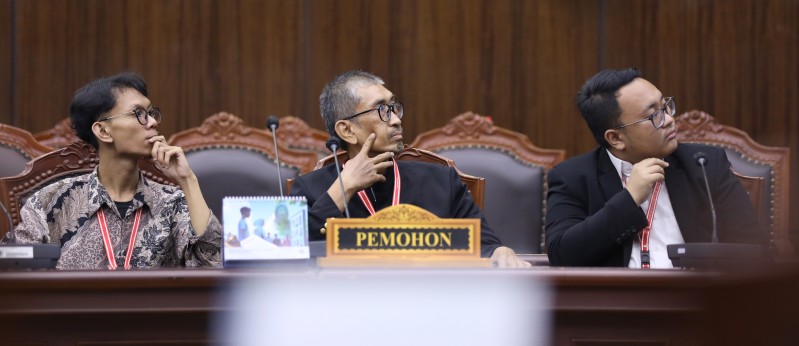
Principal Petitioner Lucky Permana (center) attending the ruling hearing of the judicial review of Law No. 20 of 2023 on Civil Servants, Thursday (6/5/2025) in the Courtroom of the Constitutional Court. Photo by MKRI/Ifa.
JAKARTA (MKRI) — The Constitutional Court (MK) has rejected the petition in Case No. 36/PUU-XXIII/2025, which challenged Article 52 paragraph (3) point i and paragraph (4) insofar as it refers to “point i” of Law No. 20 of 2023 on Civil Servants. The Court affirmed that dishonorable dismissal of a civil servant, even after serving a prison sentence, does not constitute double punishment for the same offense.
“Dismissal from civil service is a consequence of a final and binding court decision. It is a follow-up measure, not a second penalty for the same act,” said Constitutional Justice Guntur M. Hamzah as he delivered the Court’s legal considerations during the ruling hearing on Thursday, June 5, 2025, in the Constitutional Court’s plenary courtroom.
Justice Guntur stated that it would be inappropriate to impose additional conditions, such as personal evaluation and administrative rehabilitation, before enforcing Article 52 paragraph (3) point i and paragraph (4), as proposed by the Petitioner. Civil servants, he emphasized, are required to uphold core values, ethical standards, and professional conduct in fulfilling their duties as public officials, in line with the national goals mandated by the 1945 Constitution.
The Court also referred to its previous Decision No. 87/PUU-XVI/2018 on a similar provision in Law No. 5 of 2014, the predecessor of Law No. 20 of 2023. That ruling confirmed that a civil servant may be dismissed for committing an offense related to their position, as such conduct is considered a betrayal of public trust.
According to the Court, civil servants who commit job-related crimes abuse their responsibilities and, in doing so, also fail the people they are meant to serve. Their actions hinder the fulfillment of public service, governance, and development goals.
Therefore, the Petitioner’s request to add individual review and rehabilitation as preconditions for dismissal was found to be legally unfounded. The Court added that accepting such a request would weaken the meaning of a serious sanction like dishonorable dismissal for civil servants proven to have abused their position.
“The Court finds no reason to depart from its stance in Decision No. 87/PUU-XVI/2018. That legal reasoning applies in full to this case, particularly regarding the constitutionality of Article 52 paragraph (3) point i and paragraph (4) of Law No. 20 of 2023,” Justice Guntur explained. “As such, the Petitioner’s claims are not legally justified.”
Also read:
Former BPS Civil Servant Challenges ASN Law on Dismissal of Convicted Civil Servants
Former BPS Civil Servant Revises Petition on ASN Law
Previously, Lucky Permana, former civil servant at Statistics Indonesia (BPS), filed the petition after being dishonorably dismissed following a conviction. He was sentenced to two years and six months in prison and fined Rp250 million for negligence in managing a government procurement project, which caused financial losses to the state. The court found that he had failed to supervise the project, didn’t inspect the site, and was unaware that the work had been subcontracted.
Based on the verdict, BPS issued a dismissal decree on April 29, 2019.
The Petitioner argued that the dismissal lacked any individual assessment of his performance, work experience, dedication, or the severity of his mistake. He said that Article 52 paragraph (3) point i did not allow room for such evaluation or a process to restore the civil rights of those who had completed their sentence.
He also referred to the “Ban the Box” policy in the United States, which restricts employers from asking about an applicant’s criminal record in early hiring stages. Under this policy, employers must consider the seriousness of the offense, how much time has passed, and the nature of the job.
In his petitum, the Petitioner asked the Court to declare the provision unconstitutional and not legally binding unless interpreted to allow dishonorable dismissal only after an individual assessment and administrative rehabilitation.
The full decision is available at the following link: Decision No. 36/PUU-XXIII/2025.
Author : Mimi Kartika
Editor : Lulu Anjarsari P.
PR : Fauzan Febriyan
Translator : Yuanna Sisilia
Disclaimer: The original version of this news article is in Indonesian. In case of any differences between the English and Indonesian versions, the Indonesian version shall prevail.
Thursday, June 05, 2025 | 11:31 WIB 336