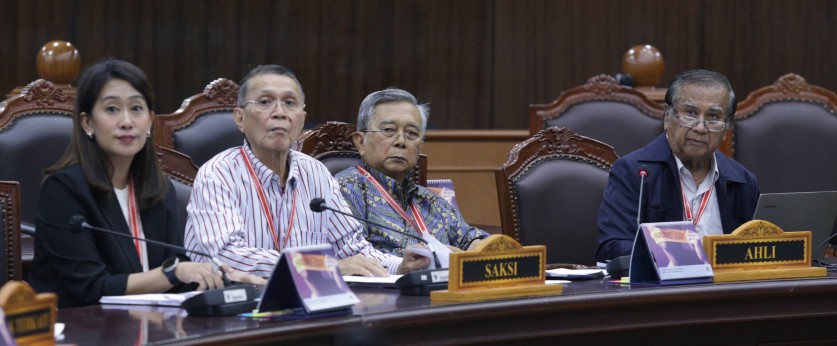
The Petitioner’s experts and witnesses listening at a judicial review hearing of the Law on the Committee for State Receivables Management, Wednesday (5/28/2025). Photo by MKRI/Bayu.
JAKARTA (MKRI) — It is not legally appropriate for a shareholder of a banking limited liability company (PT) who has never signed PKPS (settlement of shareholders’ obligations), MSAA (master settlement and acquisition agreement), MRNIA (master refinancing and note issuance agreement), APU (deed of debt recognition) or personal guarantee, to then unilaterally be determined as a debt insurer by the Committee of State Receivables Management (PUPN). Therefore, such determination is not legally appropriate.
The statement was made by Nindyo Pramono as an expert presented by Andri Tedjadharma, a shareholder of Bank Centris Internasional (BCI), as the Petitioner of the material judicial review of the Government Regulation in Lieu of Law No. 49 of 1960 on the Committee of State Receivables Management (PUPN Perppu) on Wednesday, May 28, 2025. The fourth hearing for case No. 128/PUU-XXII/2024 had taken place to hear the testimonies of the PUPN as Relevant Party and the Petitioners’ witnesses and experts.
“To be able to hold a shareholder accountable, in a court decision on a dispute between the Indonesian Banking Restructuring Agency (BPPN) and a shareholder, where the shareholder is declared to have committed an unlawful act (PMH) but is not punished by debt payment, fines, and interest, if the shareholder is still going to be held accountable to the debt, fines, and interest, then a lawsuit must first be filed against the shareholder through the court,” explained Nindyo, a business law professor at the Law Faculty of Gadjah Mada University.
Nindyo further explained that in the theory of corporate law, PT shareholders are not personally liable for agreements made on behalf of the PT and for the company’s losses exceeding the shares they own, as stipulated under Article 3 paragraph (1) of Law No. 40 of 2007 on Limited Liability Companies (PT Law) and Law No. 1 of 1995. However, the provisions of these norms do not apply if the requirements of a PT as a legal entity have not been or are not fulfilled; the shareholder concerned either directly or indirectly in bad faith utilizes the PT for personal interests; the shareholder concerned is involved in illegal acts committed by the PT; the shareholder concerned either directly or indirectly unlawfully used the assets of the PT resulting in insufficient asset to pay off the debts of the PT.
In corporate law theory, this provision is referred to as the doctrine or principle of piercing the corporate veil, which means that limited liability becomes unlimited, not only for shareholders, but also for directors and commissioners. However, it must be proven that the shareholder has participated in an illegal act that harms the PT and may also harm third parties or the state.
“However, if a shareholder of a PT is not involved in illegal acts committed jointly with the PT represented by the board of directors nor has he utilized the PT for his own interests; never signed PKPS, MSAA, MRNIA, APU, and personal guarantees to the Government through the BPPN, then the shareholder cannot be held liable up to his personal assets, based on the piercing the corporate veil doctrine for losses to the Government, and cannot be unilaterally determined as a debt insurer,” Nindyo explained.
Court Lawsuit
Nindyo also explained that if the Government—in this case the PUPN—will hold the directors or management of an entity accountable, for example banking PT that owes the state, then a lawsuit must first be filed through the court and not through the issuance of a demand letter, unless from the beginning the directors or management of the body acting on behalf of the body have made a joint agreement between the committee and the debtor (directors/management of the body) as stipulated in Article 10 of Government Regulation (PP) No. 49 of 1960.
Referring to PP No. 49 of 1960, especially Article 10 and the Elucidation to the PP, by making a joint agreement between the committee and the debt insurer on the amount of debt that still has to be paid, including interest, non-criminal fines, and costs related to the receivables, and the obligation of the debt insurer to pay it, this Joint Declaration has the power of execution like a judge’s decision in a civil case that has definite force and can be carried out by issuing a demand letter.
“If there has never been a joint agreement between the committee and the debt insurer on the amount of the debt to be paid, including interest, non-criminal fines, and costs related to the receivables, as well as the obligation of the debt insurer to pay it, the issuance of a demand letter cannot be justified,” explained Nindyo.
Due Process of Law
Meanwhile, Maruarar Siahaan, another expert presented by the Petitioner, explained that legal certainty is fair certainty. He emphasized on the Petitioner’s concrete case that the emergence of debt was due to the results of the BPK (Audit Board) audit in the trial of the South Jakarta District Court case. The results of the BLBI (Bank of Indonesia Liquidity Assistance) audit by BPK as outlined in the chronology of Case No. 350 show that there were two bank accounts on behalf of Bank Centris International (BCI). In short, the Bank of Indonesia and BCI did not distribute the BLBI to BCI through its actual account number.
“From this, it can be seen that there should be no deprivation without due process of law, meaning that [there should be] an opportunity to put forward the legal basis and provide evidence and this process must be carried out fairly as contained in the provisions of Article 28H of the 1945 Constitution,” said Siahaan.
PUPN’s Duties
Next, PUPN chairman Rionald Silaban as the Relevant Party stated that the PUPN is tasked with managing state/regional receivables submitted by ministries/agencies/regional governments. In carrying out this task, the PUPN complies with the PUPN Law and its derivative regulations. In principle, all state and regional bad receivables must be submitted to the PUPN to be taken care of optimally.
In carrying out its duties, Silaban continued, the PUPN has the authority to issue a letter of acceptance of state receivables management, make a joint statement, issue a decree determining the amount of state receivables, issue a notice of correction or change in the amount of state receivables, issue a demande letter, issue a confiscation order, and issue a confiscated goods sale order.
“The PUPN’s role in managing state receivables based on the PUPN Law has been strengthened by many laws and regulations in Indonesia, including Article 34 paragraph (2) of Law No. 1 of 2004 on the State Treasury, Article 41A paragraph (1) of Law No. 4 of 2023 on the Financial Sector Development and Reinforcement, and PP No. 28 of 2002 on the Management of State Receivables by the Committee of State Receivables Management,” he explained.
Also read:
BCI Shareholder Challenges State Receivables Committee Law
BCI Shareholder Revises Petition on State Receivables Management Committee Law
Govt: PUPN Law Protects State Finances
At the preliminary hearing, the Petitioner revealed that the DKI Jakarta PUPN had issued a decree on state receivables amounting to Rp897,678,101.21 under the name of Andri Tedjadharma/Bank Centris Internasional, with added administrative fees of 1% or 10% of the receivables, depending on the time of payment. The decree referred to a letter by the Minister of Finance, who had handed over the management of receivables to PUPN based on the findings of the Audit Board (BPK) in the 2002-2003 financial statements.
The Petitioner argued that the transfer of receivables management was legally flawed, because it did not meet the requirements of legal certainty as stipulated in Article 4 paragraph (2) and Article 12 paragraph (1) of Law No. 49 Prp of 1960 on the State Receivables Management Committee. He also highlighted the PUPN’s far-reaching authority, as stated in Article 4 paragraph (3), which stipulates that the PUPN can “manage state receivables without having to wait for their transfer.” This authority, the Petitioner argued, has led to arbitrary actions by the PUPN, who determines the amounts of receivables and guarantor without a clear legal basis. He feels that his constitutional rights have been violated when he was declared a guarantor and his property confiscated without due process of the law. He has suffered a constitutional loss as a result of the PUPN’s unlimited authority as referred to in Article 4 paragraph (3), especially the phrase “manage state receivables without having to wait for the transfer if there is a strong enough reason.” The receivables must be managed immediately. This phrase means that the PUPN overrides large state receivables according to the law.
In the provisional petitums, he requests the Court to order the PUPN to delay the confiscation and auction of his and his wife’s property, to declare Law No. 49 of 1960 on PUPN unconstitutional, and to order the House of Representatives (DPR) and the Government to immediately form a new law on the State Receivables Management Committee in accordance with the 1945 Constitution. Furthermore, he requests that all PUPN’s actions, including the determination of state receivables, confiscation of property, letter of coercion, and execution of auctions, be declared invalid and cannot be continued after this decision is pronounced.
Author : Utami Argawati
Editor : Lulu Anjarsari P.
PR : Fauzan Febriyan
Translator : Yuniar Widiastuti (NL)
Disclaimer: The original version of the news is in Indonesian. In case of any differences between the English and the Indonesian versions, the Indonesian version will prevail.
Wednesday, May 28, 2025 | 16:38 WIB 210