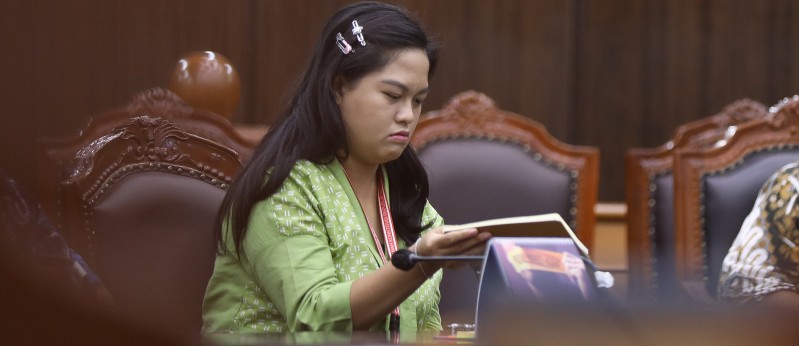
The Petitioner’s proxy at the ruling hearing for the material judicial review of Law No. 14 of 2002n the Tax Court, Tuesday (5/27/2025). Photo by MKRI/Ifa.
JAKARTA (MKRI) — The Constitutional Court (MK) rejected the entire petition No. 25/PUU-XXIII/2025 on the material judicial review petition of Law No. 14 of 2002n the Tax Court. Zico Leonard Djagardo Simanjuntak (Petitioner) challenges other requirements for legal counsels in the tax court, set forth by the finance minister.
“[The Court] adjudicated, to reject the Petitioner’s petition in its entirety,” said Chief Justice Suhartoyo at the ruling hearing on Tuesday, May 27, 2025 in the plenary courtroom.
Delivering the Court’s legal consideration, Constitutional Justice M. Guntur Hamzah said that the substance of the Petitioner’s petition was premature, because he had not regarded the integration process of the tax court into the one-roof system as part of the judiciary, whose fostering in the judicial and general (organizational, structural, and financial) administration is under the Supreme Court (MA).
Referring to the consideration of Decision No. 63/PUU-XV/2017, Decision No. 26/PUU-XXI/2023, and the legal consideration for this decision, Article 34 paragraphs (2) and (3) of Law No. 14 of 2002—which substantially regulates the requirements to become a legal representative at the tax court and its technical administrative implementation—is regulated in Minister of Finance Regulation (PMK) No. 184/PMK.01/2017, and its regulation and enforceability are still within the transformation timeframe or integration sequence within the framework of the one-roof system, which is expected to be completed on December 31, 2026. The legislators have been given the opportunity to carry out the integration process, including drafting procedural laws which, among others, can consider the material of the Petitioner’s petition in accordance with the time limit in Decision No. 26/PUU-XXI/2023.
“This integration process is carried out comprehensively, including the regulation of the requirements to become a legal counsel at the tax court as part of the administration of tax justice to ensure fair representation for justice seekers (justiciabelen) in the context of law enforcement in the field of taxation,” Justice Guntur explained.
The Petitioner argued for the presumption of unconstitutionality of Article 34 paragraph (3) of Law No. 14 of 2002n the grounds that the norm provides an exception for blood relatives or relatives by marriage up to the second degree not requiring the requirements of a lawyer or advocate when acting as a counsel or a proxy for taxpayers in the tax court. According to the Petitioner, the article has violated his right to develop himself and has caused injustice, discrimination, and harm to advocates including himself, because advocates who have fulfilled all formal requirements including education, bar examination, and registration with an advocate organization do not get privileges as family relationships regulated under Article 34 paragraph (3) of said Law.
Justice Guntur explained that with regard to the Petitioner’s argument, there are exceptions to the regulation of the requirements for legal counsel under Article 34 paragraph (3) of Law No. 14 of 2002, the requirements for certain parties can be ruled out as a permissible exception. This means that the requirement does not apply to the parties regulated under Article 34 paragraph (3) of Law No. 14 of 2002.
In this case, the legal counsels who can accompany or represent the appellant or plaintiff in the tax court can be divided into two: those who must fulfill the requirements set out in Article 34 paragraph (2) of Law No. 14 of 2002 and Article 2 of PMK No. 184/PMK.01/2017 and those who are not required to do so—i.e. legal counsels for appellants or plaintiffs have blood or marital relation up to the second degree, or are their employees or guardians, as stipulated under Article 34 paragraph (3) of Law No. 14 of 2002.
Based on Article 34 paragraph (3) of No. 14 of 2002, blood relatives or relatives by marriage can become legal counsels in tax disputes because the Law regulates that legal counsels do not have to come from certain professions, such as legal consultants or advocates, but may also be blood relatives or relatives by marriage of the taxpayers. This aims to provide flexibility to taxpayers in choosing trustworthy legal counsels, including relatives as long as they are given special power of attorney.
Article 34 paragraph (3) of the a quo Law not only serves to provide taxpayers with access to court and justice, but also to provide additional protection for taxpayers with an important note. Although blood relatives or relatives by marriage may act as legal counsels in the tax court, they must still have sufficient understanding of the procedural law relating to tax disputes or cooperate with competent parties to ensure effective representation of the interests of the taxpayers they assist or represent, so that although they do not require the requirements for attorneys in the tax court, family counsels within the limits of reasonable reasoning are granted power solely to protect the taxpayers’ legal interests.
“The tax court may request clarification regarding the capacity or competence of the legal counsel, including if they are a family member, to ensure that the trial process runs according to the law,” said Justice Guntur.
Also read:
Other Requirements for Tax Counsels Challenged
Petitioner Revises Petitums in Case on Tax Court Law
Article 34 paragraph (2) of Law No. 14 of 2002 reads, “To become a legal counsel, the following requirements shall be fulfilled: a. Indonesian citizen; b. have broad knowledge and expertise in tax laws and regulations; c. other requirements stipulated by the Minister.” Meanwhile, Article 34 paragraph (3) reads, “In the event that the legal counsel accompanying or representing the appellant or plaintiff is a blood relative or a relative by marriage up to the second degree, an employee, or a guardian, the requirements as referred to in paragraph (2) shall not be required.”
The Petitioner requested that the Court declare Article 34 paragraph (2) of Law No. 14 of 2002 unconstitutional and not legally binding if not interpreted as “To become a legal counsel, the following requirements shall be fulfilled: a. Indonesian citizen; b. requirements as regulated in the Advocate Law” and declare Article 34 paragraph (3) of Law No. 14 of 2002 unconstitutional and not legally binding.
He had asserted that the principles inherent in the advocate would be threatened if there was still power controlling the advocate, in this case the executive through the finance minister. The regulation of the requirements to become a legal counsel in the finance minister regulation could potentially create a conflict of interest in tax case trials that can hamper the advocate’s independence and objectivity.
Author : Mimi Kartika
Editor : Lulu Anjarsari P.
PR : Raisa Ayuditha Marsaulina
Translator : Yuniar Widiastuti (NL)
Disclaimer: The original version of the news is in Indonesian. In case of any differences between the English and the Indonesian versions, the Indonesian version will prevail.
Tuesday, May 27, 2025 | 16:48 WIB 265