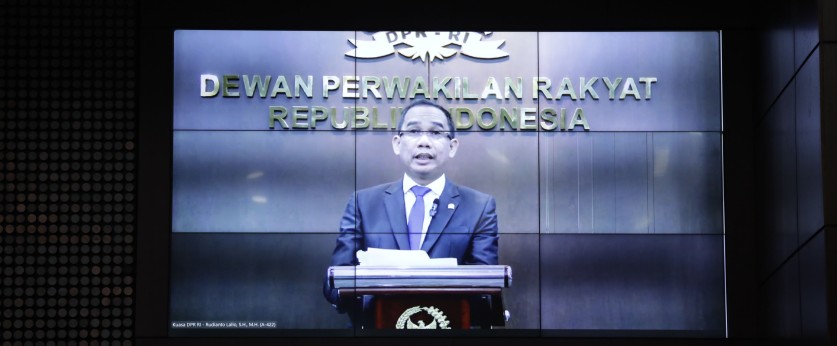
Jakarta (MKRI) – The Constitutional Court held another material judicial review hearing of Law No. 11 of 2021 on the Amendment to Law No. 16 of 2004 on the Attorney General’s Office of the Republic of Indonesia (AGO Law) against the 1945 Constitution of the Republic of Indonesia on Monday, May 26, 2025. Agus Setiawan (activist/student), Sulaiman (Advocate), and Civic Youth Alliance (Perhimpunan Pemuda Madani), represented by Furqan Jurdi as chairman, attended the hearing to hear testimony from the House of Representatives and the Government/President. Case No. 15/PUU-XXIII/2025 questions the constitutionality of Article 11 paragraph (1) and paragraph (2), Article 30B letter a, Article 35 paragraph (1) letter g and letter e of the AGO Law. However, the government asked to postpone the hearing; meanwhile, the House, through Rudianto Lallo, provided the testimony online.
Rudianto delivered arguments regarding the review of Article 35 paragraph (1) letter e of the AGO Law on the duties and authorities of the Attorney General, which may provide legal technical consideration to the Supreme Court in cassation examinations. Initially, the authority is given to execute the functions of the Attorney General as the general advocate or officer who carries out the state authorities in prosecution.
The Attorney General’s authority to provide legal technical consideration to the Supreme Court in reducing cassation is not immediately considered a hidden intervention in the judiciary. This is because the legal consideration offered by the Attorney General is not binding, only advisory. The Supreme Court decides on cases based on judges' independence. Hence, if carried out personally, transparently, and not binding, the Attorney General's participation in providing legal consideration in the cassation process may strengthen checks and balances principles in the context of accountable justice enforcement.
“The provisions of Article a quo of the AGO Law align with the spirit to protect general interest, public interest, and legality principles because it enables the Attorney General, as the higher prosecuting officer, to deliver a legal view to ensure law enforcement that is consistent, just, and does not deviate from the prevailing legal norms,” Rudianto explained.
Strengthening Prosecutors and Attorney General’s Roles
Rudianto further explained related to the Petitioners’ arguments on the constitutionality of Article 35 paragraph (1) letter g of the AGO Law for questioning the duties and authorities of Prosecutors to coordinate, control, investigate, examine, and prosecute crimes that are committed by the subject of both ordinary and military courts. The government opined that the norm must be understood in its entirety, including its elucidation. It is because the regulation contains specific provisions on connected cases, namely those involving perpetrators of two different court jurisdictions – ordinary and military courts.
Moreover, strengthening prosecutors’ roles as the supreme public prosecutor gives certainty about implementing the prosecutor's office's primary duties, functions, and authorities within the state system. It aligns with the rule of law principle and international standards adopted in the United Nations Congress in 1950, which states the importance of dominus litis and opportunity principles, which are only carried out by prosecutors and the Attorney General.
“The provisions of article a quo give a legitimate basis for the integrated national policy in the judicial system to prevent prosecution disparity, both in handling corruption cases and crime within the scope of the military court. It is important to minimize confusion in law enforcement, which may lead to injustice for justice seekers,” Rudianto explained.
Also read:
Prosecutors’ Overlapping Authorities Questioned
Petitioners Strengthen Arguments on the Cause of Prosecutor’s Authority Overlap
During the preliminary hearing on Thursday, March 3, 2025, the petitioners challenged Article 11 paragraph (1) and paragraph (2), Article 30B letter a, Article 35 paragraph (1) letter g and letter e of the General Attorney’s Office Law. The Petitioners argued that the articles were contrary to Article 30 paragraph (3) and paragraph (4) of the 1945 Constitution. Based on the provisions of Article 11A of the Attorney General’s Office Law, the Prosecutor’s duties implementation, as referred to in paragraph (1), may be conducted with concurrent positions as long as they relate to the competence and authority of the Prosecutor. According to the Petitioners, this is contrary to Article 24 paragraph (1) and paragraph (3) of the 1945 Constitution because the extension of the Prosecutor’s duties to occupy or fill positions outside the prosecutorial institution undermines the freedom and independence of the institution.
Subsequently, Sulaiman added arguments related to the provisions of Article 35 paragraph (1) letter e of Law No. 21 of 2021 that gives the authority to the Attorney General to submit technical legal considerations to the Supreme Court in the cassation examination within the scope of general courts, state administrative courts, religious courts, and military courts. According to the Petitioners, the said Attorney General’s authority was a form of legalized covert intervention through the interpretation of the phrase “legal technical.” In other words, the Petitioners opined that the Attorney General’s authority to give technical consideration to the Supreme Court of all judicial offices would potentially lead to full control of the Attorney General in the legal process.
The Petitioners also questioned the extension of the prosecutor's duties and authorities in Article 35 paragraph (1) letter g of the Attorney General’s Office Law to coordinate, control, and conduct investigations, examinations, and prosecutions of criminal offenses, which may lead to overlapping authorities. Sulaiman added that the prosecutors’ authority in the examination should be limited to specific criminal offenses stipulated under law and regulations.
Author: Sri Pujianti
Editor: Lulu Anjarsari P.
PR: Raisa Ayuditha M.
Translator: Rizky Kurnia Chaesario
Disclaimer: The original version of the news is in Indonesian. In case of any differences between the English and the Indonesian versions, the Indonesian version will prevail.
Tuesday, May 27, 2025 | 09:03 WIB 133