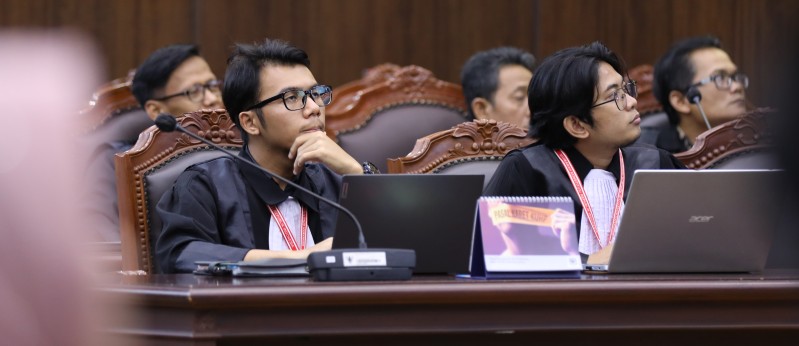
Petitioner's legal counsel Tareq Muhammad Aziz Elven (Left) during the ruling hearing on the General Election Results Dispute of the Mayor and Deputy Mayor of Banjarbaru City, Monday (26/5/2025) at the Constitutional Court. Photo by MKRI/Ifa.
JAKARTA, MKRI – The Constitutional Court of the Republic of Indonesia declared the petition filed by the Election Monitoring Institute (LPRI), represented by Syarifah, in the case concerning the 2024 General Election Results Dispute of the Mayor and Deputy Mayor Election of Banjarbaru City, to be inadmissible."
"The Court declares the Petitioner's petition to be inadmissible," said Chief Justice Suhartoyo during the ruling hearing for Case Number 318/PHPU.WAKO-XXIII/2025, held on Monday (26 May 2025) at the Constitutional Court, Jakarta.
In the legal considerations delivered by Constitutional Justice Arief Hidayat, the Court held that the Election Monitoring Institute (LPRI) did not meet the formal requirements as stipulated in Article 158 paragraph (2) letter b of Law Number 10 of 2016 concerning Regional Elections (Pilkada Law). Based on the results of the re-vote, the vote margin between the sole candidate pair and the 'empty box' was recorded at 4,628 votes or 4.3 percent. Meanwhile, the legal threshold for filing a petition is a maximum vote difference of 1.5 percent of the total valid votes, or no more than 1,612 votes."
In addition to not meeting the formal requirements, the Court also declared that the principal arguments submitted by the Petitioner were legally unfounded. LPRI had alleged that structured, systematic, and massive (TSM) money politics occurred across all areas where the re-vote was conducted. These allegations were based, among other things, on the statement of the Head of the Related Party’s Support Team and social media posts uploaded by members of the public.
"However, the Court held that information obtained from social media is subjective and anonymous, and therefore cannot be regarded as accurate or convincing evidence. 'Social media accounts, as referred to by the Petitioner, are platforms for disseminating information that is generally subjective and anonymous, and the truthfulness of the statements uploaded on such accounts cannot be deemed accurate or sufficient to convince the Court of the occurrence of a legal event,' said Constitutional Justice Enny Nurbaningsih when delivering the Court’s legal considerations."
The Constitutional Court stated that social media content cannot be treated as reliable evidence, as it is often subjective and difficult to distinguish from personal opinions. Without supporting evidence, the Court found such claims insufficient to prove the alleged distribution of money. Even if money politics had occurred, the Court said, the matter should have been reported to the Integrated Law Enforcement Center (Gakkumdu) as required by law, to allow verification of both the account holders and the posted information. The Court also noted that no objections or special incident reports were submitted by the Petitioner’s witnesses or election observers during the re-vote for the 2024 Banjarbaru mayoral election.
The Court also found that the other evidence submitted by the Petitioner failed to support their claims. Among them were photographs allegedly showing the intimidation of a voter named Iqbal, which lacked details about the nature of the threat or its direct link to the re-vote process.
The Court further rejected the claim that the Head of the Visi Nusantara Foundation had been intimidated, which the Petitioner described as criminalization of election monitors. The Court ruled that the legal proceedings involving the monitors could not be considered intimidation, as there was no evidence showing any impact on the election results.
Unconvincing Evidence
The Court also addressed the issue of accreditation revocation against the Petitioner, stating that while it did not amount to proven intimidation of election monitors, such actions should be avoided once a petition has been filed. The Court emphasized that revoking accreditation after a case is submitted could create legal uncertainty regarding the Petitioner's standing. It warned that allowing election organizers—such as the KPU, which also acts as a Respondent in election disputes—to revoke accreditation during the proceedings may open the door to misuse of authority aimed at halting legal processes in cases involving a single candidate pair.
Constitutional Justice Enny Nurbaningsih stated that while the law allows for sanctions against election monitors and gives the KPU authority to revoke accreditation, the rights of monitors who have filed petitions with the Court must still be protected. She emphasized that revocation should not automatically eliminate the Petitioner’s legal standing.
Justice Enny further stressed the importance of maintaining a fair electoral process, even in elections with only one candidate pair. "This ensures that the election does not become an uncontested or indisputable election," she said. She also urged the KPU to exercise greater caution in issuing accreditation to election monitors, particularly during the verification process, by upholding the principle of neutrality.
Nevertheless, the Court ruled that the Petitioner, LPRI, failed to meet the vote threshold requirement under Article 158 paragraph (2) letter b of the Pilkada Law. As a result, LPRI was deemed to have no legal standing, and the petition could not proceed to the evidentiary stage.
In the preliminary hearing, Syarifah, representing the Petitioner and serving as an election observer, claimed she faced intimidation and pressure after filing the petition with the Constitutional Court. She stated that LPRI’s accreditation as an election monitoring institution had been revoked and that she had been named a suspect by law enforcement. Syarifah also alleged that various parties had pressured her to withdraw the lawsuit, but affirmed her commitment to continue the legal challenge. The Petitioner further alleged that structured, systematic, and massive (TSM) violations occurred during the re-vote, including money politics, the non-neutrality of state officials, and intimidation directed at both voters and election observers.
Read also:
Banjarbaru Mayoral Election Violates Constitution, Court Orders Revote with Empty Column
Banjarbaru Election Dispute: Allegations of Observer Intimidation After Revote
Banjarbaru Election Dispute: KPU Says Petition Has Wrong Object
For information, the Court partially granted the petition filed by the Coordinator of the Nusantara Vision Study Institute, Muhamad Arifin, in the Banjarbaru City mayoral election dispute under Case Number 05/PHPU.WAKO-XXIII/2025. In its ruling delivered on Monday (24 February 2025), the Court ordered the Banjarbaru City General Election Commission (KPU) to conduct a re-voting , this time including the option of an empty column on the ballot.
In its legal considerations, the Court stated that the Banjarbaru City mayoral election, as conducted, did not fulfill the constitutional criteria of an election. The Court emphasized that such a process—where the regional head was not democratically elected—was clearly in contradiction with Article 18 paragraph (4) of the 1945 Constitution of the Republic of Indonesia, which affirms that “Governors, Regents, and Mayors as heads of provincial, regency, and city governments are democratically elected.” (*)
Author :Utami Argawati
Editor : Lulu Anjarsari P.
PR : Tiara Agustina
Translator : Fuad Subhan
Disclaimer: The original version of the news is in Indonesian. In case of any differences between the English and the Indonesian versions, the Indonesian version will prevail.
Monday, May 26, 2025 | 15:32 WIB 170