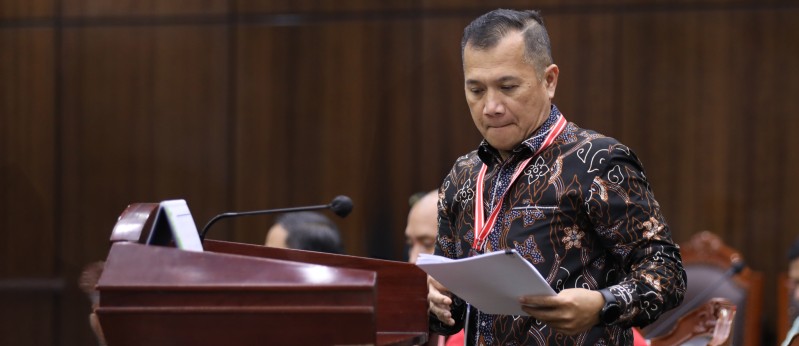
Dhahana Putra as Director General of Legislation delivering information at the hearing of Law No. 31 of 1999 on the Eradication of Criminal Acts of Corruption, Friday (5/23/2025). Photo by MKRI/Ifa.
JAKARTA (MKRI) — The Constitutional Court (MK) held a joint hearing of Case No. 142/PUU-XXII/2024 and Case No. 161/PUU-XXII/2024 on the judicial review of Article 2 paragraph (1) and Article 3 of Law No. 31 of 1999 on the Eradication of Criminal Acts of Corruption (Anti-Corruption Law/PTPK Law) on Friday, May 23, 2025. Today's hearing was scheduled to hear statements from the House of Representatives (DPR) and the President regarding the phrases "enriching oneself or others or corporations", "benefiting oneself or others or corporations", and "harming state finances or the state economy" in the articles being challenged.
The President, represented by the Director General of Legislation of the Ministry of Law, Dhahana Putra, said that through the formulation of the provisions of Article 2 paragraph (1) and Article 3 of the Anti-Corruption Law, it is hoped that it will be able to meet and anticipate the development of the legal needs of the people in order to prevent and eradicate more effectively every form of criminal act that is very detrimental to state finances or the state economy in particular and the people in general. The offense listed in these articles are in essence appropriate and needed in the current situation of the people of the country where the integrity of state administrators is still low, so that the regulations are still needed in Indonesia.
"The importance of the regulation regarding Article 2 paragraph (1) and Article 3 of the Anti-Corruption Law is because at the point of placement of the element of causing losses to state finances and the state economy in the Anti-Corruption Law is aimed at being able to restore losses to state finances and the state economy that occur as a result of acts of corruption," said Dhahana before the constitutional justices in the Plenary Courtroom of the Court, Jakarta.
In order to reach various modus operandi of deviations from state finances or the state economy that are increasingly sophisticated along with technological developments, the criminal acts regulated as per Article 2 paragraph (1) and Article 3 of the Anti-Corruption Law are formulated in such a way that they include acts to enrich oneself or another person or a corporation unlawfully. Not all unlawful acts that result in losses to state finances or the state economy can be processed by referring to the criminal provisions in the Corruption Law other than the crimes listed in Article 2 paragraph (1) and Article 3 of the Anti-Corruption Law.
Therefore, according to the Government, the Petitioner's petition to request that Article 2 paragraph (1) and Article 3 of the Anti-Corruption Law be declared not to have binding legal force, this is actually contrary to the government's goal of taking preventive measures and eradicating corruption systematically and continuously and the Government's commitment to eradicating corruption. Dhahana said, the argument based on the case experienced by the Petitioners that to proof of the elements regulated in the articles does not need to pay attention to mens rea or the intention of the perpetrators of corruption to enrich/benefit themselves/other people/a corporation and the intention of the perpetrators to harm the country's finances or economy is incorrect and baseless.
"The court still declared a verdict stating that the Petitioners were guilty, this is an individual and concrete legal norm whose testing must be carried out through the appeal, cassation and reconsideration institutions. Not through a material judicial review to the Constitutional Court against the legal norms contained in Article 2 paragraph (1) and Article 3 of the Anti-Corruption Law," explained Dhahana.
Meanwhile, he continued, if the norms will be amended according to the Petitioner's petition to delete or create a new formulation, it will actually be an attempt to decriminalize. Because, the Petitioner's request will narrow the criminal act which was originally intentional in a broad sense, namely covering three forms of intention, to only one form of intention as intent.
In addition, the constitutional justices asked for further explanation regarding the discussion of the formulation of the norms of Article 2 paragraph (1) and Article 3 of the Anti-Corruption Law. According to Constitutional Justice Arsul Sani, in these norms there is clarity regarding the subject element, namely every person, the element of consequence, namely harming state finances or the state economy, and the element of purpose, namely enriching or benefiting oneself or others or corporations.
However, Justice Arsul said, the phrase "unlawfully" mentioned in the norm is not yet clear. The boundaries of what is called an unlawful act have not been explained.
"One day, someone steals money from the Constitutional Court's safety box, they can also be subject to corruption, because of what, because the subject is clear, the element of the purpose is clear to enrich themselves, for example for the thief, then it is also clear that the state's finances are being harmed, the money taken from the Constitutional Court is indeed owned by the state, the consequence is that thieves in government offices or in ministries/agencies can commit a crime (corruption)," said Justice Arsul.
Before closing the hearing, Chief Justice Suhartoyo said that the hearing for this case would be continued on Wednesday, June 18, 2025 at 13.30 WIB. The hearing agenda is to hear the statements of the DPR and the Petitioner's witnesses and experts.
Also read:
Former President-Director and Former Governor to Test Anti-corruption law
Petitioners Request Conditions for Imposing Defendant Sanction in Anti-Corruption Law
Case No. 142/PUU-XXII/2024 was filed by the Former President Director of Perum Perikanan Indonesia (2016-2017) Syahril Japarin (Petitioner I), Former Employee of PT Chevron Pacific Indonesia Kukuh Kertasafari (Petitioner II), and Former Governor of Southeast Sulawesi Nur Alam (Petitioner III). The Petitioners requested the Court to provide conditions for suspects or defendants who are subject to criminal sanctions/fines in the provisions of the norms being reviewed.
In their petitums, the Petitioners request the Court to Declare Article 2 paragraph (1) and Article 3 of the Anti-Corruption Law as contradictory to the 1945 Constitution of the Republic of Indonesia (UUD NRI) and not have binding legal force. Or the Petitioners request the Court to issue an alternative decision to declare the phrase “enriching oneself or another person or a corporation” in Article 2 paragraph (1) of the Anti-Corruption Law as contradictory to the 1945 Constitution and not have binding legal force as long as it is not interpreted as “enriching oneself or another person or a corporation as a result of or in connection with bribery, embezzlement in office, extortion, fraudulent acts, conflicts of interest in the procurement and receipt of gratuities as stated in the Anti-Corruption Law,” or “enriching oneself or another person or a corporation as a result of or in connection with bribery,” or “enriching oneself directly or indirectly and another person or a corporation”; states that the phrase "with the aim of benefiting oneself or another person or a corporation" in Article 3 of the Anti-Corruption Law is contrary to the 1945 Constitution and has no binding legal force as long as it is not interpreted as "with the aim of benefiting oneself, or another person, or a corporation as a result of or in connection with bribery, embezzlement in office, extortion, fraudulent acts, conflicts of interest in the procurement and receipt of gratuities as stated in the Anti-Corruption Law", or “with the aim of benefiting oneself, or another person, or a corporation as a result of or in connection with bribery” or “with the aim of benefiting oneself directly or indirectly, and another person, or a corporation”;
Petitioner I has been named a suspect by the Attorney General of the Republic of Indonesia and was then charged in the trial process at the Corruption Crimes Court (Tipikor) at the Central Jakarta District Court (PN) for committing a crime as referred to in Article 2 paragraph (1) or Article 3 in conjunction with Article 18 of the PTPK Law in conjunction with Article 55 paragraph (1) point 1 of the Criminal Code in his capacity as President Director of Perum Perindo for the term of office from 16 January 2016 to 17 December 2017.
Meanwhile, in 2012, Petitioner II in his capacity as Head/Coordinator (Team Leader) of the Social/Environmental Issues Handling Team or Environmental Issues Settlement Team (EIST) SLS Minas PT Chevron Pacific Indonesia (CPI) was charged in the Corruption Crimes Court at the Central Jakarta District Court by the Public Prosecutor at the Attorney General's Office of the Republic of Indonesia with committing a criminal act of corruption together with Endah Rumbiyant and Herland respectively as Environmental Manager/Environmental Manager of Sumatera Light Operation (SLO) PT CPI and Director of PT Sumigita Jaya related to waste management at PT CPI, Sumatera Light South (SLS) Minas Operation Area, Minas District, Siak Regency, Riau Province, with the primary charge as stipulated in Article 2 paragraph (1) of the PTPK Law and the subsidiary charge of Article 3, related to the management of B3 waste from PT CPI's oil and gas work, where for the charges referred to, Petitioner II was found guilty according to Article 3 of the PTPK Law and therefore was sentenced to a criminal sentence by the Corruption Crimes Court at the Central Jakarta District Court as stated in decision No. 84/Pid.B/TPK/2012/PN.Jkt.Pst dated 17 July 2013 which was then confirmed by the Corruption Crimes Court at the Jakarta High Court (PT) through its decision No. 03/PID/TPK/2014/PT.DK1 dated 19 March 2014 (Evidence P - 6) and confirmed by the Panel of Judges at the Cassation Level in its decision No. 23 K/PID.SUS/2015 dated 23 November 2015.
Meanwhile, Petitioner III is the former Governor of Southeast Sulawesi who was once charged with violating Article 2 paragraph (1) of the PTPK Law or subsidiary charges of Article 3 of the PTPK Law, related to environmental destruction as a result of granting Mining Area Reserve Approval, Mining Business Permit Approval (TUP) Exploration and Approval of Increasing Exploration IUP to Production Operation IUP to PT Anugerah Harisma Barakah (AHB), committing acts of enriching himself or another person or a corporation, namely enriching himself by IDR 2.7 billion and enriching the corporation, namely PT Billy Indonesia by around IDR 1.5 trillion which can harm state finances or the state economy, namely harming state finances by IDR 4.3 trillion or at least IDR 1.5 trillion.
Also read:
Ex-Director of PT Merpati Airlines Challenges Anti-Corruption Catchall Articles
Petitioner Asks Catchall Anti-Corruption Articles Be Reinterpreted
Anti-Corruption Law Hearing Postponed, Will Be Merged to Similar Cases
Meanwhile, Case No.161/PUU-XXII/2024 was filed by Hotasi Nababan, a defendant in a corruption case who after undergoing a trial process was acquitted by the Panel of Judges at the Jakarta Corruption Crimes Court in 2013. However, based on the Cassation Decision Level in 2014/2015, Hotasi was found guilty of committing a crime of corruption according to the primary charge of Article 2 paragraph (1) in conjunction with Article 18 of the Anti-Corruption Law in conjunction with Article 55 paragraph (1) point 1 of the Criminal Code (KUHP) so that the Petitioner was sentenced to four years in prison and a fine of IDR 200 million.
According to the Petitioner who at that time served as Director of PT Merpati Nusantara Airline, it has been proven in the trial that he had good intentions in running the state-owned company and there was no mens rea or evil intention in him to harm state finances. According to him, the petition of the law of the a quo articles has caused problems because in fact there has been a shift in practice by ensnaring everyone in whose case there is a state loss using Article 2 and Article 3 of the Anti-Corruption Law. In fact, said Hotasi, the state's financial or economic losses that arose were not from his actions in giving money.
He said the process of proving his case was only drawn from separate and unrelated facts inserted together in such a way as to show that the elements in Article 2 paragraph (1) of the Anti-Corruption Law were fulfilled even though the form of the perpetrator's guilt was interpreted in a very broad way. The Petitioner said that Article 2 paragraph (1) of the Anti-Corruption Law must explicitly state the formulation of the crime for intent (opzet) in which case the form of intent is intent as an intention so that the formulation in a law must read "every person with the intention etc...".
As a result of the formulation of Article 2 paragraph (1) of the Anti-Corruption Law not containing the formulation with the intention of harming the state's finances or economy, the Petitioner was convicted even though it could not be proven that the Petitioner intentionally/with malicious intent/mens rea harmed the state's finances or economy and gained profit. In fact, the Petitioner's cooperation was purely a business decision to save PT MNA's finances, which had been taken in good faith according to the procedures and principles of the Business Judgement Rules (BJR), without any conflict/interest or kick-back for the Petitioner.
In his petitum, the Petitioner requested the Court to declare the phrase "unlawfully carrying out acts of enriching oneself or another person or a corporation that can harm state finances" in Article 2 paragraph (1) of the Anti-Corruption Law to be contrary to the 1945 Constitution and not legally binding as long as it is not interpreted as "with the intention of harming state finances and enriching oneself, or another person or a corporation in an unlawful manner". In addition, the Petitioner requested the Court to also declare the phrase "with the intention of benefiting oneself or another person or a corporation, abusing the authority, opportunity or means available to him because of his position or position which is detrimental to state finances or the state economy" in Article 3 of the Anti-Corruption Law to be contrary to the 1945 Constitution and not legally binding as long as it is not interpreted as "with the intention of harming state finances or the state economy and benefiting oneself or another person or a corporation by abusing the authority, opportunity or means available to him because of his position or position".
For information, the full text of Article 2 paragraph (1) of the Anti Corruption Law is "Any person who unlawfully commits an act of enriching themselves or another person or a corporation which is detrimental to state finances or the state economy, shall be punished with life imprisonment or imprisonment for a minimum of 4 (four) years and a maximum of 20 (twenty) years and a fine of at least IDR 200,000,000.00 (two hundred million rupiah) and a maximum of IDR 1,000,000,000.00 (one billion rupiah)". Article 3 of the Anti-Corruption Law states, "Any person who, with the aim of benefiting himself or another person or a corporation, abuses the authority, opportunity or means available to him because of his position or position which is detrimental to state finances or the state economy, shall be punished with life imprisonment or imprisonment for a minimum of 1 (one) year and a maximum of 20 (twenty) years and/or a fine of at least Rp. 50,000,000.00 (fifty million rupiah) and a maximum of Rp. 1,000,000,000.00 (one billion rupiah)."
Read more Petition Case No. 142/PUU-XXII/2024
Read more Petition Case No. 161/PUU-XXII/2024
Author : Mimi Kartika
Editor : N. Rosi
PR : Raisa Ayuditha Marsaulina
Translator : Donny Yuniarto
Disclaimer: The original version of the news is in Indonesian. In case of any differences between the English and the Indonesian versions, the Indonesian version will prevail
Friday, May 23, 2025 | 16:06 WIB 2573