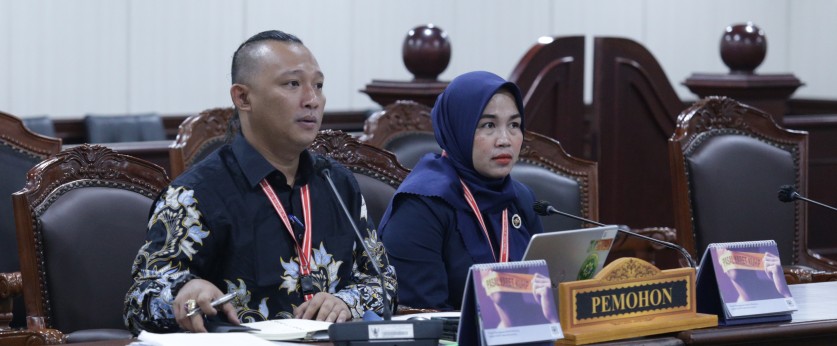
Petitioners Syamsul Jahidin and Ernawati attending the preliminary hearing of cases No. 76/PUU-XXIII/2025 and 78/PUU-XXIII/2025, Thursday (5/22/2025). Photo by MKRI/Bayu.
JAKARTA (MKRI) — The Constitutional Court (MK) held a preliminary hearing for the judicial review of Law No. 2 of 2002 on the Indonesian National Police (the Police Law) against the 1945 Constitution on Thursday, May 22, 2025. Two separate cases were examined at the hearing. The first, case No. 76/PUU-XXIII/2025, was filed by Syamsul Jahidin, challenging Article 16 paragraph (1) letter l and paragraph (2) letter c of the Police Law. The second, case No. 78/PUU-XXIII/2025, was lodged by Jahidin (Petitioner I) and Ernawati (Petitioner II), challenging Article 11 paragraph (2) and its elucidation. The hearing was presided over by Constitutional Justice Arief Hidayat (panel chair) and Justices Enny Nurbaningsih and Anwar Usman.
In case No. 76/PUU-XXIII/2025, Jahidin argued that Article 16 paragraph (1) letter l—which authorizes “other actions according to law under accountable circumstances”—and paragraph (2) letter c—requiring that such actions be “appropriate, reasonable, and within the scope of duty”—contradict the 1945 Constitution. He asserted that the lack of strict procedural standards renders these provisions vulnerable to abuse by law enforcement officers.
He elaborated that these catchall provisions enable potential criminalization and repressive behavior by the state apparatus, such as arbitrary arrest, improper search and seizure, or coercive actions justified solely within the institution of the police.
“As a citizen, the Petitioner is vulnerable to arbitrary treatment, criminalization, intimidation, or procedural rights violations sanctioned under this vague legal language. Yet, the Constitution expressly guarantees the right to be free from arbitrary actions (Article 28G(1)) and the right to justice and equal treatment before the law (Article 28D(1)),” Jahidin said before the Court.
He requested that the Court declare Article 16 paragraph (1) letter l and paragraph (2) letter c of the Police Law unconstitutional and not legally binding.
No Clear Term Limit for the Police Chief
Meanwhile, in case No. 78/PUU-XXIII/2025, Petitioners Jahidin and Ernawati challenged Article 11 paragraph (2) and its elucidation. The provision reads, “The President shall propose the appointment and dismissal of the National Police Chief to the House of Representatives with justification.” The elucidation further outlines various grounds for dismissal but lacks clarity on the Police Chief’s term of office. Petitioners deemed the provision incompatible with Articles 1(3) and 28D(1) of the 1945 Constitution.
They argued that a defined term limit is a legal mechanism to check executive power, including that of the Police Chief. Although the elucidation mentions term expiration as a ground for dismissal, the statute lacks concrete limits, leading to ambiguity and legal uncertainty in practice.
The Petitioners also highlighted a legal vacuum regarding the President’s prerogative to dismiss the Police Chief during their term with DPR approval. According to Jahidin, while Article 11(1) affirms the President’s authority to appoint the Police Chief with DPR consent (as reinforced by Constitutional Court Decision No. 22/PUU-XIII/2015), the same prerogative should logically extend to dismissal on performance grounds.
The Petitioners further stated that Petitioner II was designated as a suspect and later convicted over her online criticism tagged #PercumaLaporPolisi (“Reporting to the Police is Useless”). As a result, she was sentenced to 1.5 years in prison and lost her basic rights, including the right to work and communicate with dignity.
Accordingly, the Petitioners requested the Court to rule Article 11 paragraph (2) unconstitutional and not legally binding unless interpreted to mean that the President’s proposal must be based on valid grounds, including: (a) expiration of the presidential term along with the cabinet’s; (b) performance-based dismissal by the President during their term with DPR consent; (c) expiration of the Police Chief’s term of office; (d) resignation; (e) retirement; (f) permanent disability; (g) conviction with permanent legal force. If the DPR rejects the proposal, the President may withdraw and resubmit it in the following session.
Panel’s Advice
Justice Enny advised the Petitioner in case No. 76/PUU-XXIII/2025 to simplify the petition, starting with the Court’s jurisdiction and elaborating on the constitutional losses suffered. “Refer to the constitutional rights handbook—evaluate whether the asserted loss is factual or potential,” she said.
For case No. 78/PUU-XXIII/2025, Enny emphasized the importance of focusing on the constitutionality of the norm itself, not institutional performance. “The constitutional loss must be clearly described, with a causal link to the challenged provision,” she added.
Justice Anwar also urged the Petitioners to refine their arguments on the constitutional loss. “Please elaborate on how the challenged articles infringe your constitutional rights,” he stressed.
Justice Arief recommended that the Petitioner in case No. 76/PUU-XXIII/2025 contest the provisions based on constitutional theory and criminal law principles. “You need to show how the norms clash with constitutional guarantees, not just cite a specific incident,” he concluded.
The panel granted the Petitioners 14 days to revise and submit their improved petitions by Wednesday, June 4, 2025, to the Registrar’s Office. The next hearing will examine the revised petitums.
Author: Sri Pujianti
Editor: N. Rosi
PR: Raisa Ayuditha Marsaulina
Translator: Yuanna Sisilia
Disclaimer: The original version of this news article is in Indonesian. In case of discrepancies, the Indonesian version shall prevail
Thursday, May 22, 2025 | 14:02 WIB 133