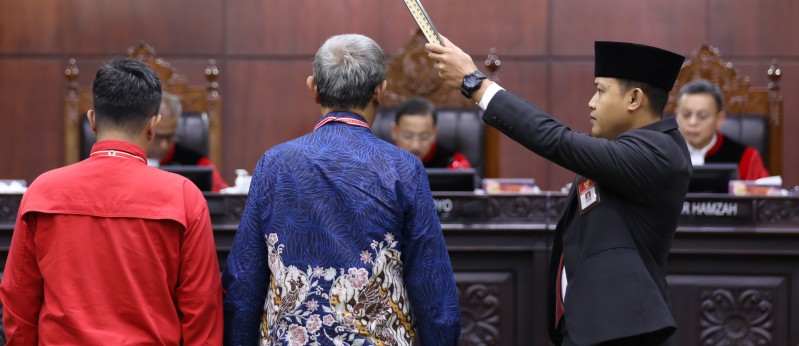
Petitioners’ witness taking their oath before the Panel of Justices during the continued judicial review hearing of Law No. 4 of 2016 on Public Housing Savings, Wednesday (21/05). Photo by MKRI/Ifa.
Jakarta (MKRI) – The Constitutional Court held another judicial review hearing of Law No. 4 of 2016 on Public Housing Savings (Tapera Law) against the 1945 Constitution of the Republic of Indonesia. The joint hearing of Cases No. 86/PUU-XXII/2024, No. 96/PUU-XXII/2024, and No. 134/PUU-XXII/2024 was to hear testimony from the Petitioners’ witness and expert. Witness Rahmat Saputra, who attended the hearing for Case No. 134/PUU-XXII/2024, stated that Tapera's mandatory contribution would burden him due to additional deductions from his salary.
“Public Housing Savings Law imposes a mandatory contribution on all workers registered as members of Public Housing Savings, which surely adds burdens and is very burdensome for me,” Rahmat, who works in a factory in Sumedang Regency, shared his thoughts in front of the Justices on Wednesday, May 21, 2025.
He explained that his current salary was 5.6 million rupiah with over 14 years of service. However, this was before 1.4 million rupiah deductions for medical insurance (BPJS Kesehatan), employment insurance (BPJS Ketenagakerjaan), Article 21 of income tax, and cooperative contributions.
Rahmat admitted that he has a mortgage. His salary is deducted from various contributions, including mortgage payments and daily needs, which are often bigger than his salary. To overcome this, he and his wife tried to look for another job by selling phone credit.
However, if the Tapera mandatory contributions start to be implemented, his salary will be smaller. According to Rahmat, if the Tapera requires 2.5 percent, his current salary will be deducted by 140 thousand rupiah.
In addition, the Petitioners of Case No. 134/PUU-XXII/2024 also presented Surya Tjandra, who works in the Law Faculty of Universitas Katolik Atma Jaya, as an expert. According to Surya, the membership contribution is relatively high because it is derived from the salary or wage percentage. For a worker with a salary higher than the minimum salary, 2.5 percent of their salary will be deducted every month. Civil servants and all workers will be members of Tapera starting in 2027.
“Amid the weakened economy and lower society's purchasing power, this deduction is deemed burdensome,” Surya stated.
Also read:
Parameters of Mandatory Public Housing Savings Participation Questioned
Labor Unions Question the Obligation of Workers to Become Tapera Participants
Petitioners Present Survey on Rejection of Public Housing Savings
Petitioners Mention China’s Failed Tapera Program
Govt, House Not Ready, Hearing on Tapera Law Postponed
Hearing on Tapera Law Postponed Again
Government: Obligation to Become Tapera Participants in Line with the Principle of Mutual Cooperation
BP Tapera: Tapera Scheme Is Not a Financial Burden
Expert: Tapera Mandatory Program May Lower Investment and Increase Employment Termination
Petitioners’ Unprepared, Hearing on Tapera Law Review Postponed
The case No. 86/PUU-XXII/2024 was filed by Leonardo Olefins Hamonangan and Ricky Donny Lamhot Marpaung. They challenge Article 7 paragraphs (1) and (2) and Article 72 paragraph (1) letter c of the Tapera Law, which they believe are against Article 28D paragraph (1) and Article 27 paragraph (2) of the 1945 Constitution. They believe the mandatory Tapera would drain low-income people, while the cost of living is getting higher and wages are deducted for BPJS and other costs.
The case No. 96/PUU-XXII/2024 was filed by the Confederation of All Indonesian Labor Unions (KSBSI). It is claiming that Article 7 paragraph (1), Article 9 paragraphs (1) and (2), Article 16, Article 17 paragraph (1), Article 54 paragraph (1), and 72 paragraph (1) of the Tapera Law are in violation of Article 28D paragraph (2), Article 28I paragraph (2), and Article 34 paragraph (1) of the 1945 Constitution. It argues that the wages of independent workers/laborers are very low and even insufficient to afford a decent life. However, they are required to pay substantial social security contributions including Tapera, which overlaps with employment BPJS (social security).
Lastly, case No. 134/PUU-XXII/2024 was filed by several workers unions, i.e. the Federation of National Worker Unions (FKSPN), Federation of Energy Chemical and Mining Worker Union-Confederation of Indonesian Worker Unions (FSP KEP KSPSI), and the Federation of Tourism and Creative Economy Workers Union-Confederation of Indonesian Worker Unions. They challenge Article 7 paragraph (1) and Article 9 paragraph (1) of the Tapera Law, which they believe are in violation of Article 23A, Article 28D paragraph (1), and Article 28H paragraph (1) of the 1945 Constitution. They believe the mandatory Tapera membership is unconstitutional. They argue the provision is mandatory or coercive as if it were a tax, while it is not supposed to be a coercive levy for low-income workers (MBR) and non-MBR.
Author: Mimi Kartika
Editor: N. Rosi.
PR: Fauzan Febriyan
Translators: Rizky Kurnia Chaesario/Yuniar Widiastuti
Disclaimer: The original version of the news is in Indonesian. In case of any differences between the English and the Indonesian versions, the Indonesian version will prevail.
Wednesday, May 21, 2025 | 14:16 WIB 322