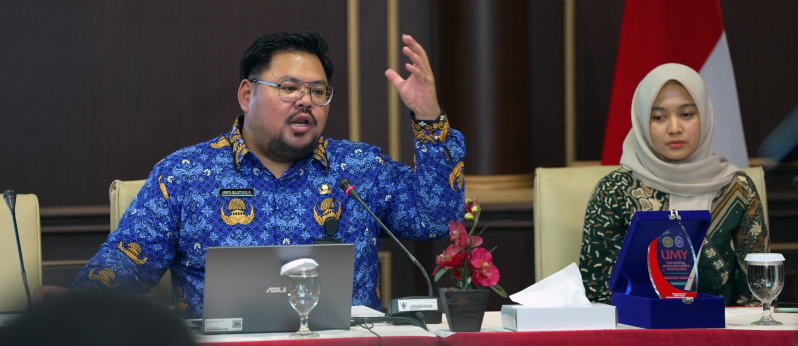
Legal Analyst of the Constitutional Court Arinta Sulistiyo Eko P. while giving his presentation to Law students from Muhammadiyah University of Yogyakarta. Photo by PR/Fauzan.
JAKARTA (MKRI) - Around 160 students from the Faculty of Law, Muhammadiyah University of Yogyakarta (UMY), including the teaching assistants who accompanied them, visited the Constitutional Court (MK) on Tuesday (20/5/2025). In the discussion session, questions arose about how to improve constitutional culture among students. According to MK Legal Analyst Arinta Sulistiyo, there is no limit to every citizen being able to apply values, norms, and behavior of society related to the constitution and legal system of a country.
"There is no limit to increasing among friends or in the community of friends," said the man who is familiarly called Tiyo in the Delegation Room, 4th Floor, Building I, MK, Jakarta.
According to him, students can start to care about the problems in Indonesia. Then, students can criticize every policy issued by the government or the DPR as lawmakers to ensure that no constitutional rights of citizens are violated.
Not only that, Tiyo suggested that students, especially those with a legal education background, could provide information and knowledge about constitutional rights to the surrounding community. However, academics can change the complicated legal language by using language that is easier for the wider community to understand and down to earth.
"Not only by testing the law, but by increasing public understanding of constitutional rights," explained Tiyo.
Constitutional rights are rights that are owned by every citizen in accordance with and guaranteed by the constitution in force in their respective countries. In Indonesia, constitutional rights are guaranteed and protected by the 1945 Constitution (UUD 1945).
For parties who consider that constitutional rights and/or authorities are harmed by the enactment of the law, they can file a prtition for judicial review of the law to the Constitutional Court. Through Constitutional Court Decision Number 46/PUU-VIII/2010, the Constitutional Court reinterpreted the norm in Law Number 1 of 1974 concerning Marriage that a child born out of wedlock has a civil relationship with his/her mother and his/her mother's family and with a man as his/her father who can be proven based on science and technology and/or other evidence according to the law to have a blood relationship, including a civil relationship with his/her father's family.(*)
Author: Mimi Kartika
Editor: Lulu Anjarsari P.
Translator : SO
Disclaimer: The original version of the news is in Indonesian. In case of any differences between the English and the Indonesian versions, the Indonesian version will prevail.
Tuesday, May 20, 2025 | 16:53 WIB 248