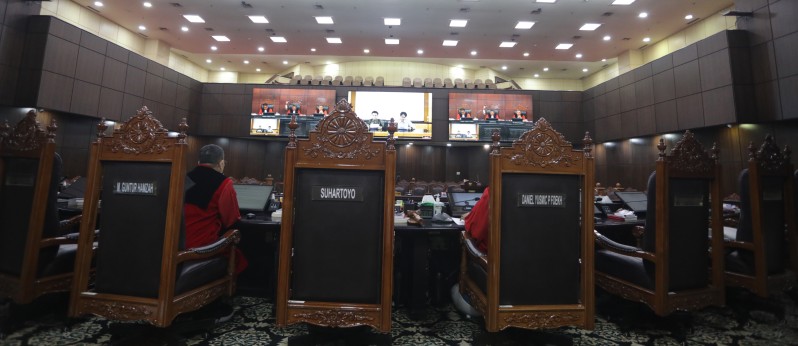
The second hearing of the material judicial review of the Law on the Legislative Branch, Monday (5/19/2025). Photo by MKRI/Ilham W.M.
JAKARTA (MKRI) — Gadjah Mada University constitutional law students Mochamad Adli Wafi and Muhammad Kevin Setio Haryanto attended the second material judicial review hearing of Article 70 paragraph (3), Article 72 letter d, and Article 185 paragraphs (1) and (2) of Law No. 17 of 2014 on the People’s Consultative Assembly (MPR), House of Representatives (DPR), Regional Representatives Council (DPD), and Regional Legislative Council (DPRD), also known as the MD3 Law. The petition revision hearing for case No. 47/PUU-XXIII/2025 was presided over by Chief Justice Suhartoyo (chair) and Constitutional Justices Daniel Yusmic P. Foekh and M. Guntur Hamzah on Monday, May 19, 2025.
Adli Wafi stated that the Petitioners had included the latest amendment to the MD3 Law; used only Article 1 paragraph (2), Article 1 paragraph (3), Article 28C paragraph (4), and Article 28D paragraph (1) of the 1945 Constitution to review the articles against.
“On the legal standing, the Petitioners have elaborated potential losses and causal relation. In this case, the Petitioners as part of the younger generation really need independent state institutions. Within the limits of reasonable reasoning, state officials will be full of concern if they have views that do not align with the House’s interests. It is very likely that they will be dismissed or recalled by the House, as has happened in the past. Without independent state officials, the Petitioners’ constitutional rights as justice seekers to fight for their rights collectively to develop the nation and state will end in vain, because the Petitioners’ advocacy efforts in various state institutions will be counteracted by the House’s political intervention,” explained Adli Wafi.
Also read: Students Ask House’s Authority to Recall State Officials Restricted
At the preliminary hearing on Tuesday, April 6, the Petitioners requested that the authority to recall public officials in state institutions be reviewed. They argue that the articles have impaired the Petitioners’ constitutional rights as citizens, as they are prevented from having independent state institutions. They argued that the House has interpreted its oversight function in the recruitment of public officials in state institutions in a way that is unconstitutional, as it goes into recalling those officials.
The Petitioners believe that, in order to implement the mandate of the 1998 Reform, the Constitutional Court must strictly interpret the oversight function to maintain constitutional democracy. It needs to ensure that the function does not allow any state institution to dominate others under the pretext of oversight. They believe the House’s intervention into other state institutions is a clear denial of the hierarchy of state institutions after the amendment to the Constitution and the principle of popular sovereignty. Such intervention directly contradicts the history of the formation of Article 1 paragraph (2) of the 1945 Constitution, which affirms that sovereignty is vested in the people and exercised according to the Constitution, not monopolized by any particular state institution.
Therefore, the Petitioners request that the Court declare Article 70 paragraph (3) of Law No. 17 of 2014 conditionally unconstitutional if the phrase “oversight function” is interpreted to include the authority to recall public officials in state institutions, whose recruitment involves the House.
They also request that the Article 72 letter d be declared conditionally unconstitutional if the word “oversight” is interpreted to include the authority to recall public officials in state institutions, whose recruitment involves the House.
They also request that the Court declare Article 185 paragraph (1) conditionally unconstitutional if it is not interpreted that a certain state official’s appointment is final and cannot be rescinded after their appointment into public service. They ask that it be interpreted as “The House shall nominate a candidate to take any office based on laws and regulations through a plenary House meeting that is final and cannot be rescinded after their appointment as an official.”
Author : Sri Pujianti
Editor : Lulu Anjarsari P.
PR : Fauzan Febriyan
Translator : Yuniar Widiastuti (NL)
Disclaimer: The original version of the news is in Indonesian. In case of any differences between the English and the Indonesian versions, the Indonesian version will prevail.
Monday, May 19, 2025 | 16:18 WIB 104