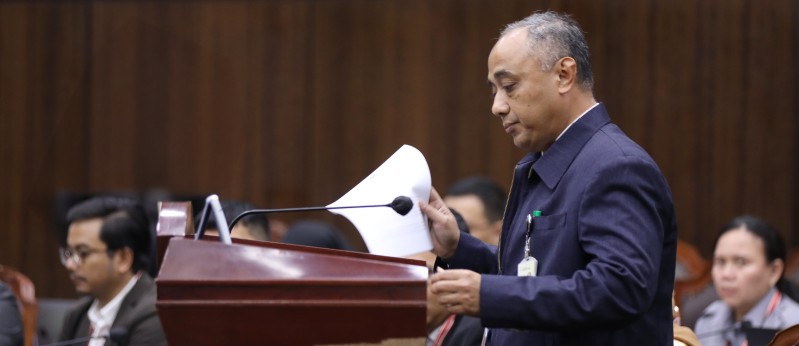
Head of the Legal and Compliance Unit of the OIKN Agung Dodit Muliawan testifying at a judicial review hearing of Law No. 21 of 2023 on the IKN Law on behalf of the Government, Monday (5/19/2025). Photo by MKRI/Ifa.
JAKARTA (MKRI) — The provisions on right over land (HAT) under the State Capital/IKN Law is an effort to attract more investors to invest in the Nusantara Capital City (IKN), said head of the Legal and Compliance Unit of the OIKN (Nusantara Capital City Authority) Agung Dodit Muliawan at the third hearing for case No. 185/PUU-XXII/2024 on Monday, May 19, 2025 in a panel courtroom. The hearing presented the Government and the House of Representatives (DPR) to testify for the judicial review of Article 16A of Law No. 21 of 2023 on the Amendment to Law No. 3 of 2022 on the State Capital (IKN Law), especially the provisions on the right over land (HAT), the right to cultivate (HGU), the right to build (HGB), and the right to use.
“This is basically not excessive, considering that similar provisions in a number of ASEAN countries also regulate the duration that is more or less the same as that regulated in this Law. The longer period of HAT in the Nusantara Capital City Authority does not reduce the essence of the state’s right to control land, because the state still carries out the evaluation and supervision of land ownership actively,” Agung explained before Chief Justice Suhartoyo and the other eight constitutional justices.
Agung said the benefit of such a duration is that it can provide legal certainty and protection for parties that obtain right over land during the specified period. In addition, he stated that right over land can provide incentives for those who have the right to utilize land optimally and responsibly, thus creates a competitive investment ecosystem in the IKN.
“Guaranteed and stable investment activities are expected to support the achievement of people’s prosperity, for the happiness, welfare, and independence of the independent, sovereign, just, and prosperous Indonesian legal society and State,” he explained.
Petitioners’ Assumption
Agung also refuted the Petitioners’ allegation of potential bribes or corruption on the process of right over land in the OIKN due to Article 16A paragraphs (1), (2), and (3) of the IKN Law.
“One of the duties of the IKN Authority is organizing internal supervision, coordinating compliance supervision, and preventing violations within the Nusantara Capital City Authority in accordance with statutory provisions,” he said.
He said prevention and enforcement of law related to bribery will be carried out in accordance with the provisions of criminal law and Law No. 31 of 1999 on the Eradication of the Criminal Acts of Corruption as amended by Law No. 20 of 2001 on the Amendment to Law No. 31 of 1999 on the Eradication of the Criminal Acts of Corruption and other relevant laws and regulations.
Also read:
Duration of Right over Land in New State Capital Deemed Too Lengthy
Two Petitioners Now Challenge Duration of Right over Land in New Capital
Petitioner I Stepanus Febyan Babaro is a Dayak tribe member and chairman of the West Kalimantan Provincial Customary Council, who was appointed based on a decree by the council. He believes that the duration of the right to cultivate (HGU), the right to build (HGB), and the right to use for up to 160 years in Article 16A paragraphs (1), (2), and (3) of the IKN Law could potentially cause ongoing conflicts and the indigenous peoples’ customary rights and land. Petitioner II is Ronggo Warsito.
The Petitioners believe there are two different regulations regarding the duration of the right to cultivate, the right to build, and the right of use: Article 16A paragraphs (1), (2), and (3) of the IKN Law as well as Article 9 of the Presidential Regulation (Perpres) No. 75 of 2024 on the Acceleration of the Development of the Nusantara Capital City (IKN). They argued that the IKN Law and Presidential Regulation No. 75 of 2024 do not clearly regulate the parties entitled to have the right to cultivate, the right to build, and the right of use. This, they stressed, could allow foreign parties to control land in IKN for a very long period of time. They also emphasized that granting land rights with too long a duration can sacrifice the interests of future generations.
For this reason, the Petitioners requested that the constitutional justices grant the petition in its entirety; and that Article 16A paragraphs (1), (2), and (3) of the IKN Law be declared unconstitutional or be interpreted to mean that the maximum duration of the right to cultivate and the right to use be limited to 25 years while the right to build be limited to 20 years.
Author : Utami Argawati
Editor : Lulu Anjarsari P.
PR : Fauzan Febriyan
Translator : Yuniar Widiastuti (NL)
Disclaimer: The original version of the news is in Indonesian. In case of any differences between the English and the Indonesian versions, the Indonesian version will prevail.
Monday, May 19, 2025 | 15:26 WIB 809