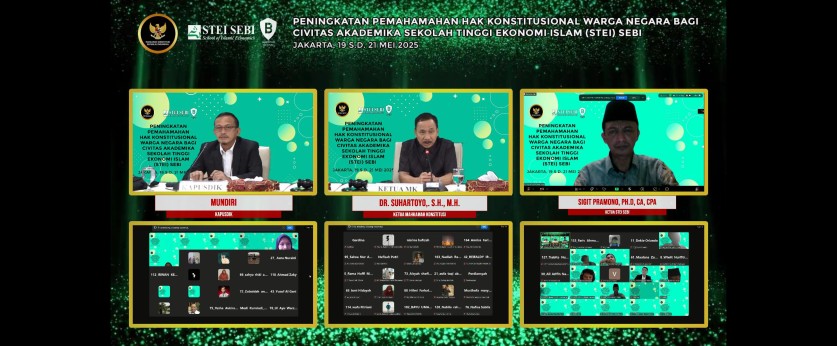
Chief Justice Suhartoyo delivering remarks at the opening of the Technical Guidance on Enhancing Understanding of Citizens’ Constitutional Rights for the Academic Community of the Islamic College of Economics (STEI) SEBI, held online by the Pancasila and Constitution Education Center of the Constitutional Court of the Republic of Indonesia on Monday (5/20/2025). Photo by PR/Teguh
JAKARTA (MKRI) — Chief Justice Suhartoyo emphasized that members of the academic community play a vital role in supporting the Constitutional Court in promoting constitutional awareness among the public. He delivered this message during the opening of the Technical Guidance on Enhancing Understanding of Citizens’ Constitutional Rights for the academic community of the Islamic College of Economics (STEI) SEBI, organized virtually by the Pancasila and Constitution Education Center of the Constitutional Court (Pusdik MK) on Monday (19/5/2025).
“As agents of change, students are expected to advocate, protect, and disseminate knowledge about citizens’ constitutional rights. But how can students do so if they do not understand what those rights entail as guaranteed by the 1945 Constitution?” said Suhartoyo.
He further explained that the Constitutional Court, as the guardian of the constitution, cannot operate in isolation. It requires comprehensive cooperation and support from all sectors of society, including the academic community and educational institutions. Collaborative efforts, particularly in promoting constitutional literacy, must be carried out responsibly to embed the values of morality and truth in alignment with Pancasila and the Constitution through various educational activities.
One of these collaborations is this technical guidance, which aims to optimize the dissemination of constitutional awareness programs, particularly for those seeking justice at the Court, including members of the academic community. Suhartoyo hopes the positive impact of such collaborations will also benefit wider society.
Suhartoyo also reaffirmed that the Court has the duty to protect citizens’ constitutional rights, including through the judicial review of laws against the 1945 Constitution. This effort ensures that laws enacted by the government and the House of Representatives (DPR) do not infringe upon constitutional rights.
“The Court examines whether laws enacted by the government and the House of Representatives (DPR) uphold or violate the constitutional rights of citizens. It is essential to determine the extent to which such laws are constitutionally compliant,” Suhartoyo elaborated.
As widely known, the Constitutional Court has ruled on several cases considered landmark decisions, which have protected the constitutional rights of Indonesian citizens in the field of education, such as:
The first is Decision No. 13/PUU-VI/2008. This decision mandated that 20% of the state and regional budgets (APBN/APBD) be allocated specifically for education, including teachers’ and lecturers’ salaries, reinforcing Article 31(4) of the 1945 Constitution.
The second decision is Decision No. 5/PUU-X/2012. It annulled Article 50(3) of Law No. 20 of 2003 on the National Education System, which allowed the establishment of International Standard Schools (SBI), on grounds that it violated the principle of equal rights to education.
The third one is Decision No. 30/PUU-XIV/2016. It restored authority over the management of secondary education (SMA/SMK) to provincial governments, annulling provisions of Law No. 23 of 2014 that had transferred this authority to municipal and regency governments.
The fourth is Decision No. 111/PUU-X/2012. This decision interpreted the concept of university autonomy to include both academic and non-academic autonomy, stressing the importance of freedom from political and economic interference.
Next is Decision No. 31/PUU-XVII/2019. This interpreted the phrase “manage their own institutions” in Article 63 of Law No. 12 of 2012 to mean that higher education institutions must be managed independently, free from external influences that could compromise academic autonomy.
Decision No. 81/PUU-XV/2017 on Religious Education, although specifically addressing religious education, it reaffirmed the essential role of the state in guaranteeing and facilitating religious instruction as an integral part of the national education system.
Decision No. 4/PUU-XXII/2024 on the Twelve-Year Compulsory Education Program, the Constitutional Court interpreted the phrase “at least at the basic education level” in Article 34(2) of the National Education System Law to mean “at least from the basic education level through senior high schools (SMA), Islamic senior high schools (MA), vocational high schools (SMK), and other equivalent forms of education”. Consequently, the state is obligated to guarantee the implementation of twelve years of compulsory education.
Finally, Decision No. 65/PUU-XXI/2023 on Campaign Activities in Educational Institutions, the Constitutional Court ruled that campaign activities may be conducted within educational institutions provided that no campaign attributes are used. The activities are held outside of class hours, and prior approval is obtained from the institution’s leadership.
These decisions underscore the Constitutional Court’s critical function in upholding the constitutionality of education laws and shaping the direction of national education policy.
In his remarks, STEI SEBI Chairperson, Sigit Pramono expressed appreciation for the Court’s collaboration. He noted that the program would equip both students and educators with essential knowledge to perform their roles effectively as future leaders and agents of change.
“This initiative provides a crucial foundation for navigating life, fulfilling professional responsibilities, and contributing to society with an informed understanding of citizens’ constitutional rights,” said Sigit.
The Technical Guidance on Enhancing Understanding of Citizens’ Constitutional Rights for the Academic Community of STEI SEBI took place from Monday to Wednesday (19–21/5/2025) and was attended by 300 participants who received materials on the Constitutional Court and related subjects. (*)
Author: Mimi Kartika
Editor: Lulu Anjarsari P.
Translator: Siti Rosmalina Nurhayati
Disclaimer: The original version of this news article is in Indonesian. In case of any discrepancy, the Indonesian version shall prevail.
Monday, May 19, 2025 | 17:26 WIB 377