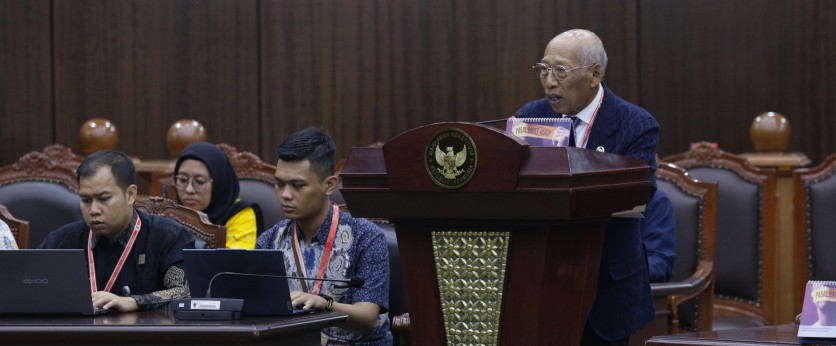
House representative I Wayan Sudirta at a material judicial review hearing of Law No. 13 of 2023 on Manpower for case No. 183/PUU-XXII/2024, Friday (5/16/2025). Photo by MKRI/Bayu.
JAKARTA (MKRI) — The Constitutional Court (MK) held the third hearing for the material judicial review of case No. 183/PUU-XXII/2024 on the material judicial review of Article 28 paragraph (3) of Law No. 18 of 2003 on Advocate on Friday, May 16, 2025. The Court heard testimonies by the House of Representatives (DPR) and the President (Government).
The petition was filed by advocate Andri Darmawan, who questions the absence of prohibition for leaders of advocate organizations to also be a state official under the article being reviewed. As a result, there has been an advocate organization leader who doubles as a deputy minister, which the Petitioner argues has harmed his constitutional rights as an advocate.
However, House Commission III member I Wayan Sudirta argued that a person’s appointment into the office of the deputy minister is the president’s prerogative, despite them being an advocate organization leader. Their position in the organization is left to the organization following the statute/bylaws.
“When the appointed deputy minister concurrently serves as chairman of an advocate organization, it is left to the bylaws of the advocate organization and it is a matter of norm implementation and not a matter of constitutionality,” Wayan said before the justices in the plenary courtroom.
He explained that advocate organizations have internal authority in determining the requirements of their leaders. The provisions have been stipulated in sufficient detail in the bylaws of the organization. This confirms that Article 28 paragraph (3) of the Advocate Law is a manifestation of an open legal policy that provides space for advocate organizations to further regulate their requirements of organizational leadership in accordance with their members’ needs and aspirations.
“Thus, the Petitioner’s argument that there is vagueness and legal uncertainty related to restrictions for leaders of advocate organizations who are concurrently state officials is an unfounded concern,” said Wayan.
This is because, he continued, Article 20 paragraph (3) of the Advocate Law has provided legal certainty that advocates who are state officials cannot carry out their professional duties to avoid potential conflicts of interest, as well as to maintain the independence, integrity, and professionalism of the advocate profession. Advocates as law enforcers must be free from the influence of public office.
This provision is also mandated by Article 3 letter i of the Code of Ethics of Indonesian advocates, which states, “An Advocate who is then appointed to hold a State office (executive, legislative, and judiciary) shall not be allowed to practice as an Advocate and not allowed to have their name included or used by anyone or by any office in a case that is being processed while he they are taking office.”
However, for the leaders of advocate organizations who have administrative and organizational duties, the legislators give the organizations freedom to regulate independently through bylaws according to the members’ needs and aspirations. Therefore, the House is of the view that all of the Petitioner’s arguments are legally baseless and there is no issue of norm unconstitutionality related to the applicability of Article 28 paragraph (3) of the Advocate Law being petitioned for review.
Also read:
Advocate Law Review: Conflict of Interest Potential of Otto Hasibuan’s Position
Constitutional Harm Due to the Absence of a Prohibition on Dual Positions for Leaders of Advocate Organizations
The Petitioner questions the absence of a provision prohibiting leaders of advocate organizations from being state officials in Article 28 paragraph (3) of the Advocate Law. The article has been interpreted through the Constitutional Court Decision No. 91/PUU-XX/2022, pronounced on October 31, 2022. The article reads, “The leadership of an advocate organization holds a term of office for 5 (five) years and can only be re-elected 1 (one) time in the same position, either consecutively or non-consecutively, and cannot be concurrent with the leadership of a political party, both at the central and regional levels.”
The Petitioner believes leaders of advocate organizations who are also state officials cannot be independent due to intervention by the government power in the advocate organization, and there tends to be individual or group domination within the advocate organization that may lead to abuse of power. He stated that Prof. Otto Hasibuan, chairman of Peradi (Association of Indonesian Advocates), was appointed Deputy Coordinating Minister of Law, Human Rights, Immigration, and Corrections on October 21, 2024.
However, until now, Hasibuan remains the chairman of Peradi. Moreover, as chairman, he delivered his recommendation at Peradi’s National Working Meeting of 2024 in Bali on December 5-6, 2024, in which, among other things, he urged the Supreme Court to revoke its Circular Letter No. 73 of 2015 on the Swearing-In of Advocates. Hasibuan suggested that all advocates who have taken their oaths join Peradi and requested the Supreme Court to swear in all advocate candidates proposed by Peradi.
The Petitioner, who is affiliated with the Congress of Indonesian Advocates (KAI), Hasibuan’s recommendation as Peradi chairman cannot be separated from his position as a deputy coordinating minister. He stated that the recommendation could be interpreted as a recommendation from the Coordinating Ministry of Law, Human Rights, Immigration, and Correction.
He added that the action did not comply with Constitutional Court Decision No. 112/PUU-VII/2014, which declared Article 4 paragraph (1) of the Advocate Law unconstitutional as long as it is not interpreted as “The Court of Appeal is obliged by law to take oaths for advocates before exercising their profession without associating them with membership of existing organizations, namely PERADI and KAI.”
The Petitioner also questioned Hasibuan’s action, which did not comply with Constitutional Court Decision No. 91/PUU-XX/2022 because he led Peradi for three periods even though the Court had set the limit for the advocate organization leadership for two periods.
He believes for leaders of advocate organization to also serve as state officials would lead to a conflict of interest because they cannot separate their individual or organizational interest and their duties as state officials.
Therefore, in his petitums, the Petitioner requested the Court to grant the petition in its entirety, to declare Article 28 paragraph (3) of Advocate Law as has been interpreted in the Constitutional Court Decision No. 91/PUU-XX/2022 conditionally unconstitutional and not legally binding as long as it is not interpreted as “The leadership of an advocate organization shall hold a term of office for 5 (five) years and can only be re-elected 1 (one) time in the same position, either consecutively or non-consecutively, and cannot simultaneously serve as state officials or leaders of political parties, both at the central and regional levels.”
Author : Mimi Kartika
Editor : N. Rosi
PR : Raisa Ayuditha Marsaulina
Translator : Yuniar Widiastuti (NL)
Disclaimer: The original version of the news is in Indonesian. In case of any differences between the English and the Indonesian versions, the Indonesian version will prevail.
Friday, May 16, 2025 | 15:53 WIB 185