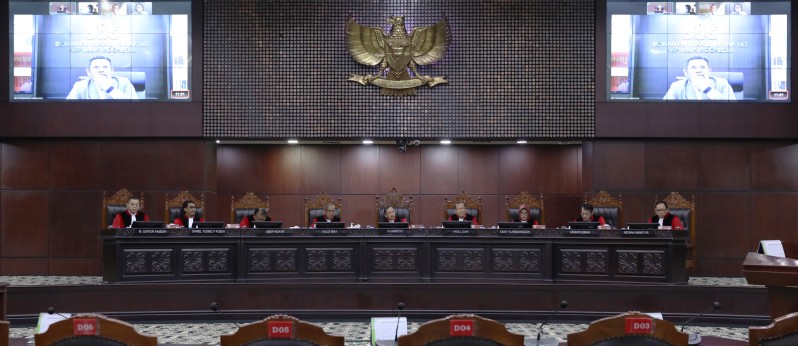
The Constitutional Court holding a continued material judicial review hearing of Law No. 1 of 1979 on Extradition to hear the House and the President’s testimony, Thursday (15/05) at the Courtroom. Photo by MKRI/Ifa.
Jakarta (MKRI) – The Constitutional Court held another material judicial review hearing of Article 21, Article 22 paragraph (2), Article 23, Article 24, Article 33 paragraph (2), Article 35 paragraph (2) letter b, Article 36 paragraph (1), paragraph (3), paragraph (4), paragraph (5), Article 40 paragraph (1), Article 44, and the Elucidation of Article 23 of Law No. 1 of 1979 on Extradition (Extradition Law), and Article 1 point 10 of Law No. 1 of 2006 on Mutual Assistance in Criminal Cases (Mutual Assistance Law) on Thursday, May 15, 2025. Case No. 180/PUU-XXII/2024 was filed by prosecutors who are still in office, namely Olivia Sembiring (Petitioner I), Ariawan Agustiartono (Petitioner II), Rudi Pradisetia Sudiradja (Petitioner III), Muh. Ibnu Fajar Rahim (Petitioner IV), and Yan Aswarih (Petitioner V). The hearing was to hear the testimony from Abdullah, a member of the House of Representatives, regarding the Petitioner’s arguments that questioned the articles that put the Ministry of Law as the central authority during extradition.
Abdullah mentioned that Indonesia has a national legal framework for extradition, namely, Law No. 1 of 1979 on Extradition. Meanwhile, the cooperation mechanism arrangement in the investigation, prosecution, and examination process during the trial or sentencing is regulated by Law No. 1 of 2006 on Mutual Assistance in Criminal Cases. Extradition and mutual assistance in criminal cases are based on an agreement founded on good relations between countries. The difference in the form of the two cooperation agreements is that the extradition agreement aims to hand over people (criminals), while the mutual assistance agreement in criminal matters aims to assist in the process of investigation, prosecution, and examination at the criminal trial, including investigation, confiscation, and return of assets resulting from crime.
With regard to the mechanism of extradition and mutual assistance in criminal cases, the state appoints an institution to act on behalf of the government and the state to be responsible for the extradition process. In the article a quo in Law No. 1 of 1979, the Minister of Justice is the authority that coordinates and facilitates the entire extradition process between Indonesia and other countries. If there is a request for extradition from a foreign country, it must be submitted in writing through diplomatic channels to the Minister of Justice and then given to the President for approval. In addition, Abdullah added, the Minister of Justice plays a role in submitting and determining courts related to extradition to the President accompanied by considerations from various related parties to obtain a final decision regarding whether or not a person can be extradited.
Open Legal Policy
Furthermore, regarding the provisions of article a quo in Law No. 1 of 2006, Abdullah mentioned that the Minister of Law and Human Rights is the central role holder in implementing mutual assistance for criminal cases related to the coordination and submission of requests for legal assistance from Indonesia to foreign countries and the handling of similar requests submitted by foreign countries to Indonesia.
Abdullah admitted that granting authority to an institution as a central authority is a form of open legal policy from legislators. The 1945 Constitution does not specify which institution is authorized to submit and handle requests for extradition and requests for mutual assistance in criminal cases.
"In the general explanation of Law No. 1 of 2006, it is clearly explained that the decision on extradition requests is not the decision of the judiciary, but the decision of the executive body. Therefore, at the final level, it lies in the hands of the President, after receiving juridical advice from the Minister of Justice based on a court order. Therefore, this authority is given to the Minister of Justice as the central authority and not to other law enforcement agencies," Abdullah explained.
Also read:
Ministry of Law's Role as Central Authority for Extradition Questioned
An Indonesian Migrant Worker in Malaysia Joins Petitioner to Test the Constitutionality of Extradition Law
It was revealed in the Preliminary Hearing on December 24, 2024, that Petitioner I, in carrying out her duties and responsibilities, often took care of incoming and outgoing extradition requests. She faced challenges and limitations due to the enactment of the regulation regarding the duration of processing mutual assistance requests. In a real case, Petitioner I was asked to facilitate a technical work unit in handling a special criminal case to identify evidence in the form of banknotes, which was suspected to be the amount of 3.3 million US Dollars from Argentina. The Ministry of Law and Human Rights Regulation No. 12 of 2022 on the Handling of Mutual Assistance in Criminal Cases states that the processing time of a mutual assistance request starts from the receipt of the request to the fulfillment and feedback stages.
In the petition, the Petitioners argued that the articles position the Ministry of Judiciary as the central authority in implementing extradition. It is deemed contradictory to the provisions of Article 1 paragraph (3), Article 17 paragraph (3), Article 24 paragraph (3), Article 24 paragraph (3), and Article 28D paragraph (1) of the 1945 Constitution. To them, extradition and mutual assistance in criminal cases shall be within the law enforcement authority, under the domain of other agencies related to the judiciary, such as the Prosecutor’s Office. As a result, the construction of the norms creates legal uncertainty, and it does not conform to the principles of the rule of law because the current nomenclature of the Ministry of Judiciary No. 1 of 1979 and the Ministry of Law and Human Rights No. 1 of 2006 have been transformed into three separated ministries, namely the Ministry of Law, Ministry of Human Rights, and Ministry of Immigration and Correctional Services. Hence, it has created disfunction and ambiguity regarding the central authority in extradition and mutual assistance in criminal cases.
In the petitum, the Petitioners requested the articles to be declared contradictory to the 1945 Constitution. The Petitioners also asked the Court to declare Article 21 of the Extradition Law conditionally constitutional against the 1945 Constitution and does not have legally binding power as long as it is not interpreted as “In the event that the person concerned is detained, the person shall be released by the Attorney General if within a time deemed sufficient from the date of detention, the President through the Attorney General does not receive a request for extradition along with the documents referred to in Article 22 from the requesting country”.
Author: Sri Pujianti
Editor: Lulu Anjarsari P.
PR: Raisa Ayuditha M.
Translator: Rizky Kurnia Chaesario
Disclaimer: The original version of the news is in Indonesian. In case of any differences between the English and the Indonesian versions, the Indonesian version will prevail.
Thursday, May 15, 2025 | 16:05 WIB 1197