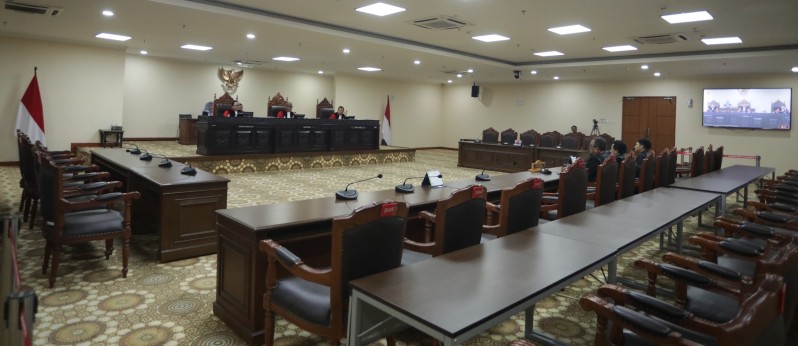
The Court holding a preliminary hearing of the judicial review of the Civil Code. Thursday (5/16/2025). Photo by MKRI/Ilham WM.
JAKARTA (MKRI) — The Constitutional Court (MK) held a preliminary hearing for the judicial review of the Civil Code (Kitab Undang-Undang Hukum Perdata/KUHPer), petitioned by PT Wijaya Perca through its President Director Aditia Tedja Nurma Diah. The Petitioner challenged the constitutionality of Article 1239 of the Civil Code, arguing that the provision allowing the charging of interest in lending agreements contravenes the republican principles as enshrined in Article 1 paragraph (1) of the 1945 Constitution.
“Permitting loans to be burdened with interest constitutes an exploitative and cruel practice, one that is incompatible with the ideals of a republic as espoused by thinkers such as Plato, Aristotle, and Cicero,” said Irwan Santoso, the Petitioner’s legal counsel, before the panel of justices at the hearing for Case No. 59/PUU-XXIII/2025, which took place on Thursday, May 15, 2025.
The Petitioner contended that Article 1239 of the Civil Code, which legitimizes interest-bearing loans, stands in fundamental conflict with the Republic of Indonesia’s constitutional identity. Cicero, a Roman philosopher and statesman (106–43 BC), regarded usury as morally reprehensible and likened it to profiting from acts of violence.
In his work De Officiis (Book II, Section XXV), Cicero asserted that in a republic, the practice of usury must be strictly forbidden. He further argued that it is the moral obligation of a republican government to safeguard its citizens from predatory lending practices.
The Petitioner explained its legal standing by referencing a credit agreement it entered into in 1981 with PT Bank Dagang Nasional (now part of PT Bank Mandiri). The Petitioner secured a loan amounting to IDR 25 billion at an annual interest rate of 12 percent to fund a palm oil plantation business. However, the Petitioner claimed to have suffered substantial financial loss—approximately IDR 13 billion—as a consequence of the interest clause, which was enabled by the provision under review.
As such, the Petitioner requested the Court to declare that the word “interest” in Article 1239 of the Civil Code is inconsistent with the 1945 Constitution and therefore lacks binding legal force.
The hearing was presided over by Deputy Chief Justice Saldi Isra, with Constitutional Justices Ridwan Mansyur and Arsul Sani serving on the panel. During the proceeding, Justice Ridwan pointed out several formal deficiencies in the petition’s structure and substance, particularly its incompatibility with Constitutional Court Regulation (PMK) No. 2 of 2021 on the Court’s Rules of Procedure.
Justice Ridwan further noted that the constitutional provision cited as the basis of the petition—Article 1 paragraph (1)—was ill-suited for reviewing a norm concerning private legal transactions. “Perhaps Article 28D would be more appropriate, as it relates to the protection of property rights. But Article 1 paragraph (1) clearly does not apply in this context, especially given the explanation you have presented,” he said.
Justice Saldi also commented that the petition lacked a clear elaboration on how the challenged provision violates constitutional norms. Instead, the argument relied heavily on classical philosophical concepts that bore little relevance to the alleged constitutional harm.
Before adjourning the hearing, Justice Saldi informed the Petitioner that it may revise and refile the petition within 14 days. The deadline for submission of the revised petition is May 28, 2025.
Author: Mimi Kartika
Editor: Lulu Anjarsari P.
PR: Raisa Ayuditha Marsaulina
Translator: Yuanna Sisilia
Disclaimer: The original version of this news article is in Indonesian. In case of any discrepancy, the Indonesian version shall prevail.
Thursday, May 15, 2025 | 15:04 WIB 307