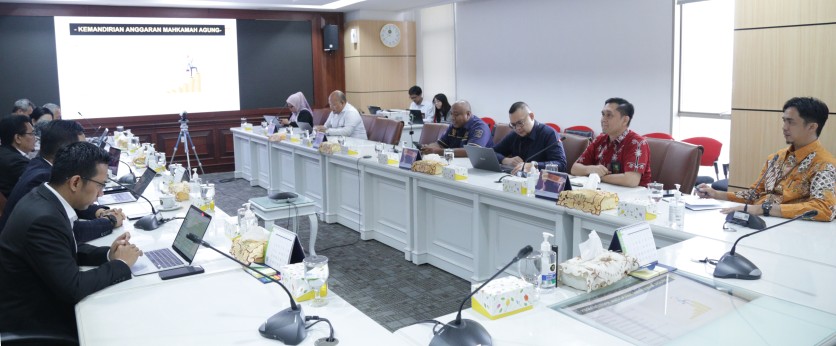
Several officials from the Supreme Court held an audience “Budgetary Independence of the Supreme Court and the Judicial Bodies under It”, Wednesday (5/14/2025). Photo by PR/Bay
JAKARTA (MKRI) — As part of the preparation of the 2025 Fiscal Year Policy Paper, the Supreme Court of the Republic of Indonesia (Supreme Court) held an audience with the Constitutional Court. The audience, titled “Budgetary Independence of the Supreme Court and the Judicial Bodies under It,” took place in the Meeting Room on the 10th floor of the Constitutional Court Building in Jakarta. This event is part of efforts to strengthen the judiciary’s budgetary position in order to realize an independent and integrity-based judicial system.
The audience was attended by several officials from the Supreme Court, including Judicial Justices from the Legal Affairs and Public Relations Bureau, Riki Perdana Raya Waruwu, Fikri Habibi, and Andhy Martuaraja; as well as Judicial Justices from the Registrar’s Office of the Supreme Court, Rio Satria and Ferdian Permadi. Also in attendance were Johanes, Junior Expert Translator from the Center for Legal and Judicial Policy Research and Analysis (Pustrajak), and Beni Harmoni Harefa.
The delegation was directly greeted by Head of the Legal Affairs and Registrar Administration Bureau (HAK) Fajar Laksono, Head of the Public Relations and Protocol Bureau Pan Mohamad Faiz, Head of the Planning and Finance Bureau Tatang Garjito, along with several other Constitutional Court’s officials and staff members.
Audience coordinator Riki Perdana Raya Waruwu explained that budgetary independence issue was one of the Supreme Court’s priorities in this year’s policy formulation. According to him, the issue involves two important aspects: the judiciary’s internal needs and the interests of justice seekers. “This is a priority because it targets two aspects: the internal needs of justices and judicial apparatuses, and the needs of justice seekers,” Riki said.
He added that the idea of budgetary independence is not new. Since 2009, the Supreme Court has included this issue in its Judicial Reform Blueprint, and in 2018 the discourse resurfaced for further action. “However, until now, it has only remained as a big idea that has been difficult to realize. This time, we are asked to draft concrete and measurable recommendations,” he said.
Furthermore, Riki emphasized that judicial power is an independent power to administer justice in upholding the law and justice. “The word ‘independent’ is used by both the Supreme Court and the Constitutional Court. The question is, to what extent does this independence include institutional matters, justices, or even the proceedings themselves? This needs to be clarified from a constitutional perspective,” he explained.
On this occasion, Riki also mentioned that the visit to the Constitutional Court aimed to exchange information and experiences related to budget management. “We want to explore ideal ideas that can be realized to strengthen the needs of the judiciary,” he concluded.
Meanwhile, Head of the Planning and Finance Bureau, Tatang Garjito, explained that the Constitutional Court’s budget cycle still refers to the government’s budget mechanism. “Since its establishment in 2003, the Constitutional Court initially relied on the People’s Consultative Assembly (MPR)’s budget. However, starting in 2004, the Constitutional Court has been financially independent and has had its own budget line, managed independently,” Tatang explained.
In preparing the following year’s budget, he continued, the Constitutional Court’s Planning and Finance Bureau requests that each work unit within the Constitutional Court propose activities to be implemented. Each bureau and center in the Constitutional Court then compiles their proposed activities, both related to judicial and administrative functions, and submits them to the Planning and Finance Bureau for further processing.
Author: Utami Argawati.
Editor: N. Rosi.
Translator: Siti Rosmalina Nurhayati
Disclaimer: The original version of the news is in Indonesian. In case of any differences between the English and the Indonesian versions, the Indonesian version will prevail.
Wednesday, May 14, 2025 | 14:10 WIB 329