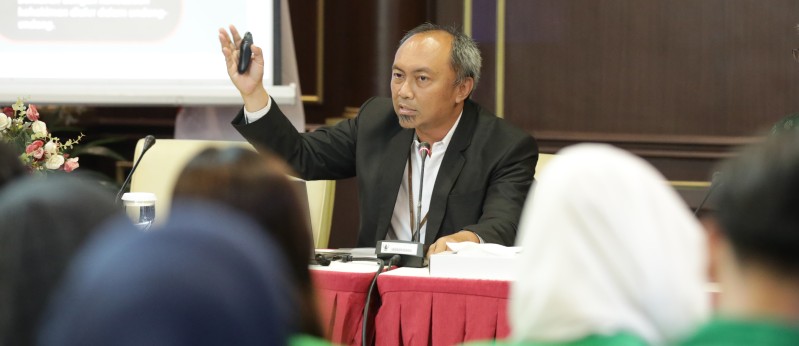
Constitutional Court Legal Analyst, Syamsudin Noer, delivered the process of judicial review to STIH Gunung Jati Tangerang Students during a visit to the Court on Wednesday (5/4/2025). Photo by MKRI/Ilham WM
JAKARTA (MKRI) – A total of 43 students and 2 lecturers from the School of Law (STIH) Gunung Jati Tangerang visited the Court on Wednesday, May 14, 2025 as part of the Field Law Course (KHL). The visit aimed to provide students with direct insight into the Court hearing process and to serve as learning material in preparation due to the Final Semester Examination (UAS). Students had the opportunity to observe a hearing at the Plenary Courtroom of Building 1 of the Court and were welcomed by Constitutional Court Legal Analyst, Syamsudin Noer.
In his presentation, Syamsudin emphasized the crucial role of students in democracy and law enforcement. “In a democratic state, laws are produced and space is provided for citizens to offer criticism. Every Indonesian citizen has the right to file a petition. It should be noted that the petitions submitted to the Court are filed by active university students,” he stated.
He stated, “This visit today is not solely for the Field Law Course, but it also represents that students can submit petitions to the Court.”
Furthermore, He illustrated the difference between formal and material judicial reviews. A formal review must be submitted within 45 days of promulgation of a law, where as a material review is not subject to any time limit. He emphasized that judicial review (PUU) examines the normative content of a statute, not its implementation. He represented the principle of judicial authority as stated in Article 24 of the 1945 Constitution, which affirms that judicial authority is independent and serves to uphold law and justice through the Supreme Court, the Constitutional Court, and judicial bodies beneath them.
Regarding judicial review, He highlighted that the petitioners must be required that loss of constitutional rights and authority due to the enactment of a particular law as Article 51 paragraph (1) of the Constitutional Court Law stated.
He also stressed that the accessibility and simplicity of the petition process at the Court. “If the hiring legal counsel is deemed too costly, it is permissible to submit a petition without representation, even those who have not yet attained a law degree are allowed to represent themselves,” he explained.
The visit concluded with a group photo and an appeal for students to not only learn about law in the academic program but also to take an active role in safeguarding and reinforcing constitutional democracy. “Law students must be prepared to serve as agents of change, than observers in the nation’s constitutional development,” He concluded.
Following the presentation, a discussion and question and answer session took place. The students were invited to visit the Constitutional History Center (Puskon) on the 5th and 6th floors of Building 1 of the Court. The Puskon is an educational facility that documents the history of the Constitution and the Constitutional Court through an integration of technology, art, and information. Visitors are given the opportunity to experience the atmosphere of a constitutional hearing through virtual simulation. (*)
Author : Fauzan Febriyan
Editor : Lulu Anjarsari P.
Translator : Nies Lindy Happyana
Disclaimer: The original version of the news is in Indonesian. In case of any differences between the English and the Indonesian versions, the Indonesian version will prevail.
Wednesday, May 14, 2025 | 14:35 WIB 307