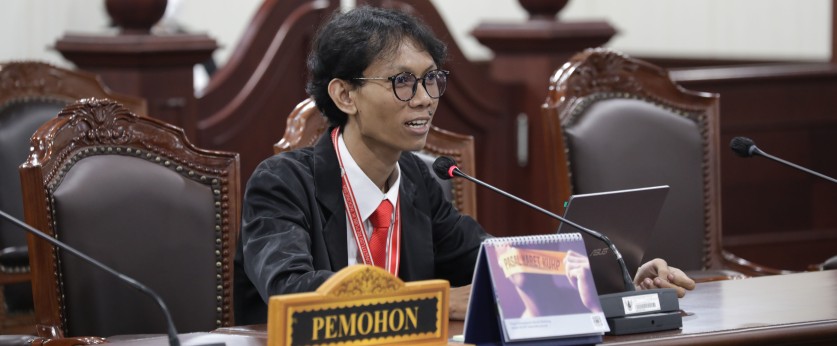
Petitioner Wahyu Dwi Kanang delivering the revised petition at the judicial review hearing of the MD3 Law, Thursday (5/14/2025). Photo by MKRI/Panji.
JAKARTA (MKRI)—The Constitutional Court (MK) held another petition revision hearing for the material judicial review of Article 239 paragraph (2) letter d of Law No. 17 of 2014 on the People’s Consultative Assembly, the House of Representatives, the Regional Representatives Council, and the Regional Legislative Councils (Law on MPR, DPR, DPD, and DPRD) against the 1945 Constitution (UUD 1945) on Wednesday, May 14, 2025.
The petition, registered as Case No. 41/PUU-XXIII/2025, was filed by Chindy Trivendi Junior (Petitioner I), Halim Rahmansah (Petitioner II), Insan Kamil (Petitioner III), Muhammad Arya Ansar (Petitioner IV), and Wahyu Dwi Kanang (Petitioner V). The hearing was held in the Panel Courtroom in the main building. Justice Arsul Sani presided over as panel chair, alongside Justices Anwar Usman and Justice Daniel Yusmic P. Foekh.
During the hearing, Wahyu Dwi Kanang explained the revisions to the petition, which included technical corrections, removal of Petitioner III’s student status, a more precise explanation of the Constitutional Court’s authority, references to Law No. 12 of 2011 and Constitutional Court Regulation No. 2 of 2021, as well as a comparative review of similar rules in Australia and the United States. The Petitioners also submitted an additional article as evidence, discussing the recall mechanism of the Aceh Party for DPR members for the 2024–2029 term.
“We have also amended and added an alternative petitum, namely to declare Article 239 paragraph (2) letter d of Law No. 17 of 2014 on MPR, DPR, DPD, and DPRD as contrary to the 1945 Constitution and thus not legally binding; or alternatively, to declare the provision unconstitutional and not legally binding unless interpreted to mean ‘proposed by the nominating political party in accordance with statutory laws and regulations, with due observance of the principle of public transparency, through an open-to-public internal tribunal of the party and by hearing statements from constituents represented by community leaders in the relevant electoral district,’” said Wahyu on behalf of the Petitioners.
“We have also amended and added our petitum with an alternative request,” Wahyu stated. “We ask the Court to rule that Article 239(2)(d) of Law No. 17 of 2014 is unconstitutional and thus not legally binding. “Alternatively, we ask that the article be ruled unconstitutional unless it is interpreted to require the recall to follow existing laws, be discussed in an open party forum, and involve input from community leaders representing voters in the electoral district.”
Also read:
Recall Authority of Political Parties under MD3 Law Questioned
At the preliminary hearing on Wednesday, April 30, 2025, Chindy Trivendi Junior (Petitioner I), Halim Rahmansah (Petitioner II), Insan Kamil (Petitioner III), Muhammad Arya Ansar (Petitioner IV), and Wahyu Dwi Kanang (Petitioner V) challenged the constitutionality of Article 239 paragraph (2) letter d of Law No. 17 of 2014 on the MPR, DPR, DPD, and DPRD (the MD3 Law). The article stipulates, “A member of the DPR shall be subject to interim dismissal as referred to in paragraph (1) letter c if... (d) they are proposed for dismissal by their political party in accordance with prevailing laws and regulations.”
Chindy Trivendi Junior argued that the provision threatens the integrity of the representative system formed through general elections by allowing political parties to recall legislators who were democratically elected by the people. She warned that this undermines the independence of DPR members in conveying the aspirations of their constituents.
“The aspirations of voters do not always align with the interests of the nominating party. When a party recalls its elected member, the votes we cast lose their meaning,” said Chindy, who attended the hearing online.
The Petitioners, therefore, urged the Court to declare Article 239(2)(d) of the MD3 Law unconstitutional and without binding legal force. As an alternative, they asked that the article be upheld only if interpreted to mean that any recall must be initiated by the nominating party in line with existing laws, carried out transparently through an open party hearing, and based on input from local community leaders representing the voters in the affected electoral district.
Read more: Case No. 41/PUU-XXIII/2025
Author: Sri Pujianti
Editor: N. Rosi
PR: Raisa Ayuditha Marsaulina
Translator: Yuanna Sisilia
Disclaimer: The original version of the news is in Indonesian. In case of any differences between the English and the Indonesian versions, the Indonesian version will prevail.
Wednesday, May 14, 2025 | 13:40 WIB 249