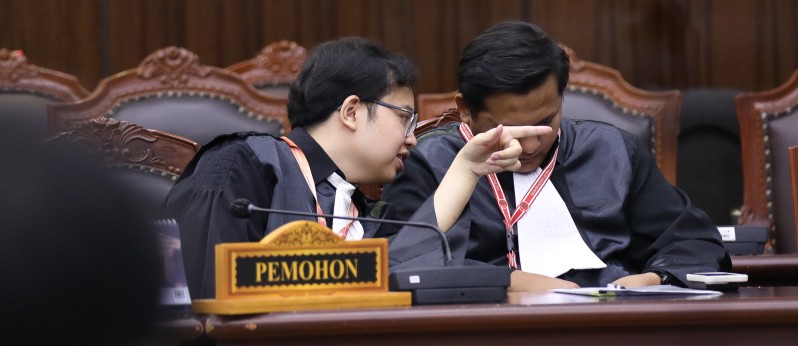
Legal counsel, Zico Laonard, attending the Decision Pronouncement Hearing on the judicial review of the Political Party Law, Wednesday (14/05), at the Courtroom. Photo by MKRI/Ifa.
Jakarta (MKRI) – Political parties have significant and strategic roles as the pillar of democracy within the representative democracy in Indonesia through the general election. In the modern democratic system, the representative system is carried out by political parties as stipulated in Article 22E paragraph (3) of the 1945 Constitution of the Republic of Indonesia. Such was the legal consideration of Decision No. 22/PUU-XXIII/2025, pronounced by Justice Enny Nurbaningsih. The decision of the case submitted by Edward Tomas Lamury Hadjon, a constitutional law lecturer at Universitas Udayana, was pronounced on Wednesday, May 14, 2025.
Furthermore, Justice Enny stated that political parties as participants in the election of legislative members will propose their best candidates to be representatives of the people by promoting their visions, missions, and platforms. Hence, only those listed as permanent candidates of legislative members from political parties can be elected by the people during the general election. They will advance the interest of their constituents and the people, in general, based on the parties’ visions, missions, and platforms.
Justice Enny mentioned that in the legal consideration of the Court Decision No. 38/PUU-XXIII/2010, it was emphasized that the Court’s standing regarding the intermittent change, both proposed by a political party or the dismissal of a legislative member as a member of a political party, is constitutional to ensure the authority and integrity of the political party. Hence, the intermittent change mechanism is part of the effort to maintain the balance between the political party, legislative member candidates, and their constituents.
“Therefore, there is no constitutional issue in the norms of Article 239 paragraph (2) letter d and letter g of Law No. 17 of 2014. Automatically, regarding the Elucidation or Article 239 paragraph (2) letter d of Law No. 17 of 2014, which reads, “clear” also has no constitutional issue in its norm. In this case, the political party members who undergo intermittent change and question the decision can seek justice by using available legal remedies,” Justice Enny explained on the judicial review petition on Article 23 paragraph (1) of Law No. 2 of 2011 on the Amendment to Law No. 2 of 2008 on Political Party (Political Party Law) and Article 17 of 2014 on the People’s Consultative Assembly, the People’s Representatives Council, the Regional Representatives Council, and the Regional People’s Representatives Council (MD3 Law).
People’s Involvement in the Intermittent Change Mechanism
Justice Enny further explained the Petitioner’s arguments on the need to involve the people in the intermittent change mechanism by organizing a reelection in electoral districts where a legislative member is proposed to be dismissed. Regarding the request, the Court opined that it will not align with the principle of representative democracy, because in a closed voting system, no one knows whose vote is for.
If the Petitioner hoped that all voters in the electoral districts would be given the right to opine, that would mean reelection in the electoral districts. Moreover, the legislative members' voting mechanism applied is an open proportional system, which combines political parties and candidates while maintaining the authority of the political parties. According to Article 22E paragraph (3) of the 1945 Constitution of the Republic of Indonesia, participants of a general election are political parties. The ‘plebiscite model, as requested by the Petitioner in his petitum, to an extent, may be interpreted as reelection as stipulated in Article 22E paragraph (1) of the 1945 Constitution, which can only be organized regularly once every five years.
“The possibility of conducting a ‘plebiscite’ does not align with the principle of one man, one vote, because it cannot be certain who voted for the member who is changed intermittently. It can happen if the previous voters who did not vote for the legislative members who will be dismissed were given the voting right in the reelection, as argued by the Petitioner. It is because it is related to the secrecy of the voters, which cannot be revealed, that the voters no longer have the constitutional right to vote for the replacement candidate of the legislative member who will be dismissed. Therefore, the Petitioner’s arguments are not legally reasonable,” Justice Enny explained.
Based on the consideration, the Court opined that the provisions of the norm in Article 239 paragraph (2) letter d and letter g of Law No. 17 of 2014 and the Elucidation of Article 239 paragraph (2) letter d of Law No. 17 of 2014 do not violate the principle of rule of law, equality before law, the right to self-improvement, and do not create legal uncertainty as stipulated in Article 1 paragraph (3), Article 27 paragraph (1), Article 28C paragraph (1), and Article 28D paragraph (1) of the 1945 Constitution of the Republic Indonesia. Therefore, the petitioner’s arguments are not legally reasonable in its entirety.
“Declare the Petitioner’s petition as long as it is related to the review of Article 23 paragraph (1) of Law No. 2 of 2011 on the Amendment to Law No. 2 of 2008 on Political Party cannot be accepted,” Chief Justice Suhartoyo pronouned the ruling.
Also read:
Constitutional Law Lecturer Questions the Absence of Leadership Position Tenure Limit and Political Party’s Right to Recall
Petitioner on Political Parties’ Recall Right Provision Review Strengthens His Arguments
On the preliminary hearing, Tuesday, April 22, 2025, the Petitioner, as a constitutional law lecturer and citizen, felt harmed by the enactment of the articles of the law. The Petitioner experienced difficulties explaining to his students the political parties’ positions on constitutional law in Indonesia. This is due to the absence of a limit on the political parties’ leadership positions, and the reason for giving recall rights to the political parties.
The limit on the tenure of the political parties' leadership positions is a control mechanism and aims to create a mechanism of checks and balances, referring to the Constitutional Court Decision No. 91/PUU-XX/2022, which in essence states the need to limit the tenure of advocate organizations leadership positions, the existence of the limit is to provide legal certainty, with the same logic the limit should apply to political parties leaders.
Hence, the Petitioner requested the Court to declare Article 23 paragraph (1) of Law No. 2 of 2011 on the Amendment to Law No. 2 of 2008 on Political Parties contradicts the 1945 Constitution and has no legally binding power. (*)
Author: Sri Pujianti
Editor: Lulu Anjarsari P.
PR: Fauzan Febriyan
Translator: Rizky Kurnia Chaesario
Disclaimer: The original version of the news is in Indonesian. In case of any differences between the English and the Indonesian versions, the Indonesian version will prevail.
Wednesday, May 14, 2025 | 17:28 WIB 1174