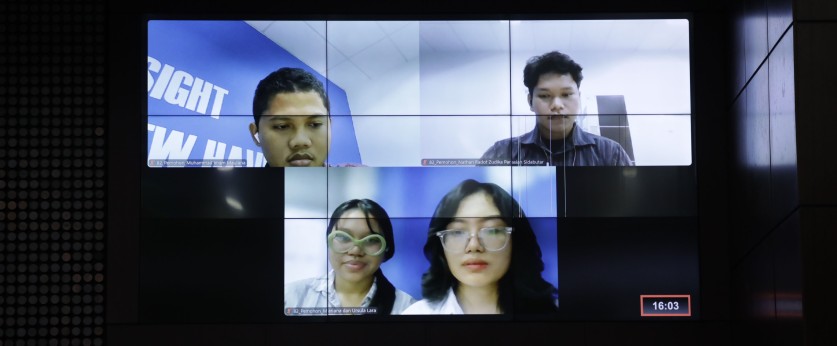
The Petitioners of the judicial review of the Army Law conveying their arguments, Wednesday (5/14/2025). Photo by MKRI/Panji.
JAKARTA (MKRI) — Muhammad Imam Maulana, Mariana Sri Rahayu Yohana Silaban, Nathan Radot Zudika Parasian Sidabutar, and Ursula Lara Pagitta Tarigan (Petitioners I-IV) have filed a material judicial review petition of Law No. 3 of 2025 on the Amendment to Law No. 34 of 2004 on the Indonesian Armed Forces (TNI/Army Law) to the Constitutional Court (MK). The preliminary hearing for case No. 82/PUU-XXIII/2025 on Wednesday, May 14, 2025 was presided over by Constitutional Justices Arief Hidayat, Anwar Usman, and Enny Nurbaningsih.
The Petitioners, who attended the hearing remotely, argued that Article 7 paragraph (2) points 9 and 15 and Article 47 paragraph (1) of Law No. 3 of 2025 are unconstitutional. Article 7 paragraph (2) points 9 and 15 of the TNI Law reads, “(9) Assisting government duties in the regions; (15) Assisting in efforts to counter cyber defense threats.” Meanwhile, Article 47 paragraph (1) reads, “Soldiers may occupy positions in ministries/agencies in charge of coordinating state politics and security, state defense including the national defense council, the state secretariat handling the affairs of the presidential secretariat and the presidential military secretariat, state intelligence, cyber and/or state encryption, national security agency, search and rescue, national narcotics, border management, disaster management, counter-terrorism, maritime security, the Attorney General’s Office of the Republic of Indonesia, and the Supreme Court.”
The Petitioners argued that contextually inappropriate involvement of the army in the civilian sphere can be negative as it could break their concentration, organization, training, and preparation for their main role of defense against war. In addition, it might disregard the army’s raison d’etre. Inappropriate involvement can also lead to military intervention in the civilian sphere, which would be a bad precedent for democracy as well as military professionalism. Therefore, the army’s involvement in the civilian sphere must be strictly limited and implemented based on strict principles and norms.
The Petitioners believe that the provisions in the a quo articles is a form of autocratic legalism that allows of the authorities to act arbitrarily, as it can be used to legitimize violations by armed soldiers in several civilian institutions. The articles could potentially restore the army’s dual function by allowing soldiers to involve themselves in civil affairs. The expansion of the army’s authority under the articles is not in line with the mandate of the Reform, which abolished the army’s dual function by separating the army and the police through MPR (People’s Consultative Assembly) Decree No. VI/MPR/2000.
These articles could have logical consequences related to the expansion of the army’s authority, because the command-based decision-making system, where decision are made by superiors without any criticism, is not in line with democratic principles. Another logical consequence is the compromise to the army’s professionalism in terms of national defense. Therefore, the expansion of the army’s authority in the a quo provisions clearly violates the principles of democracy and the rule of law, thus is contrary to Article 1 paragraph (3) of the 1945 Constitution.
“If the provisions of the a quo articles be implemented differently from its interpretation, the constitutional rights of the Petitioners in obtaining guarantees of freedom of association, assembly, and expression as mandated in Article 28E paragraph (3) of the 1945 Constitution would be greatly threatened and harmed. The enforcement of these articles [directly causes] the Petitioners’ constitutional losses, that is: the obstruction of their rights as citizens to army performance that is responsible and respects the rights of civilians,” explained Sri Rahayu Yohana Silaban, who attended the hearing remotely.
For this reason, the Petitioners requested that Article 7 paragraph (2) point 9 of Law No. 3 of 2025 be declared conditionally unconstitutional if not interpreted as “outside the function of national defense,” that Article 7 paragraph (2) point 15 be declared conditionally unconstitutional if the Constitutional Court provides an interpretation of the limits of the army’s authority in the cyber domain in accordance with its duties under the 1945 Constitution; Article 47 paragraph (1) be declared unconstitutional and not legally binding if not interpreted as “the state secretariat that handles the affairs of the president’s military secretariat.”
Justices’ Advice
In response to the petition, Justice Enny noted that not all of the a quo Law is challenged, so she advised the Petitioners to affirm the a quo articles. She also stated that as the Petitioners do not have legal counsels as proxy, must be present at all hearings.
“As individual citizens or civilians, [to understand] the basic rights granted by the laws, see the 66 icons of the citizens’ constitutional rights published by the Constitutional Court. Explain whether the constitutional loss is actual or potential, and describe [the constitutional loss] as civilians, for example, the form of legal uncertainty related to the loss of [your] constitutional rights,” she explained.
Meanwhile, Justice Anwar said it was important for the Petitioners to elaborate on the meaning of state organs and state institutions mentioned in the petition. “In the petition, [you] mention the interpretation of norms. Is this included in the matter being questioned in this case? Make a comparison of several countries where the army is only in charge of the military,” he explained.
Next, Justice Arief reminded the Petitioners to explain their legal standing in full, starting from the legal subject referred to in the petition. “Due to the enforcement of the TNI Law, what is the constitutional loss? The petitums must be corrected; what is actually requested relates to the posita, so the posita and petitums must be consistent and well-described. The posita compared the articles being reviewed existing articles in the 1945 Constitution,” he explained.
Before adjourning the hearing, Justice Arief announced that the Petitioners would have 14 days to revise the petition, which is to be submitted no later than Tuesday, May 27, 2025 to the Registrar’s Office during working hours. The Court will then schedule a second hearing to hear the revisions to the petition.
Author : Sri Pujianti
Editor : Lulu Anjarsari P.
PR : Tiara Agustina
Translator : Yuniar Widiastuti (NL)
Disclaimer: The original version of the news is in Indonesian. In case of any differences between the English and the Indonesian versions, the Indonesian version will prevail.
Wednesday, May 14, 2025 | 18:20 WIB 249