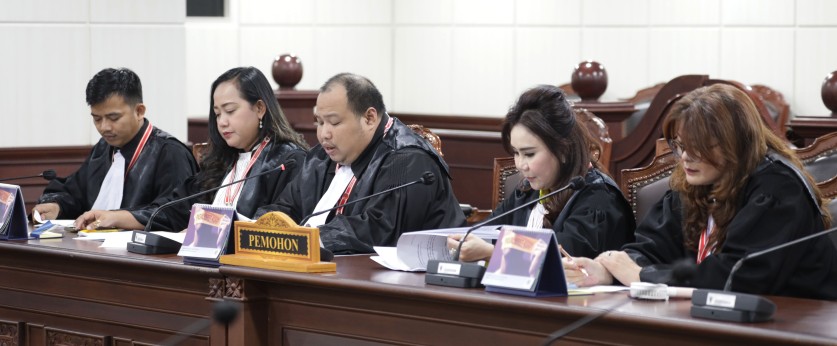
The Petitioner’s legal counsels at the preliminary hearing of the material judicial review of Law No. 8 of 1981 on the Criminal Procedure Code, Wednesday (5/7/2025). Photo by MKRI/Panji.
JAKARTA (MKRI) — Kurniani, a homemaker, has filed a material judicial review petition of Article 160 paragraph (1) letter b of Law No. 8 of 1981 on the Criminal Procedure Code (KUHAP) to the Constitutional Court (MK). The norm reads, “(1) a. Witnesses shall be called into the session room one by one in a succession which is considered best by the judge/chairman of the session after hearing the opinion of the public prosecutor, the defendant or their legal adviser. b. The first to be heard shall be the victim who serves as witness.” The Petitioner believes it to be multi-interpretive and could potentially violate her constitutional rights as a defendant. The preliminary hearing for case No. 50/PUU-XXIII/2025 took place on Wednesday, May 7, 2025 with Constitutional Justice Arief Hidayat as chair.
In the petition, Kurniani stated that Article 160 paragraph (1) letter b of the Criminal Procedure Code, which requires the victim be the first witness, does not guarantee legal certainty if not interpreted strictly. She asks that it be interpreted that the victim’s testimony be mandated in the investigation and trial process.
Legal counsel Ferdian Susanto said that as the disadvantaged party, the Petitioner was never examined in the investigation and trial at the Tangerang District Court. The court presented company employee given authority by the board of directors to make a police report. The Petitioner argued that legally, the board of directors as the organ of the company is authorized to represent the company’s interests. Ironically, the power of attorney in the police report states the grantor of power a homemaker, not a member of the board of directors.
The Petitioner also compared her case to then Coordinating Minister of Maritime Affairs and Investment Luhut Binsar Pandjaitan, who appeared before the court and testify as a victim, despite also being a recognized state official. This shows that the witness testimony of the victim in the trial is an important part of a fair legal process.
“Observing the Petitioner’s case as a defendant in trial at the Tangerang District Court, she questions how her case compares to Luhut Binsar Panjaitan’s defamation case that she saw in news reports, where he, then Coordinating Minister for Maritime Affairs and Investment in Indonesia, reported human rights activists to the Greater Jakarta Metropolitan Regional Police for alleged defamation in September 2021. While being examined in the East Jakarta District Court as the victim, it was clear that Luhut Binsar Panjaitan carried out his obligations to provide testimony as victim, even though then he was a Minister. Ironically, in the Petitioner’s case as defendant, it seems that the victim is not examined in court. This begs a question, who suffered loss? Is it the victim or the reporting witness? Of course it is the victim,” Ferdian said.
He said that the reporting witness had testified that the company he worked at had suffered loss. “So, why has her victim testimony never been presented both during police investigation and in court? The fundamental question is: is the criminal procedure code different? Or can the code be applied in different manners?” he asked.
The Petitioner argued that the multi-interpretive Article 160 paragraph (1) letter b of the Criminal Procedure Code may lead to different treatment against a defendant, which is against the principle of the rule of law as emphasized in Article 1 paragraph (3) of the 1945 Constitution, and the principle of fair legal certainty stipulated under Article 28D paragraph (1) of the 1945 Constitution. The Petitioner also quoted the Constitutional Court Decision No. 65/PUU-VIII/2010, which she believes is relevant to her case, on the importance of equality before the law and thorough substantiation in criminal proceedings.
On that basis, the Petitioner requested that the Court declare Article 160 paragraph (1) letter b of the Criminal Procedure Code unconstitutional and not legally binding if not interpreted as “the victim must be examined at the investigation stage and/or the first-level trial.”
In response, Constitutional Justice Enny Nurbaningsih asked the Petitioner to reconstruct the petition and improve the elaboration of her constitutional impairment. “What are her rights granted by the Law? Explain whether the rights are violated due to the enforcement of the norm. Mention the norm here,” she said.
At the end of the hearing, the justices gave the Petitioner 14 days to revise the petition and submit it by Tuesday, May 20, 2025.
Author : Utami Argawati
Editor : Lulu Anjarsari P.
PR : Raisa Ayuditha Marsaulina
Translator : Yuniar Widiastuti (NL)
Disclaimer: The original version of the news is in Indonesian. In case of any differences between the English and the Indonesian versions, the Indonesian version will prevail.
Wednesday, May 07, 2025 | 16:08 WIB 175