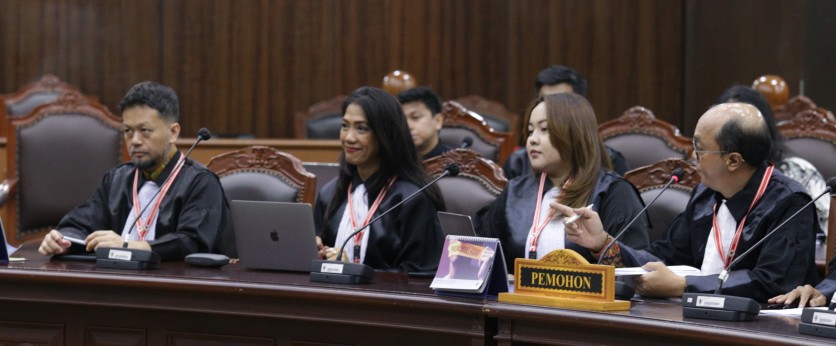
Petitioners’ legal counsel in Case No. 28/PUU-XXIII/2025 during the petition revision hearing on the material judicial review of Law No. 28 of 2014 on Copyright, Wednesday (7/5/2025). Photo by MKRI/Bay.
Jakarta (MKRI) – The Constitutional Court held a petition revision hearing on the judicial review of Law No. 28 of 2014 on Copyright against the 1945 Constitution of the Republic of Indonesia. The hearing is scheduled for Case No. 28/PUU-XXIII/2025 and 37/PUU-XXIII/2025. The Petitioners of Case No. 37/PUU-XXIII/2025 delivered information on the international practice of Collective Management Organizations (CMOs).
“[It is] regarding the certainty of indirect licensing implementation,” legal counsel David Surya stated in a hearing presided over by Deputy Chief Justice Saldi Isra, along with Justice Enny Nurbaningsih and Justice Arsul Sani, on Wednesday, May 7, 2025, at the Courtroom.
The Petitioners explained that the indirect licensing system through CMO is a realistic and efficient copyright management. This practice enables a just and easy mass licensing process between the copyright owners and users, such as radios, cafes, and live performances. CMO acts as a middleman who conducts monitoring, negotiation, licensing, and, at the same time, collects royalties from licensing that are given and distributed to the copyright owners, including the creators.
The Petitioners stated that the Performing Right Society (PRS), which is an organization tasked with collecting and distributing royalties from music used publicly in the United Kingdom, represents the creators to license their music for business, online, broadcasting and film, live performances, and recording purposes. The American Society for Composers, Authors, and Publishers (ASCAP) is a non-profit organization consisting of music writers, composers, and music publishers in the United States of America; ASCAP is tasked with collecting and distributing performing royalties to their members, ensuring that they are paid for the use of their creations (songs/music) publicly.
The Australian Performing Rights Association Limited (APRA) represents songwriters and song creators in Australia, and then merges with the Australian Mechanical Copyright Owners Society Limited (AMCOS) to become APRA AMCOS. The organization represents 124.000 songwriters and song creators, giving organizations to play, display, copy, record, or provide music, and distribute the royalties to its members and international affiliated groups, which later, will pay their members. The Music Author Copyright Protection (MACP) represents songwriters in Malaysia, which licenses rights to the users. BUMASTEMRA represents and licenses the rights of 38.000 writers, creators, and publishers in the Netherlands and Europe, protects their copyrights, and ensures that they are paid justly for the music they created.
Case No. 37/PUU-XXIII/2025 was filed by five performers under the Koes Plus inspired group, T’Koes, and Saatje Sylvia, a creation performer who is nicknamed the first lady rocker. T’Koes Band often performed old songs by Koes Plus, D’Mercys, The Everly Brothers, and The Beatles. However, they were banned from performing Koes Plus’s songs since September 22, 2023, by Koes Plus’ inheritors.
According to them, it proved that the implementation of Article 9 paragraph (2) of the Copyright Law harmed them and created legal uncertainty in obtaining permission. It was despite that, in every show, T’Koes Band had asked for a license and/or paid royalties to the CMO in Indonesia. They also approached and gave the inheritors a nominal amount of money, although it may not be up to their wishes.
The Petitioners revised their petitions by requesting the Court to declare Article 9 paragraph (2) of the Copyright Law contrary to the 1945 Constitution of the Republic of Indonesia and has no legally binding force as long as it is not interpreted as “Every person exercising economic rights as refered to in Article 9 paragraph (1) shall not be prohibited to perform a creation, as long as the obligation to pay for royalties has been made through the Collective Management Organization (CMO)/National Collective Managemen Organization (NCMO).” The Petitioners also requested the Court to declare Article 113 paragraph (2) of the Copyright Law for the phrase “without right and/or permission as refered to in Article 9 paragraph (1) letter f contrary to the 1945 Constitution of the Republic of Indonesia and has no legally binding force as long as it is not interpreted as “that users with ill-intention that do not fulfill their obligations in the fulfillment of economic rights of the creators or Copyright Owners through the Collective Management Organization (CMO)/National Collective Organization (NCMO).”
The Petitioners of Case No. 28/PUU-XXIII/2025, who were represented by their legal counsel, also delivered their revised petition. The case was filed by Tubagus Arman Maulana, better known as Arman Maulana, Nazriel Irmah, or commonly called Ariel NOAH, along with 27 other musicians.
They challenged Article 9 paragraph (3), Article 23 paragraph (5), Article 81, Article 87 paragraph (1), and Article 113 paragraph (2) of Law No. 28 of 2014 on Copyright against the 1945 Constitution. The singers and music creators realised that there were legal issues in the norms tested that created legal uncertainty and potentially harmed their constitutional rights.
Article 9 paragraph (3) reads, “Every person who, without permission from songwriters or copyright owners, is prohibited from duplicating and/or commercially using the creation.” Article 23 paragraph 5 states that, “Every person may commercially use a creation in a performance without asking permission in advance to the creator by paying compensation to the creator through a collective management organization.”
Subsequently, Article 81 reads, “Unless otherwise agreed, Copyright owners or owners of Related Rights may self-execute or grant licenses to third parties to carry out the acts referred to in Article 9 paragraph (1), Article 23 paragraph (2), Article 24 paragraph (2), and Article 25 paragraph (21). Article 87 paragraph (1) reads, “To acquire economic rights, every creator, copyright owners, owners of related rights, becomes a member of the Collective Management Organization so that they can collect reasonable remuneration from users who utilize copyright and related rights in the form of commercial public services.” Article 113 paragraph (2) reads, “Every person who has no right and/or without the permission of the creator or copyright owners violates the economic right of creator as referred to in Article 9 paragraph (1) letter c, letter d, letter f, and/or letter h to use it commercially is subject to criminal offense with maximum penalty of 3 (three) years of imprisonment and/or fine of Rp500.000.000 (five hundred million rupiah).”
The Petitioners, as performers who work in the Indonesian music industry, risk the potential to be involved in legal issues, as experienced by Agnezmo, The Groove, Sammy Simorangkir, and Once Mekel, who must ask for permission directly and pay royalties not based on the prevailing provisions. It becomes a legal issues in the use of creation, considering that the provisions of Article 9 paragraph (3), Article 23 paragraph (5), Article 81, Article 87 paragraph (1), and Article 113 paragraph (2) of the Copyright Law are often used by other parties by their interpretation so that it creates uncertainty in its practice.
The Petitioners explain, as other economic rights, the use of creation by parties other than the creator, for the performing rights, the creator is entitled to receive reasonable compensation in the form of royalties, despite the performance may be done without prior permission to the creator as stipulated in Article 23 paragraph (5) of the Copyright Law. The user must pay the royalties through a collective management organization (Lembaga Manajemen Kolektif – LMK).
Consistent with the provision, royalties for performing rights are paid through the LMK mechanism. Article 87 of the Copyright Law further specifically regulates that the creator may receive economic rights in the form of compensation for performing rights if the user uses the creation for commercial purposes. Then the management of royalty collection and distribution collectively through the National Collective Management Agency (LMKN) basically operates with a mechanism where the user of a creation pays royalties to the creator through the LMKN, which will then forward it to the LMK to be distributed to creators who are members of the LMK. Royalty collection on performing rights has become a common practice that event organizers are responsible for, as users are required to pay royalties for performances at entertainment venues, concerts, radio, television stations, restaurants, and/or cafes.
The consequence of membership in the LMK is the transfer of authority to manage economic rights to the LMK attached to the agency. Therefore, in any legal action related to the management, as well as the enforcement of economic rights to copyrighted works, the creator is permitted to use their creation in a performance at the time the creator becomes a member of the LMK.
Author: Mimi Kartika
Editor: Lulu Anjarsari P.
PR: Raisa Ayuditha
Translator: Rizky Kurnia Chaesario
Disclaimer: The original version of the news is in Indonesian. In case of any differences between the English and the Indonesian versions, the Indonesian version will prevail.
Wednesday, May 07, 2025 | 17:17 WIB 636