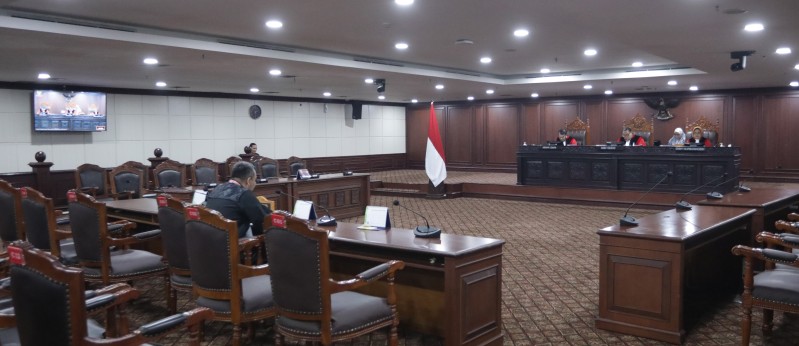
Holding the preliminary hearing of the judicial review of the Constitutional Court Law, Tuesday (5/6/2025), to examine the Petitioner’s petition. Photo by MKRI/Ilham WM.
JAKARTA (MKRI) — On Tuesday, May 6, 2025, the Constitutional Court held the preliminary hearing of the judicial review case No. 46/PUU-XXIII/2025 of Law No. 24 of 2003 on the Constitutional Court (the Constitutional Court Law) against the 1945 Constitution. The Petitioner, Rega Felix, is a constitutional law lecturer, who challenges the constitutionality of Article 10 paragraph (1) letter a of the Constitutional Court Law, which reads, “The Constitutional Court shall have the authority to adjudicate at the first and final instance, the decisions of which shall be final, to: a. conduct judicial review of laws against the 1945 Constitution of the Republic of Indonesia.”
In the hearing, Rega explained that the rapid developments in state governance have given rise to constitutional challenges that might lead to emergency situations requiring actions beyond what is regulated by the Constitution. “When submitting judicial review petitions to the Court, I often refer to human rights, especially those stated in Article 28I paragraph (1) of the 1945 Constitution, such as the right to religious freedom, freedom of thought, and other rights,” he said.
He then questioned whether such extra-constitutional acts, should they violate his fundamental rights, could be reviewed by the Court. “The main question is whether the Court has the authority to examine legal instruments that are not formally laws but are similar in substance. For example, the use of government regulations instead of laws (perppu) is becoming more common, even though the Constitution only states that laws can be reviewed. However, the Court has interpreted that perppu can also be subject to review,” he added.
In his petition, Rega also raised concerns about possible unwritten pressure or indirect intimidation due to his criticism of those in power. He also warned about the risk of the government misusing emergency situations to take extra-constitutional steps, such as returning the 1945 Constitution to its original version, which could weaken the protection of human rights. He asked the Court to interpret Article 10 paragraph (1) letter a of the Constitutional Court Law in a broader and more forward-looking way, so that it could be used to prevent potential human rights violations. According to him, this interpretation is important to ensure that citizens' rights, especially in sensitive matters like religion, remain protected amid social and political uncertainty. He noted that this idea is not new, as the Court has previously shown a progressive attitude by reviewing perppu. With increasingly complex challenges, he believes the Court should continue to serve as the guardian of the Constitution and defender of human rights.
Based on these arguments, the Petitioner requested that the Court declare Article 10 paragraph (1) letter a of Law No. 24 of 2003 on the Constitutional Court conditionally unconstitutional insofar as it is not interpreted as “the authority to review laws or quasi-laws against the 1945 Constitution of the Republic of Indonesia.”
In response, Constitutional Justice Enny Nurbaningsih asked Rega to elaborate on the harm he suffered. “The Court has reviewed perppu. Now, you mention extra-constitutional measures—what are the actual legal products in question? If you’re referring to perppu, those have been reviewed by the Court,” Enny said.
At the end of the hearing, the panel granted the Petitioner time to revise the petition. The revision must be submitted no later than Monday, May 19, 2025.
Author: Utami Argawati
Editor: N. Rosi
PR: Andhini S.F.
Translator: Yuanna Sisilia
Disclaimer: The original version of this news article is in Indonesian. In case of any differences between the English and Indonesian versions, the Indonesian version shall prevail.
Tuesday, May 06, 2025 | 16:24 WIB 211