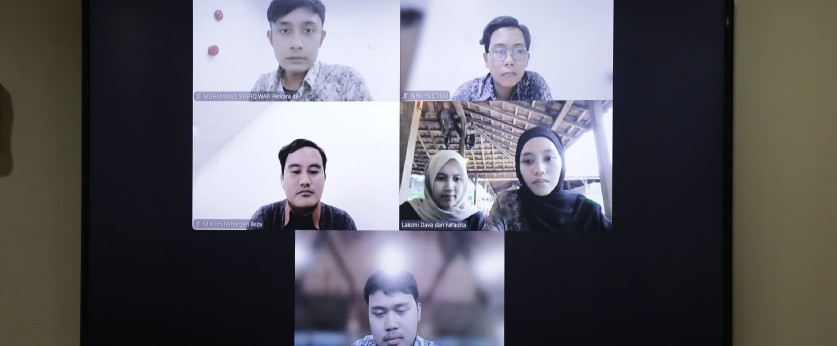
The Petitioners of the material judicial review of Law No. 13 of 2022 on Lawmaking conveying the petition at the preliminary hearing, Tuesday (5/6/2025). Photo by MKRI/Panji.
JAKARTA (MKRI) — Muhammad Syafiq Wafi, M. Hilmi Miftahzen Reza, Abdullah Widy Asshidiq, Laksmi Dava Diandra Kirana, Faradita Raihani, and Rifki Yustisio (Petitioners I-VI) have filed a material judicial review petition of Article 96 paragraph (8) of Law No. 13 of 2022 on the Second Amendment to Law No. 12 of 2011 Lawmaking to the Constitutional Court (MK). The preliminary hearing for case No. 48/PUU-XXIII/2025 took place on Tuesday, April 6, 2025 and was presided over by Deputy Chief Justice Saldi Isra (panel chair) and Constitutional Justices Ridwan Mansyur and Asrul Sani.
Article 96 paragraph (8) of the Lawmaking Law reads, “The Drafters of Legislation may explain to the public the results of the discussion of public input as referred to in paragraph (1).”
At the hearing, Muhammad Syafiq Wafi explained that the word “may” in the norm refers to an option, thus not reflecting legal certainty and justice relating to the mechanism of explanation to the public of the results of the discussion over public inputs on a bill of law. This ambiguity, the Petitioners asserted, has led to legal uncertainty that threatens the rights of citizens, especially on the mechanism of public participation in lawmaking.
Therefore, the Petitioners request that the word “may” be replaced by “shall” in order to signify legal certainty in expressing responses requested by the public as referred to in Article 96 paragraph (1) of Law No. 13 of 2022 on Lawmaking.
For that reason, they ask that the Court declare Article 96 paragraph (8) of Law No. 13 of 2022 unconstitutional and not legally binding if not interpreted as “The Drafters of Legislation shall explain to the public the results of the discussion of public input as referred to in paragraph (1).”
Factual and Potential Losses
Justice Ridwan asked about the Petitioners’ past activities relating to providing public inputs in lawmaking. “For example, joining focus group discussions or [providing inputs through] Simas PUU page, not only being passive. The current explanation has not shown the factual and potential losses, so the losses due to the article being petitioned have not been evident,” he said.
Meanwhile, Deputy Chief Justice Saldi Isra stated that the norm has been petitioned before, so the Petitioners need to ensure that they meet the requirements under Article 60 of the Constitutional Court Law and Article 78 of Constitutional Court Regulation (PMK) No. 2 of 2021. “Explain to the Court that while the article has been reviewed, the Petitioners have something different from the previous petition. If this is not met, you cannot re-file the petition. Refer to previous petitions. There is an obligation to explain the fulfilment of those articles so that the petition would not be ne bis in idem,” the deputy chief justice explained to the Petitioners, who attended the hearing remotely.
At the end of the hearing, Deputy Chief Justice Saldi Isra stated that the Petitioners would have until Tuesday, May 20, 2025 to revise the petition. The revised petition must be submitted to the Registrar’s Office for the next hearing to be scheduled.
Author : Sri Pujianti
Editor : N. Rosi.
PR : Raisa Ayuditha Marsaulina
Translator : Yuniar Widiastuti (NL)
Disclaimer: The original version of the news is in Indonesian. In case of any differences between the English and the Indonesian versions, the Indonesian version will prevail.
Tuesday, May 06, 2025 | 16:26 WIB 236