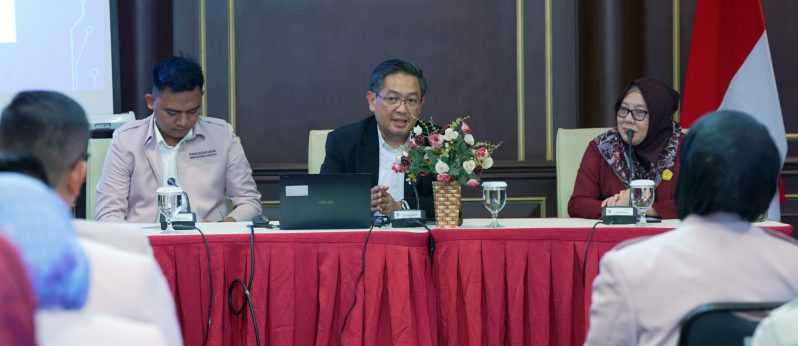
The Postgraduate Program of the Faculty of Law, Sang Bumi Ruwa Jurai (Saburai) University, Lampung, conducted an academic visit to the Constitutional Court (MK), where they were welcomed by Junior Expert Legal Analyst Rio Tri Juli Putranto. Photo by MKRI/Fauzan
JAKARTA, MKRI Public Relations – The Postgraduate Program of the Faculty of Law, Sang Bumi Ruwa Jurai (Saburai) University, Lampung, conducted an academic visit to the Constitutional Court (MK) on Monday (5/5/2025) at the MK Delegation Room, Building 1. During the visit, students received a presentation from Junior Expert Legal Analyst Rio Tri Juli Putranto, who explained the strategic role of the Constitutional Court within Indonesia's state governance system.
In his presentation, Rio emphasized that the Constitutional Court was established in response to the need for an independent judicial system authorized to resolve constitutional issues in the post-reform era.
“Before the reform, judicial power was solely held by the Supreme Court (MA). Throughout the governance process, there were many problematic legislative processes. At that time, even a president could be impeached solely for political reasons. There was no clear forum for resolving election result disputes,” explained Rio.
Rio elaborated that the Constitutional Court’s authority, as regulated in the 1945 Constitution, includes five main areas: reviewing laws against the 1945 Constitution, settling disputes over the authority of state institutions granted by the 1945 Constitution, deciding on the dissolution of political parties, resolving disputes regarding the results of general elections, and adjudicating alleged violations by the President and/or Vice President.
Furthermore, Rio detailed that judicial review at the Constitutional Court is divided into two types: formal review and material review. Formal review involves assessing whether the process of forming a law or Government Regulation in Lieu of Law (Perppu) complies with the provisions stipulated in the 1945 Constitution (Article 2 paragraph (3) of Constitutional Court Regulation No. 2 of 2021). Material review pertains to the substance or content of articles, clauses, and/or parts of a law or Perppu considered to be in conflict with the 1945 Constitution (Article 2 paragraph (4) of Constitutional Court Regulation No. 2 of 2021).
Regarding formal reviews, the Constitutional Court has a strict time limit. “Based on Constitutional Court Decision No. 25/PUU-XX/2022, the Court must resolve formal reviews of laws quickly (speedy trial), no later than 60 working days from the time the President and/or the House of Representatives (DPR) provide their statements in a plenary session,” Rio explained.
As a constitutional judicial body, the Constitutional Court serves as the court of first and final instance. Its decisions are final and binding, meaning all parties are obliged to comply with and implement them.
“A Constitutional Court decision becomes legally binding immediately after being pronounced in a public plenary session. Constitutional Court rulings are erga omnes, meaning they apply universally. Any norm annulled by the Court no longer holds binding legal force,” Rio concluded.
Author : Utami Argawati
Editor : Lulu Anjarsari P.
Translator : Agusweka Poltak Siregar (NL)
Disclaimer: The original version of the news is in Indonesian. In case of any differences between the English and the Indonesian versions, the Indonesian version will prevail.
Monday, May 05, 2025 | 15:38 WIB 325