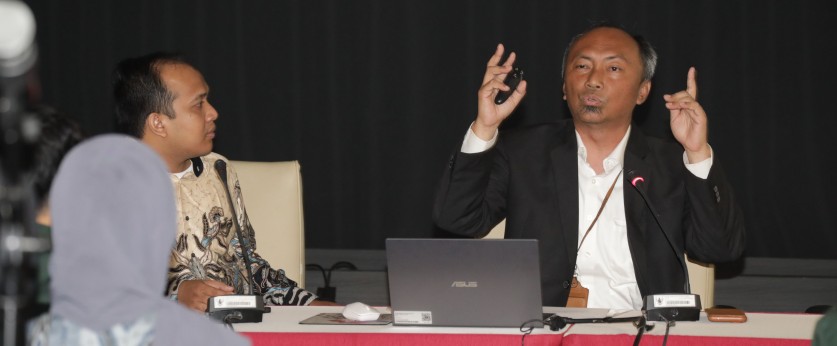
Constitutional Court Legal Analyst Welcomes Visit from UIN KH. Abdurrahman Wahid Pekalongan Faculty of Sharia on Tuesday (5/29/2025). Photo by MKRI/Panji
JAKARTA, MKRI– The Constitutional Law Study Program of the Faculty of Law, UIN KH. Abdurrahman Wahid Pekalongan conducted a Field Legal Studies Program (KHL) at the Constitutional Court (MK) on Tuesday (29/04/2025). This activity aimed to provide students with firsthand exposure to the role of the Constitutional Court in Indonesia's constitutional system. The students were welcomed by MK Legal Analyst Syamsudin Noer at the Center for Constitutional History (Puskon), Building 1 of the Court.
The Center for Constitutional History is an educational facility that documents the historical journey of Indonesia’s state system and the Constitutional Court’s dynamics, integrating information, art, and technology.
In his presentation, Syams—as he is commonly called—emphasized that such visits are important not just for understanding theory, but also for observing real practices in defending constitutional rights.
“This visit isn’t just about field study. You, as students, can also submit judicial review petitions to the Court. There have been cases filed by students that were granted by the Court,” Syams said.
He cited examples of student-initiated cases, such as Case No. 69/PUU-XXII/2024 and Case No. 70/PUU-XXII/2024 regarding the judicial review of the Regional Elections Law. He explained the fundamental difference between formal review and material review at the Court.
“For formal review, the petition must be submitted no later than 45 days after the law is enacted. But for material review, there is no time limit,” he clarified. He also reminded students that judicial review targets legal norms within the law, not its implementation.
Syams also discussed the significant changes to Article 24 of the 1945 Constitution after its amendments, which strengthened judicial independence and reaffirmed the Constitutional Court as a judicial authority.
“Legal standing to submit a petition is widely open—from individual citizens to state institutions—according to Article 51 of the Constitutional Court Law,” he added.
He continued by explaining the principle of judicial power under Article 24 of the 1945 Constitution, post-amendment: judicial power is an independent authority to administer justice to uphold law and justice. This authority is exercised by the Supreme Court, the Constitutional Court, and courts under their jurisdiction.
The students were also introduced to the concept of legal standing in constitutional review. Under Article 51 paragraph (1) of the Constitutional Court Law, petitioners must demonstrate that their constitutional rights or authority have been harmed by the enforcement of a particular law.
“You can file a judicial review on your own without needing a legal representative,” Syams explained, encouraging students to exercise their constitutional rights.
In addition, Syamsudin motivated students to prepare themselves to become future constitutional justices. He described the qualifications required, including being an Indonesian citizen, holding a doctoral degree with a law background, having at least 15 years of legal experience, and being at least 55 years old.
“If you aspire to be a constitutional justice—a true statesperson—start preparing now, because it’s an honorable position with great responsibility to the nation,” he emphasized.
The event concluded with a call for students to go beyond classroom knowledge and actively engage in safeguarding and strengthening Indonesia’s constitutional democracy.
“Law students must be ready to become agents of change—not just spectators in the nation's constitutional development,” Syams concluded.
Author : Fauzan Febriyan
Editor : Lulu Anjarsari P.
Translator : Agusweka Poltak Siregar (NL)
Disclaimer: The original version of the news is in Indonesian. In case of any differences between the English and the Indonesian versions, the Indonesian version will prevail.
Tuesday, April 29, 2025 | 14:56 WIB 345