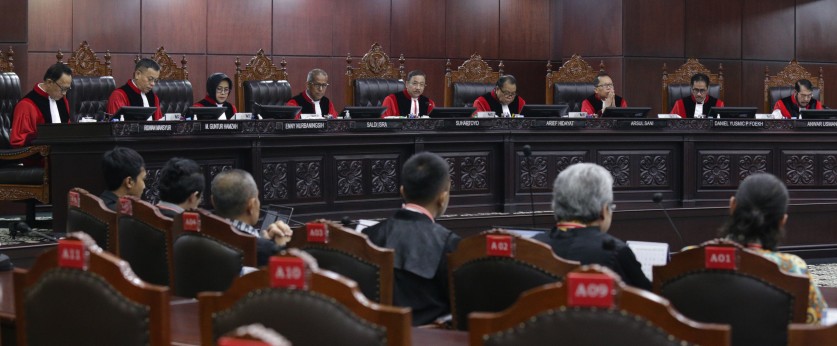
The Decision Pronouncement Hearing No. 187/PUU-XXII/2024 presided over by Chief Justice Suhartoyo, Tuesday (29/4/2025). Photo by MKRI/Bayu
Jakarta (MKRI) – The Constitutional Court declared the judicial review petition on Law No. 1 of 2024 on the Second Amendment to Law No. 11 of 2008 on the Electronic Information and Transaction (ITE Law) lost its object. The material judicial review of Article 28 paragraph (2) and Article 45A paragraph (2) of the ITE Law was filed by eleven law students of Universitas Andalas.
The Decision Pronouncement Hearing No. 187/PUU-XXII/2024 was presided over by Chief Justice Suhartoyo on Tuesday, April 29, 2025, at the Plenary Courtroom. In the ruling, the Court declared the petition could not be accepted.
“Ruling, to adjudicate: to declare that the Petitioner’s petition cannot be accepted,” Chief Justice Suhartoyo stated.
Delivering the legal consideration, Justice Ridwan Mansyur stated that the norm of Article 28 paragraph (2) jo Article 45A paragraph (2) of the ITE Law had been decided by the Court through Decision No. 105/PUU-XXII/2025 previously pronounced during an open to the public plenary hearing on April 29, 2025. In Decision No. 105/PUU-XXII/2024, the Court partly granted the Petitioner’s petition by declaring that the phrase “distributing and/or transmitting electronic information and/or electronic documents that are inciting, inviting, or influencing others to create a sense of hatred or hostility towards certain individuals and/or community groups” in the norm of Article 28 paragraph (2) and Article 45A paragraph (2) of the ITE Law contradicted the 1945 Constitution and had no legally binding power as long as it was not interpreted as “only Electronic Information and/or Electronic Documents that substantively contain acts/dissemination of hatred based on certain identities that are carried out intentionally and in public, which creates a real risk of discrimination, hostility, or violence.”
“Thus, the provision of the norms of Article 28 paragraph (2) jo Article 45A paragraph (2) of Law No. 1 of 2024 has changed because normatively, [the norms] that are enacted and have legally binding power are those that have been declared in the Constitutional Court Decision No. 105/PUU-XXII/2024 and the provisions of the norm a quo are no longer as what the Petitioners’ stated in the petition. Hence, the petitioners’ petition must be declared to have lost its object,” Judice Ridwan explained.
Also read:
Article on Spreading Hatred to Certain Communities in the ITE Law Considered Multi-interpretive
UNAND Students Improve Petitums to Challenge the Article on Spreading Hate Speech in ITE Law
The Petitioners are Muhammad Zhafran Hibrizi, Basthotan Milka Gumilang, Adria Fathan Mahmuda, Suci Rizka Fadhilla, Nia Rahma Dini, Qurratul Hilma, Fadhilla Rahmadiani Fasya, Adam Fadillah Al Basith, Hafiz Haromain Simbolon, Khoilullah MR, and Tiara. The Petitioners argued that the phrase "certain communities" in the article allows for different interpretations than they should. So that the misinterpretation can harm anyone who will criticize a social community, which is not affiliated in the name of race, nationality, ethnicity, skin color, religion, belief, gender, mental disability, or physical disability. The phrase tends to be misused by various social groups that are not affiliated with these things, and is interpreted as a certain community group only. At least it has happened in several cases of criminalization for criticism of organizations or community groups.
Also read: Decision No. 187/PUU-XXII/2024 in Indonesian Language
Author : Sri Pujianti
Editor : N. Rosi
PR : Fauzan F
Translator : Rizky Kurnia Chaesario
Disclaimer: The original version of the news is in Indonesian. In case of any differences between the English and the Indonesian versions, the Indonesian version will prevail.
Tuesday, April 29, 2025 | 15:38 WIB 218