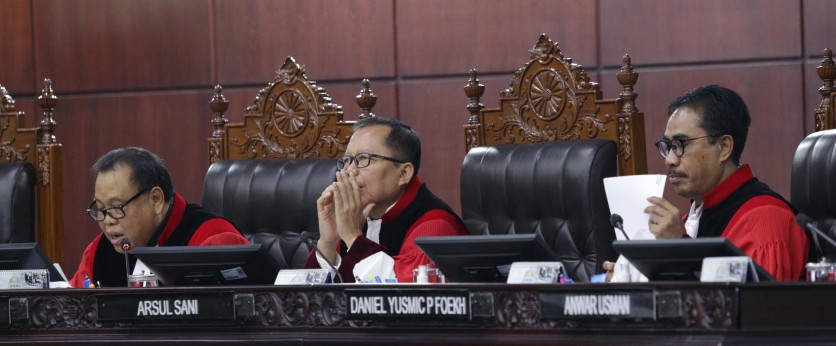
Constitutional Justice Arsul Sani reading out legal considerations in the ruling hearing for Decision Number 115/PUU-XXII/2024, Tuesday (4/29/2025). Photo by MKRI/Bay
JAKARTA (MKRI) — Regulations on the act of spreading fake news using information technology facilities that cause unrest in society, as regulated in the norm of Article 28 paragraph (3) of Law Number 1 of 2024 on the Second Amendment to Law Number 11 of 2008 on Information and Electronic Transactions (EIT Law) have apparently created legal uncertainty when linked to the Explanation of Article 28 paragraph (3) of the EIT Law which states that what is meant by "unrest" is a condition that disrupts public order in physical space, not conditions in digital/cyber space.
"This means that the Elucidation of Article 28 paragraph (3) of Law Number 1 of 2024 has provided a clear limitation that the dissemination of false information that causes unrest that occurs physically in society, does not include disturbances/unrest that occur in digital/cyber space," said Constitutional Justice Arsul Sani reading out the legal considerations in the hearing for Ruling Decision Number 115/PUU-XXII/2024 chaired by Chief Justice of the Constitutional Court Suhartoyo on Tuesday, April 29, 2025.
The Petiton for judicial review of the EIT Law was filed by Jovi Andrea Bachtiar. Furthermore, the Court in its legal considerations stated that the limitation was also in line with the Constitutional Court Decision Number 78/PUU-XXI/2023, so that law enforcement officers can only carry out legal proceedings against the spread of fake news that causes physical disturbances/unrest that occur in the community. This is intended so that the implementation of Article 28 paragraph (3) of the EIT Law, which is a material offense, places more emphasis on the consequences of actions or unrest carried out by perpetrators of criminal acts that have fulfilled the principles of lex scripta, lex certa, and lex stricta.
"Based on the above description, the norms of Article 28 paragraph (3) of Law Number 1 of 2024 and Article 45A paragraph (3) of the EIT Law have been proven not to provide legal certainty, guarantees of freedom of expression or opinion, and obtaining information to develop oneself and one's environment, as regulated in Article 28D paragraph (1), Article 28E paragraph (3), and Article 28F of the 1945 Constitution of the Republic of Indonesia as argued by the Petitioner. However, because the Court's interpretation is not as requested by the Petitioner, the Applicant's argument throughout the norms of Article 28 paragraph (3) of Law 302 1/2024 and Article 45A paragraph (3) of Law 1/2024 is legally justified in part," said Constitutional Justice Arsul in the hearing held in the Plenary Courtroom of the Constitutional Court (MK).
Meanwhile, regarding the constitutionality of Article 45A paragraph (3) of the EIT Law which is also being requested for review by the Petitioner, then with the interpretation of the norm of Article 28 paragraph (3) of the EIT Law as a primary norm, the legal consequence is that Article 45A paragraph (3) of the EIT Law must be adjusted to the interpretation of the norm of Article 28 paragraph (3) of the EIT Law. Thus, the Petitioner's argument regarding the constitutionality of the norm of Article 310 paragraph (3) of the Criminal Code, Article 45 paragraph (7), and Article 45 paragraph (7) letter a of Law Number 1 of 2024 is legally groundless.
"Granting the Petitioner's petition in part. Declaring the word "unrest" in Article 28 paragraph (3) and Article 45A paragraph (3) of Law Number 1 of 2024 on the Second Amendment to Law Number 11 of 2008 on Electronic Information and Transactions is contrary to the 1945 Constitution of the Republic of Indonesia and does not have legally binding force conditionally as long as it is not interpreted as "unrest is conditions that disrupt public order in physical space, not conditions in digital/cyber space," said Chief Justice Suhartoyo reading out the verdict in this case.
Also read:
House, President Ask for Delay of EIT Law Hearing
Govt: Restrictions in EIT Law for Balance of Freedom of Speech
Expert: Failure to Understand Changes Led to Potential Misuse of EIT Law
Expert Explains Constitutionalism of Digital Justice
EIT Law Prevents Dehumanization and Protects Minorities from Discrimination
Read more in Decision Number 115/PUU-XXII/2024
Author : Sri Pujianti
Editor : N. Rosi
PR : Fauzan F.
Translator : Donny Yuniarto
Disclaimer: The original version of the news is in Indonesian. In case of any differences between the English and the Indonesian versions, the Indonesian version will prevail.
Tuesday, April 29, 2025 | 14:09 WIB 228