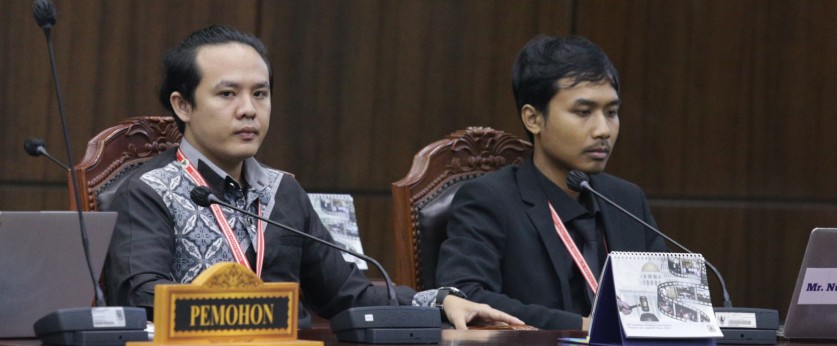
Petitioner of Case No. 3/PUU-XXIII/2025 attending the Decision Pronouncemen Hearing, Tuesday (29/4/2025). Photo by MKRI/Bay
Jakarta (MKRI) – The Constitutional Court decided to reject the Petition on material judicial review of Article 30 paragraphs (1) and (2) of Law No. 30 of 2002 on the Corruption Eradication Commission (KPK Law) on Tuesday, April 29, 2025, at the Plenary Courtroom. The Petition was filed by a legal counsel, Syukur Destieli Gulo. In his petition, Syukur Gulo highlighted the process of selection, proposing, and election of KPK Leadership for 2024-2029, which he deemed contradictory to the principle of the rule of law. According to him, the state apparatus must adhere to the regulations, including in the selection of the anti-graft institution leadership.
“In the subject matter, reject the petition in its entirety,” Chief Justice Suhartoyo stated during the pronouncement of Decision No. 3/PUU-XXIII/2025.
Delivering the legal consideration, Justice Daniel Yusmic P. Foekh stated that the Court needed to cite the legal consideration mentioned in Decision No. 160/PUU-XXII/2024 which decided on the similar case, related to the legality of the KPK leadership for 2024-2029 as a result of selection and proposing process by the President of 2019-2024 (Joko Widodo) which then elected by the House of Representative (DPR) of 2024-2029.
Without intending to judge the selection and election process of the KPK leadership candidates for 2024-2029, according to the Court, the implementation of norms of Article 30 paragraph (1) and paragraph (2) of the KPK Law, which is conducted during the transitional periods of government by involving two Presidents and DPR from two periods aligned with the Constitutional Court Decision No. 112/PUU-XX/2022.
In the decision, the Court did not determine that the President or the House of Representatives must carry out the selection and election process of KPK leadership candidates within the same period as understood and desired by the Petitioner. However, the Court focused more on the system of recruitment of KPK leaders with a 4 (four) year term scheme based on Article 34 of the KPK Law which causes or at least has the potential to be assessed by the President or DPR twice within the same term period and this has the potential to erode the independence of the KPK.
Therefore, the Court is of the opinion that the assessment of 2 (two) times by the President and the DPR in the same period through the selection process of KPK leadership candidates for the next period should be avoided and this is the fundamental reason for the Court to change the term of office of the KPK leadership to 5 (five) years from the original 4 (four) years. Thus, the Petitioner's concern that the selection of KPK leaders should be carried out by the President and the DPR, which has a different period from the previous KPK leadership period, is actually the same as the spirit of the norms in Article 34 of the KPK Law and the Court's decisions regarding the constitutionality of these norms. Therefore, according to the Court, there is no need for further clarification/interpretation regarding the phrase “House of Representatives” and the word “President” in Article 30 paragraph (1) and the word “Government” in Article 30 paragraph (2) of Law No. 30 of 2002, as requested by the Petitioner.
“Based on the legal considerations above, the Petitioner's argument regarding the unconstitutionality of the phrase ‘House of Representatives’ and the word ‘President’ in Article 30 paragraph (1) and the word 'Government in Article 30 paragraph (2) of Law No. 30 of 2002 is unreasonable according to the law,” Justice Daniel said.
Also read:
Legal Consultant Deemed Selection Process of KPK Leadership 2024-2029 Illegitimate
President and House for 2019-2024 Deemed Negligent to Anticipate KPK Leaders Vacancy
During the preliminary hearing on Wednesday, March 5, 2025, the Petitioner highlighted the selection process; proposing and selecting KPK Leadership for 2024-2029 was considered to contradict the principle of the rule of law. He stated that if the selection or recruitment of the KPK Leadership were made by the previous president (2019-2024), the KPK leadership independence for the period of 2024-2029 would potentially be disturbed.
According to Syukur, ideally, the selection and proposal of KPK leadership candidates was made by the President, who has the same tenure period as the House of Representatives (DPR). Otherwise, the selection of the KPK leadership must be made by the DPR, which has the same tenure period as the President. However, in reality, the recruitment and proposal process of the KPK leadership for 2024-2029 was made by the President of 2019-2024, while the Commission III of the DPR for 2024-2029 made the selection on November 21, 2024.
Hence, he requested the Court to emphasize the meaning of the phrases “House of Representatives”, “President”, and “Government”, in Article 30 paragraph (1) and (2) of the KPK Law so that it would be in line with the Constitutional Court Decision No. 112/PUU-XX/2022.
Author: Utami Argawati.
Editor: N. Rosi.
PR: Andhini SF.
Translator: Rizky Kurnia Chaesario
Disclaimer: The original version of the news is in Indonesian. In case of any differences between the English and the Indonesian versions, the Indonesian version will prevail.
Tuesday, April 29, 2025 | 16:14 WIB 315