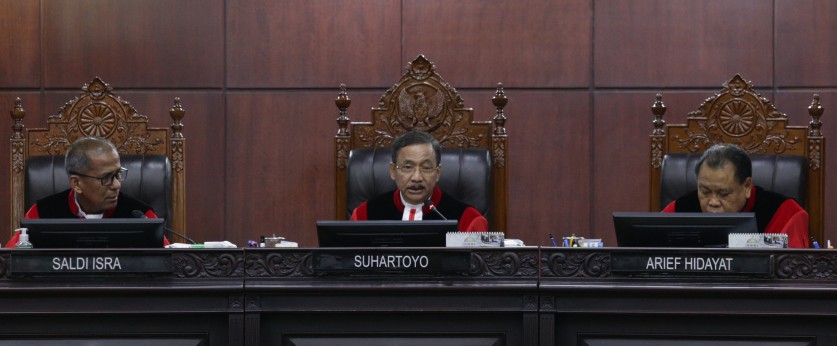
Chief Justice Suhartoyo during the pronouncement of Decision Number 6/PUU-XXIII/2025, Tuesday (29/4/2025). Photo by MKRI/Bayu
JAKARTA, MKRI – The Constitutional Court (MK) declared it could not accept a judicial review petition against Law Number 6 of 2023 on the Enactment of Government Regulation in Lieu of Law Number 2 on Job Creation into Law. The ruling for Case Number 6/PUU-XXIII/2025 was delivered on Tuesday (29/4/2025) in the Plenary Courtroom of the Constitutional Court.
The petition was filed by Putra Arista Pratama, a graduate of Electrical Engineering from Muhammadiyah University Jakarta. The Petitioner claimed to have been harmed by the educational qualification requirements set in the regulation for halal auditors.
In the legal considerations read by Deputy Chief Justice Saldi Isra, the Court stated that the Petitioner failed to provide any argumentation regarding the conflict between the articles being challenged and the constitutional provisions used as the basis for the review. The Court found the petition unclear or obscure (obscuur) and thus did not consider the Petitioner’s legal standing or the principal matters of the case due to irrelevance.
As a result, the Court ruled that the petition could not be accepted. “The verdict: Declares that the Petitioner’s request is inadmissible,” emphasized Chief Justice Suhartoyo.
Read also:
Electrical Engineering Graduate Challenges Educational Requirements for Halal Auditors
Halal Auditor Education Requirements Disadvantage Electrical Engineering Graduates
Previously, an individual named Putra Arista Pratama filed a judicial review petition against Law Number 6 of 2023 in conjunction with Article 14 Paragraph (2) Point c of Law Number 33 of 2014 on Halal Product Assurance (Halal Product Assurance Law) to the Constitutional Court. The Petitioner challenged the educational qualifications required to become a halal auditor.
The Petitioner, a graduate with a Bachelor’s degree in Electrical Engineering, argued that Article 48 Point 9 of Law 6/2023 in conjunction with Article 14 Paragraph (2) Point c of the Halal Product Assurance Law caused constitutional harm. The provision requires that halal auditors have an educational background in specific fields, such as food, chemistry, biochemistry, industrial engineering, biology, or pharmacy. As such, a graduate in Electrical Engineering like the Petitioner does not meet the requirements, despite possessing relevant technical expertise.
During the preliminary hearing held on Wednesday (5/3/2025), the Petitioner, appearing online, stated that the constitutional harm involved was the obstruction of the right to obtain proper employment as guaranteed by Article 27 Paragraph (2) of the 1945 Constitution, due to the limitation imposed by the educational qualifications. “Equality before the law, as guaranteed under Article 27 Paragraph (1) of the 1945 Constitution, is not fulfilled because a degree in Electrical Engineering, which is academically equal to Industrial Engineering, is treated differently,” he explained.
The Petitioner also highlighted the inconsistency between regulations for halal auditors and halal supervisors. Article 28 of the Halal Product Assurance Law does not require the same specific educational background for halal supervisors, who serve as internal auditors within business entities. This difference, the Petitioner argued, creates an imbalance in the implementation of halal standards in Indonesia.
“Halal auditors, who function as external auditors in Halal Inspection Agencies (LPH), must collaborate with halal supervisors during the assessment process. However, the overly specific educational qualifications for halal auditors disregard the fact that halal supervisors often perform more technical and production-related roles. This inconsistency undermines the equitable enforcement of halal standards,” Putra said.
Therefore, in the petition’s petitum, the Petitioner requested the Court to declare Article 48 Point 9 of Law 6/2023 in conjunction with Article 14 Paragraph (2) Point c of the Halal Product Assurance Law to be unconstitutional and non-binding. He also requested that the Court amend the wording of Article 14 Paragraph (2) Point c to read: “hold at minimum a bachelor’s degree (S1)” without limiting the field of study.
Read more: Decision Number 6/PUU-XXIII/2025
Author : Utami Argawati
Editor : N. Rosi.
PR : Tiara Agustina
Translator : Agusweka Poltak Siregar (NL)
Disclaimer: The original version of the news is in Indonesian. In case of any differences between the English and the Indonesian versions, the Indonesian version will prevail.
Tuesday, April 29, 2025 | 11:55 WIB 942