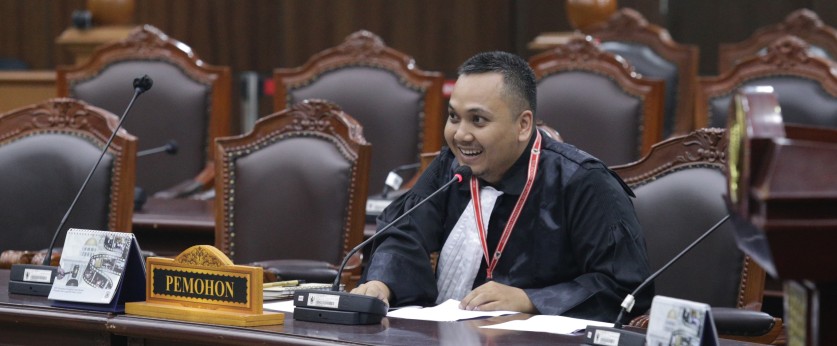
Rega Felix who works as a lecturer, filing a petition to review Article 3H paragraph (2), Article 3X paragraph (1), Article 4B, Article 9G, and Article 87 paragraph (5) of Law Number 1 of 2025 on State-Owned Enterprises (BUMN Law), Monday (4/28/2025). Photo by MKRI/Bay
JAKARTA (MKRI) – Rega Felix, a lecturer, has filed a petition to review Article 3H paragraph (2), Article 3X paragraph (1), Article 4B, Article 9G, and Article 87 paragraph (5) of Law Number 1 of 2025 on State-Owned Enterprises (BUMN Law) against the 1945 Constitution of the Republic of Indonesia (UUD NRI) to the Constitutional Court (MK). The Petitioner questions the existence of norms that separate losses of the Daya Anagata Nusantara Investment Management Agency (Danantara) and BUMN losses as state losses, which actually contradicts the spirit of eradicating corruption which is a constitutional mandate.
"How is it possible that an agency that receives direct delegation of authority from the president is not considered a state administrator, based on these reasons, Article 3X paragraph (1), Article 9G, and Article 87 paragraph (5) of the BUMN Law should be declared to be in conflict with the 1945 Constitution because it is contrary to the spirit of eradicating corruption and is not in accordance with the principles of state administration," said Rega Felix in the preliminary hearing of Case Number 38/PUU-XXIII/2025 on Monday, April 28, 2025 in the Constitutional Court Courtroom, Jakarta.
The norms reviewed by the Petitioner include, Article 3H paragraph (2) of the BUMN Law: “Profits or losses experienced by the Agency in carrying out investments as referred to in paragraph (1) are profits or losses of the Agency”; Article 3X paragraph (1) of the BUMN Law: “The Agency’s organs and employees are not state administrators”; Article 4B of the BUMN Law: “Profits or losses experienced by BUMN are profits or losses of BUMN”; Article 9G of the BUMN Law: “Members of the Board of Directors, Board of Commissioners, and Supervisory Board of BUMN are not state administrators”; and Article 87 paragraph (5) of the BUMN Law: “BUMN employees as referred to in paragraph (2) are not state administrators.”
The Petitioner explained that the intention of Article 4B of the BUMN Law is an expansion of the separation of BUMN assets from state assets which includes or has implications for the separation of BUMN losses from state losses. Based on this, the norm of Article 4B of the BUMN Law becomes an exception norm from the norm of Article 1 number 1 and Article 2 number 1 of the State Treasury Law and Article 1 number 1 and Article 2 number 1 of the State Finance Law. The implication of this exception norm is that Article 2 paragraph (1) and Article 3 of the Corruption Eradication Law (Tipikor) cannot be applied to matters relating to BUMN losses because they are not state losses as a basic element of criminal offenses.
According to the Petitioner, the provision stating that Danantara employees who are included in BUMN but are excluded as state administrators raises problems if in the future there is an act of corruption that results in state losses but cannot be charged with a corruption offense. Releasing Danantara's losses as a BUMN from state losses and releasing BUMN officials as state administrators erodes the fear of corruption and is very vulnerable to political intervention.
In his petitum, the Petitioner asked the Court to declare Article 3H paragraph (2), Article 3X paragraph (1), Article 4B, Article 9G, and Article 87 paragraph (5) of the BUMN Law contrary to the 1945 Constitution of the Republic of Indonesia and have no binding legal force. For this reason, these articles were removed from the BUMN Law.
The same thing was also questioned in Case Number 39/PUU-XXIII/2025 by Metha Maranita, a housewife. The Petitioner filed a judicial review of Article 4B, Article 9G, and Article 87 paragraph (5) of the BUMN Law against the 1945 NRI Constitution. According to the Petitioner, the enactment of these articles is detrimental to the Petitioner's constitutional rights because it has the potential for rampant corruption in the BUMN environment, thus harming the state, including the Indonesian people themselves.
"The BUMN Law through Article 4B, Article 9G, and Article 87 paragraph (5) of the BUMN Law actually opens up opportunities for corruption in the BUMN environment to become high," said the Petitioner's legal counsel, Rega Felix, who is also the Petitioner's husband.
In his petitum the Petitioner asked the Court to declare Article 4B, Article 9G, and Article 87 paragraph (5) of the BUMN Law contrary to the 1945 Constitution of the Republic of Indonesia and did not have binding legal force. For this reason, these articles do not apply and are removed from the BUMN Law.
The hearing for both cases held simultaneously by the Panel of Justices presided over by Constitutional Justice Arief Hidayat accompanied by Constitutional Justice Enny Nurbaningsih and Constitutional Justice Daniel Yusmic P Foekh. In the justice's advice, the Petitioner was asked to deepen the argument more clearly between the relationship between the conflict of the norms being tested with the constitution and the constitutional losses experienced or potentially experienced by the Petitioner.
"It is necessary to strengthen the legal standing, both Case 38 and Case 39. So the Petitioner needs to build arguments to link the Petitioner's status as a citizen and lecturer with the enactment of the BUMN Law. A proper legal logic construction must be built if there is a constitutional loss, the constitutional loss is caused by the articles being reviewed, the loss is actual or potential," explained Justice Arief.
Before closing the hearing, Justice Arief said each Petitioner could revise the petition. The petition files must be received by the Court no later than Wednesday, May 14, 2025.(*)
Author : Mimi Kartika
Editor : Lulu Anjarsari P.
PR : Fauzan Febriyan
Translator : Donny Yuniarto
Disclaimer: The original version of the news is in Indonesian. In case of any differences between the English and the Indonesian versions, the Indonesian version will prevail.
Monday, April 28, 2025 | 17:09 WIB 1239