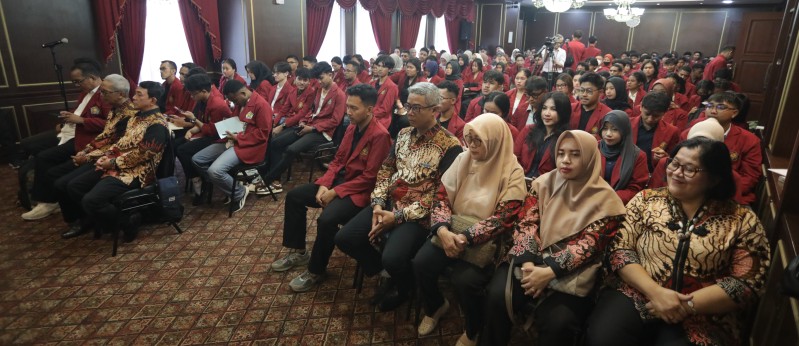
Constitutional Court Legal Analyst Syamsudin Noer serves as a speaker for the Field Study Program of the Faculty of Law, Janabadra University Yogyakarta. Photo by MKRI/Ilham WM.
JAKARTA, MKRI Public Relations – Law students from Janabadra University, Yogyakarta, visited the Constitutional Court (MK) as part of their Field Study Program (Kuliah Hukum Lapangan or KHL) on Monday (28/4/2025). A total of 171 students participating in this program were welcomed by MK Legal Analyst Syamsudin Noer in the Delegation Room, MK Building 1.
“I hope your visit today is not only for the sake of KHL, but also as an opportunity to understand how you yourselves could one day file a petition to the Constitutional Court. In fact, in several past Constitutional Court decisions, petitions were submitted by university students, some of which were granted,” said Syamsudin as he initiated a discussion with the students.
Syamsudin, who is familiarly known as Syams, provided several examples, such as Case Number 90/PUU-XXI/2023 regarding the Judicial Review of the Election Law, and Case Number 70/PUU-XXII/2024 concerning the Regional Elections Law. Both cases were initiated by student petitioners. For this reason, Syamsudin encouraged the students to deepen their understanding of the procedural law governing the judicial review (Pengujian Undang-Undang or PUU) at the Constitutional Court. He explained that judicial reviews can be filed in two forms: formal and material review, each with fundamental differences.
A formal review examines the legislative process, including the planning, drafting, discussion, approval, enactment, and promulgation stages of a law. In such cases, petitions must be filed no later than 45 days after the law is promulgated (as stipulated in Constitutional Court Decision Number 27/PUU-VII/2009). Furthermore, these cases must be decided within 60 working days from the hearing in which the House of Representatives and the President present their statements, as stipulated in Decision Number 25/PUU-XX/2022. On the other hand, Syams continued, a material review focuses on examining the substance of legal norms, for which there is no time limit for submitting a petition, nor is there a set deadline for the Court to render a decision.
“In a judicial review, it is important to understand that if you are not represented by a legal counsel, you can appear before the Court on your own. Also, keep in mind that what is being reviewed is the normative content of the law, not its implementation,” Syams explained.
During his presentation, Syams also motivated the students to prepare themselves for the possibility of becoming Constitutional Justices in the future. To become a Constitutional Justice, students must meet general, specific, and administrative requirements. As an illustration, he mentioned the specific requirements outlined in Article 15 paragraph (2) of the Constitutional Court Law, including being an Indonesian citizen, holding a doctoral degree with a bachelor’s degree in law, having faith in God Almighty and good moral character, being at least 55 years old, being physically and mentally healthy, never having been sentenced to prison by a final and binding court decision, not being declared bankrupt by a court decision, and having at least 15 years of experience in the legal field and/or, for candidates from the Supreme Court, currently serving as a high judge or Supreme Court justice.
Author : Sri Pujianti
Editor : Lulu Anjarsari P.
Translator : Agusweka Poltak Siregar (NL)
Disclaimer: The original version of the news is in Indonesian. In case of any differences between the English and the Indonesian versions, the Indonesian version will prevail.
Monday, April 28, 2025 | 15:10 WIB 141