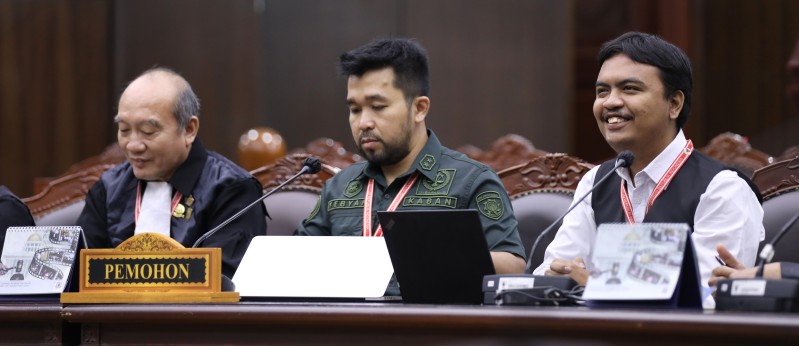
Stepanus Febyan Babaro and legal counsel Leonardo Olefins Hamonangan at the preliminary hearing for the material judicial review of Law No. 11 of 2021 on the Prosecution Office, Wednesday (4/23/2025). Photo by MKRI/Ifa.
JAKARTA (MKRI) — The Constitutional Court (MK) held the preliminary hearing for the material judicial review of Law No. 11 of 2021 on the Amendment to Law No. 16 of 2004 on the Prosecution Office on Wednesday, April 23, 2025.
The petition for case No. 26/PUU-XXIII/2025 was filed by private employee Stepanus Febyan Babaro and university student Henemia Hotmauli Purba. They challenge the phrase “with the permission of the Attorney General” in Article 8 paragraph (5) of the Prosecution Law. The article stipulates that summon, inspection, search, arrest, and detention of any prosecutor may also be carried out with the permission of the Attorney General.
The Petitioners’ legal counsel Leonardo Olefins Hamonangan stated that this provision could potentially create a conflict of interest. He also referred to Guideline No. 7 of 2020, which regulates the procedure for granting of such permission.
“When the prosecution of prosecutors depends on the permission of the Attorney General, it is very likely that a conflict of interest will occur. Especially if the prosecutor being investigated has a close relationship with the leadership,” said Hamonangan before Chief Justice Suhartoyo and Constitutional Justices Enny Nurbaningsih and Arsul Sani.
The Petitioners provided as evidence a case of alleged sexual misconduct by prosecutor AJ at the West Kalimantan High Prosecution Office in 2018. This case, they asserted, reflects law enforcement obstacles against law enforcement officials, considering that until today there has been no clarity in its progress.
Hamonangan also highlighted inequality between law enforcement agencies due to this regulation. “The police or the Corruption Eradication Commission (KPK) do not have a similar mechanism and [their members] can be investigated directly. Meanwhile, the examination of prosecutors must obtain the Attorney General’s permission. As a result, the handling of cases involving prosecutors can be hampered and it may lead to friction between institutions,” he said.
Not only that, the permission of the Attorney General has could potentially be misused for political or personal interests. “There is no definite time limit in the process of granting the permission, so it can be a loophole for unscrupulous prosecutors to avoid legal process,” he added.
On that basis, the Petitioners asked the Constitutional Court to declare the phrase “with the permission of the Attorney General” in Article 8 paragraph (5) of the Prosecution Law unconstitutional and not legally binding.
Justices’ Advice
Responding to the petition, Justice Enny Nurbaningsih suggested that the Petitioners include the full content of Article 8 paragraph (5) of the Prosecution Law. She also emphasized the importance of a clear description of the constitutional loss suffered by the Petitioners due to the enforcement of the norm.
“Please include the full content of the norm and analyze it fully in terms of its relation to the argument of legal standing. Please show consistency,” she said.
At the end of the hearing, the panel announced that the Petitioners would have 14 days to revise the petition, which must be submitted by May 6, 2025.
Read the revised petition No. 26/PUU-XXIII/2025 here.
Author : Utami Argawati
Editor : N. Rosi
PR : Fauzan F.
Translator : Yuniar Widiastuti (NL)
Disclaimer: The original version of the news is in Indonesian. In case of any differences between the English and the Indonesian versions, the Indonesian version will prevail.
Wednesday, April 23, 2025 | 16:24 WIB 230