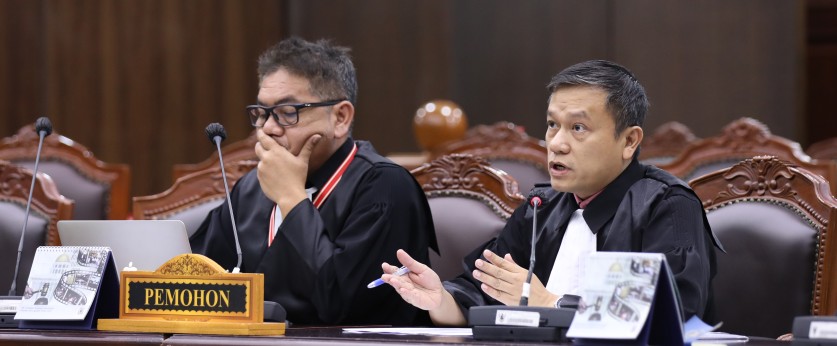
The Petitioners’ legal counsels Roy Andrian and Feerdi Annes at the petition revision hearing for the judicial review of the Criminal Code, Monday (4/21/2025). Photo by MKRI/Ifa.
JAKARTA (MKRI) — The Constitutional Court (MK) held another material judicial review hearing for Article 170 paragraph (1) of the Criminal Code (KUHP) on Monday, April 21, 2025. The panel examined the revisions to petition for case No. 16/PUU-XXIII/2025.
The petition was filed by civil servant (PNS) R. Odjahan Silalahi and farmers Lesmar Rumasondi and Lamson Sidabariba. They are currently serving a six-month prison sentence in Sidikalang after being found guilty by the Sidikalang District Court on March 7, 2024 of “committing violence against property” under Article 170 paragraph (1) of the Criminal Code. The verdict was later upheld by the Medan High Court and the Indonesian Supreme Court, with aggravated sentence from five months to six months.
Before Chief Justice Suhartoyo and members of the panel, the Petitioners’ legal counsel Saut Roy Andrian explained that the explanation for each of the Petitioners’ constitutional impairment had been separated. “It can be seen on page 5, [where] the third condition has been met. We have also included previous case No. 99. It was withdrawn and [the withdrawal request] was granted, so it is not ne bis in idem,” he said.
He also said that the Supreme Court’s jurisprudence has been included on page 26 of the revised petition. This has indirectly led to a new criminal offense because Article 170 remains a provision on violence against public order (openlijk geweld under Chapter V). however, at the same time it also stipulates violence against property (following the interpretation of the Supreme Court’s code of law.
Also read: Farmers, Civil Servant Challenge Provision on Violence in Criminal Code
The Petitioners previously argued that the article, which is under Chapter V of the Criminal Code on violence against public order, can be interpreted through several methods in criminal law, all of which conclude that the norm regulates “open violence.” In the Netherlands, the origin of the Indonesian Criminal Code, this term is known as openlijk geweld. However, they argued that the current formulation in Article 170 of the Criminal Code does not explicitly link the element of violence to public order.
“The method of interpretation of criminal law shows that Article 170 relates to open violence in the context of public order. However, in the formulation of this article, the connection with public order is not clear, so we argue that Article 170 of the Criminal Code does not satisfy the principles lex stricta, lex scripta, and lex certa,” said Andrian at the preliminary hearing on Thursday, March 13.
The Petitioners further argued that the article leaves room for multiple interpretations, which in turn can lead to legal uncertainty. According to them, the element of violence in this article does not always refer to actions that cause damage to goods or physical injury, but can also include actions such as messing up merchandises or pushing someone on the highway. However, if the violence results in damage or injury, then it is considered excessive.
They also argued that the article does not fulfill the principle of legality in criminal law, specifically lex stricta, lex scripta, and lex certa. From a grammar standpoint, it is difficult to understand due to the use of terms such as “openly,” “joint force,” and “violence,” which are not explicitly defined, thus potentially causing multiple interpretations. It is even more confusing when paragraph (1) is linked to paragraph (2) of the same article.
Article 170 of the Criminal Code reads, “Persons who with united forces openly commit violence against persons or property, shall be punished by a maximum imprisonment of five years and six months.” In the petitum, the Petitioners asked the Court to declare it unconstitutional and not legally binding. They asked that it be declared constitutional only if interpreted as, “Any group of ten persons or more who deliberately and unlawfully commit violence in public as their immediate objective against persons or property, in a manner that disturb society’s natural order, shall be punishable by a maximum imprisonment of five years and six months.”
Read the revised petition for case No. 16/PUU-XXIII/2025 here.
Author : Utami Argawati
Editor : N. Rosi
PR : Fauzan F.
Translator : Yuniar Widiastuti (NL)
Disclaimer: The original version of the news is in Indonesian. In case of any differences between the English and the Indonesian versions, the Indonesian version will prevail.
Monday, April 21, 2025 | 13:27 WIB 837