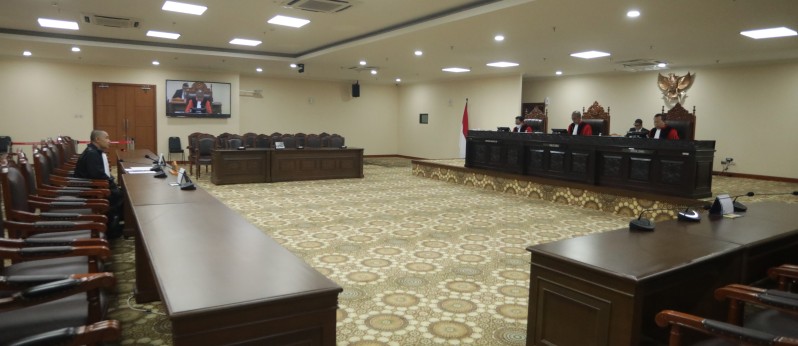
The petition revision hearing for case No. 10/PUU-XXIII/2025 on Laws on the State Administrative Court and the General Court, Monday (4/21/2025). Photo by MKRI/Ilham W.M.
JAKARTA (MKRI) — The Petitioners of case No. 10/PUU-XXIII/2025 have revised the material judicial review petition of Article 47 of Law No. 5 of 1986 on the State Administrative Court (PTUN) and Article 50 of Law No. 2 of 1986 on the General Court. They believe those norms have failed to provide legal certainty on the absolute competency of the courts to examine, adjudicate, and rule cases on land certificates.
At the petition revision hearing on Monday, April 21, 2025, Petitioner I Bahrul Ilmi Yakup explained that the petitioners for the case went down from six to four. The private legal entity, whose [legal standing] was a subject of debate, opted out. In addition, Bahrul Alwi is no longer a petitioner in this petition,” he said before Deputy Chief Justice Saldi Isra (panel chair) and Constitutional Justices Ridwan Mansyur and Asrul Sani.
The Petitioners are Bahrul Ilmi Yakup, Iwan Kurniawan, Yuseva, and Rosalina Pertiwi Gultom (Petitioners I-V). They added more norms to review the State Administrative Court Law and the General Court Law: Article 24 paragraph (1), Article 27 paragraph (2), and Article 28D paragraph (1) of the Constitution.
The Petitioners believe that disputes over land with certificates are the absolute jurisdiction of the state administrative court, not of the general court in casu the district court. Therefore, they filed a lawsuit against the Palembang City Land Office over the land belonging to their client, PT Wahana Bara Sentosa, to the Palembang State Administrative Court. The asked that the Court invalidate the land ownership certificate for the land.
The Palembang State Administrative Court handed down first and appeal decisions to affirm that the case was under the state administrative court’s jurisdiction. However, without sufficient legal consideration, the Supreme Court justices handed down a cassation decision to declare that the case was under the jurisdiction of the general court in casu the district court. The Supreme Court justices maintained their stance in their judicial review decision. This means that the case must be reexamined by the district court and the subsequent appeal, cassation, and judicial review will follow.
“It is a typical issue in the Supreme Court, because the Supreme Court has decided several times at its national meeting, such as in 2012, that this issue is under the state administrative court’s jurisdiction,” said Bahrul Ilmi at the preliminary hearing.
He added that through a circular letter in 2020, the Supreme Court emphasized that cases over land with certificates are under the state administrative court’s jurisdiction. However, the legal basis for it is weak as it only mentions the criteria for legal uncertainty.
He argued that the criteria in question are quite lax, which allows for the interpretation that the district court has jurisdiction over the issue in some cases while the state administrative court has jurisdiction in others. He said that the legal uncertainty contained in Article 47 of the State Administrative Court Law and Article 50 of the General Court Law can be utilized by the justices to hand down decisions not by law.
Also read: Authority over Disputes over Land with Certificates Questioned
Article 47 of the State Administrative Court Law reads, “The Courts shall be tasked and authorized to examine, decide, and resolve State Administrative disputes.” Meanwhile, Article 50 of the General Court Law reads, “The District Court shall have the duty and authority to examine, decide, and resolve criminal and civil cases in the first instance.”
In their revised petitums, the Petitioners request that the Court declare both articles being petitioned unconstitutional and thus must be reinterpreted. They argued that Article 47 of the State Administrative Court Law should read, “The State Administrative Court shall have the absolute authority to adjudicate [disputes] over land with certificates registered for the first time,” while Article 50 of the General Court Law should read, “Only the State Administrative Court and the State Administrative High Court shall be authorized to examine, adjudicate, and decide on exceptions of state administrative court cases.”
Author : Mimi Kartika
Editor : Lulu Anjarsari P.
PR : Fauzan Febriyan
Translator : Yuniar Widiastuti (NL)
Disclaimer: The original version of the news is in Indonesian. In case of any differences between the English and the Indonesian versions, the Indonesian version will prevail.
Monday, April 21, 2025 | 11:15 WIB 229